
How Does BMS Detect a Battery Cell Failure?

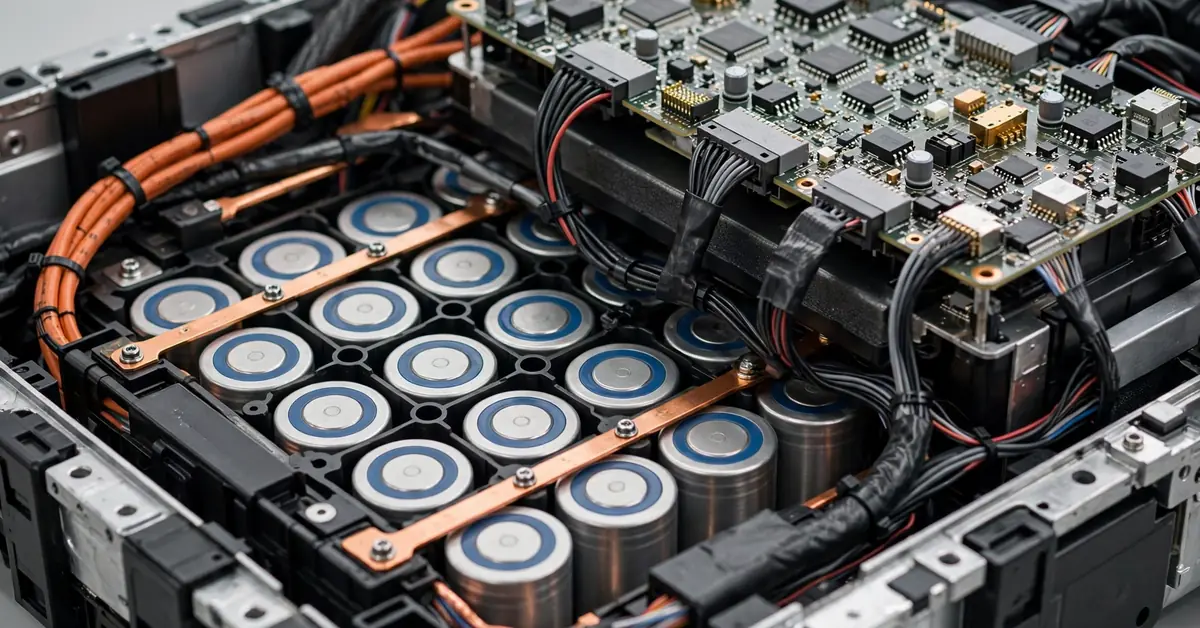
A BMS detects a battery cell failure by identifying specific patterns tied to real failure modes, like a voltage that suddenly diverges from neighboring cells, an internal short circuit signature, or abnormal self-discharge, rather than relying on one generic “failure” signal. Different failure types leave different fingerprints, and the BMS is built to recognize each one.
Why Cell Failure Isn’t a Single Event to Detect
Cells can fail in genuinely different ways, gradual capacity loss, sudden internal short circuit, physical damage, or manufacturing defect surfacing over time. A single detection method couldn’t realistically catch all of these, which is why BMS fault detection watches for several distinct signatures simultaneously.
Detecting Internal Short Circuits
An internal short circuit, often from separator damage inside the cell, typically shows up as a voltage that begins diverging from the pack average in a specific, gradual pattern, sometimes over days or weeks before becoming severe. Voltage difference analysis over time is a well-established, low-cost method for catching this specific failure mode early.
Detecting Abnormal Self-Discharge
Every cell self-discharges slightly, but a failing cell often self-discharges noticeably faster than its neighbors, even while parked and unused. The BMS can catch this by comparing voltage decay rates across cells during extended rest periods, flagging cells that lose charge unusually quickly.
Detecting Voltage Anomalies During Active Use
A cell developing a genuine internal fault often shows voltage behavior that deviates from what current draw and temperature would normally predict, sagging more than expected under load, or recovering abnormally when load is removed. Cross-referencing voltage against expected behavior under known conditions helps surface this kind of subtle deviation.
Detecting Thermal Signatures of Failure
A failing cell frequently runs measurably warmer than its neighbors even under identical conditions, a localized thermal signature the BMS can catch through its distributed temperature sensors, well before that heat becomes a broader safety concern.
Detecting Impedance and Resistance Changes
Some BMS designs periodically measure a cell’s internal resistance, using a brief current pulse and measuring the voltage response. A cell whose resistance has climbed noticeably faster than its neighbors often indicates developing internal degradation or damage ahead of an outright failure.
Cross-Referencing Multiple Signals for Confidence
Rather than flagging a failure based on any single measurement, well-designed BMS software cross-references voltage, temperature, and resistance signals together, since a genuine developing cell failure tends to show up across more than one measurement simultaneously, reducing false alarms while still catching real problems.
What Happens Once a Cell Failure Is Detected
Depending on severity, the response can range from logging the anomaly for later technician review, to reducing power and triggering a dashboard warning, to isolating the affected cell or module, or in the most severe cases, a full contactor shutdown protecting the entire pack.
| Failure Mode | Detection Signature |
|---|---|
| Internal short circuit | Gradual voltage divergence from neighboring cells |
| Abnormal self-discharge | Faster-than-normal voltage decay during rest |
| Developing internal fault | Voltage deviating from expected load behavior |
| Localized overheating | Elevated temperature vs neighboring cells |
| Internal degradation | Resistance rising faster than neighboring cells |
Conclusion
A BMS detects battery cell failure by watching for the specific signatures tied to real failure modes, voltage divergence, abnormal self-discharge, unexpected thermal behavior, and rising resistance, then cross-referencing these signals together to confirm a genuine problem rather than a sensor glitch. This targeted, multi-signal approach is what allows many cell failures to be caught well before they become a safety event.
FAQs
Can a BMS detect a cell failure before it causes any noticeable symptoms?
Often yes, particularly for internal short circuits and self-discharge issues, which can show detectable patterns well before a driver would notice anything.
Does every cell failure trigger an immediate shutdown?
No, the response scales with severity, ranging from logged data for later review up to an immediate contactor shutdown for serious faults.
Is voltage the only signal used to detect cell failure?
No, temperature and resistance measurements are often cross-referenced alongside voltage to confirm a genuine developing fault.
