
How Does BMS Work in Second-Life EV Batteries?

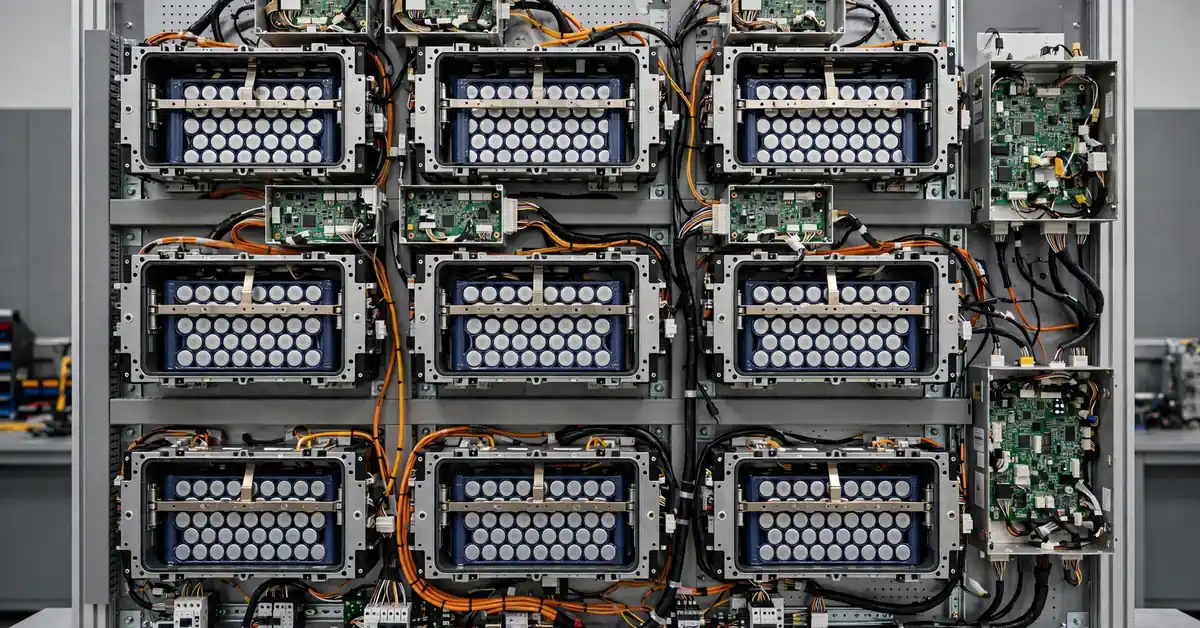
When an EV retires, its battery usually retires with about 80% of its capacity left — too weak for the car, far too good to shred. The catch is that the battery’s manager was built for the car, and the US Department of Energy says it plainly: the automotive BMS will likely not be appropriate for the battery’s second job.
In a second-life battery, the car’s original BMS is usually replaced (or overridden) by a new management system built for stationary duty. Packs are first tested and graded for state of health; the replacement BMS then monitors every cell, re-learns the pack’s real capacity, balances unevenly aged modules, enforces wider safety margins, and translates the battery’s data into the language solar inverters and grid controllers speak.
Why the car’s own BMS usually can’t come along
A vehicle BMS is married to one car — its wiring, its software, its manufacturer’s secrets — and a stationary system is a different job in a different language.
Three problems arrive together. First, access: the original BMS talks over the car’s internal network in a proprietary dialect, expects signals from the rest of the vehicle, and its maker publishes none of it — outside the car it often cannot even be woken up properly. Second, purpose: it was tuned to protect a pack in driving duty, with the car’s exact cells when they were new; it knows nothing about the aged, mixed modules it would now be guarding. Third, audience: a stationary system must report to inverters, building controllers and grid operators, none of which speak car.
In practice the industry takes one of two paths. Most repurposers fit a new, purpose-built BMS and retire the car’s unit with the vehicle. The alternative, used by some integrators for whole-pack reuse, keeps the pack intact and adds a custom pack controller that sits between the original BMS and the outside world, translating and supervising. Argonne National Laboratory’s guidance for the Department of Energy lands on the same conclusion: each second-life application needs a properly engineered BMS of its own. (How a modern pack BMS is organised in the vehicle is covered in our look at GM’s Ultium system.)
The harder problem: cells that did not age together
A first-life BMS manages identical twins. A second-life BMS manages strangers — different histories, sometimes different chemistries, all past their prime.
The mixed batch
Packs arrive at a repurposer with unknown histories: different models, different mileages, sometimes different chemistries in the same shipment. That matters more than it sounds, because the voltage curves a BMS uses to judge state of charge are chemistry-specific — the flat curve of an LFP pack and the sloping curve of an NMC pack tell completely different stories at the same voltage, which is one reason the internal logic of systems like CATL’s is built around one chemistry family. Run an NMC-tuned estimator on LFP cells and its charge and health readings are not slightly off; they are dangerously wrong. A second-life BMS therefore has to be configurable — chemistry-agnostic, in the vendors’ phrase — with thresholds and curves set per batch.
The aging knee and the weakest module
Manufacturers retire EV packs at roughly 70–80% of original capacity, near the point engineers call the knee: beyond it, internal resistance climbs and capacity falls faster. Inside a rebuilt string, the modules never sit at the same health — put an 85%-health module beside a 72% one and the weaker module sets the limits for both, hitting its empty and full points first on every cycle. Left unmanaged, the string’s usable capacity quietly shrinks toward its weakest member; that is why balancing, below, is a headline feature here rather than a footnote.
Before any BMS: screening and grading
No management system can save a bad pack — so the first job is deciding which packs deserve a second life at all.
The workflow, as described in the peer-reviewed literature, runs in order: a visual inspection for damage; a functional check that the pack charges and discharges; then full characterisation at pack level, measuring the capacity actually remaining (most simply by Coulomb counting — measuring the charge that goes in and out) and the resistance growth that signals power fade. Packs that fail are opened up and their modules graded individually; cells of similar health are then grouped together for rebuilds, because mixing health levels wastes the better cells.

The best-known grading scheme comes from 4R Energy, the Nissan–Sumitomo venture that has handled Leaf batteries for years:
| Grade | Condition | Destination |
|---|---|---|
| A | Little degradation | Can be reused in an EV |
| B | Some degradation | Most second-life applications |
| C | Heavily degraded but functional | Backup power and gentle duty |
| D | Unsuitable | Recycling |
There is still no single standardised grading process across the industry — a gap the standards world is actively closing, as the next sections show.
How second-life BMS designs answer all this
The design brief writes itself from the problems above: tolerate variety, watch everything, balance hard, and speak the building’s language.
Configurable, chemistry-agnostic control
Instead of one factory calibration, a second-life BMS lets the integrator set voltage thresholds, charge curves and discharge limits for the batch in front of it — NMC modules this month, LFP the next. Its state-of-charge and state-of-health estimators are re-baselined against the graded measurements rather than inherited from the car’s memory, and they keep learning as the modules drift.
Stronger balancing and finer monitoring
Balancing currents tell the story of the duty difference. Ordinary small BMS boards balance at tens of milliamps; second-life systems from vendors such as EMUS offer passive balancing up to several amps, because levelling a string of large, mismatched modules is continuous work, not an occasional tidy-up — weak balancing on big cells quietly strands a tenth or more of the capacity the buyer paid for. Monitoring is likewise finer than in a car: per-cell voltage and temperature, open-wire detection, and resistance tracking over time, so a module that starts ageing faster than its neighbours is flagged before it fails.
Talking to inverters, and scaling up
The new BMS must present the battery to equipment that expects standards, not secrets: Modbus or Ethernet to the inverter and site controller, with the automotive CAN dialect translated or replaced. Architectures are modular for the same reason — vendors such as Nuvation build distributed cell interfaces and multi-stack controllers that run many strings in parallel as one battery, with platforms rated for stacks up to 1,500 volts DC. A home system built from a single Leaf pack and a container of forty packs are the same idea at different scales — and the Leaf’s own in-car management shows how different the starting point is from the finished stationary system.
The standards that now govern second-life batteries
Used batteries in buildings are an insurance and permitting question as much as an engineering one — and the rulebook has caught up.
The standard written for exactly this work is UL 1974, the Standard for Evaluation for Repurposing or Remanufacturing Batteries: it sets requirements for the sorting and grading process itself, for routine testing of repurposed batteries, and it excludes components past the manufacturer’s calendar expiry date; UL also certifies repurposing facilities against it. Around it sit the stationary-storage standards: UL 1973 covers the battery for stationary use, and UL 9540 certifies the complete energy storage system; in Europe, IEC 62619 plays the corresponding industrial-battery safety role.
Europe is adding the data layer. From February 2027, every EV battery placed on the EU market must carry a battery passport, and for EV batteries it includes health data — state of certified energy, capacity fade, internal resistance and its growth, expected lifetime — accessible to businesses with a legitimate interest. That is aimed squarely at people like repurposers: the pack’s second-life BMS will increasingly start from a documented history instead of an unknown one. More on the wider BMS landscape sits in our BMS category.
Where these systems actually run
Second-life BMS is not a concept — it is running in containers and factories today, at megawatt scale.
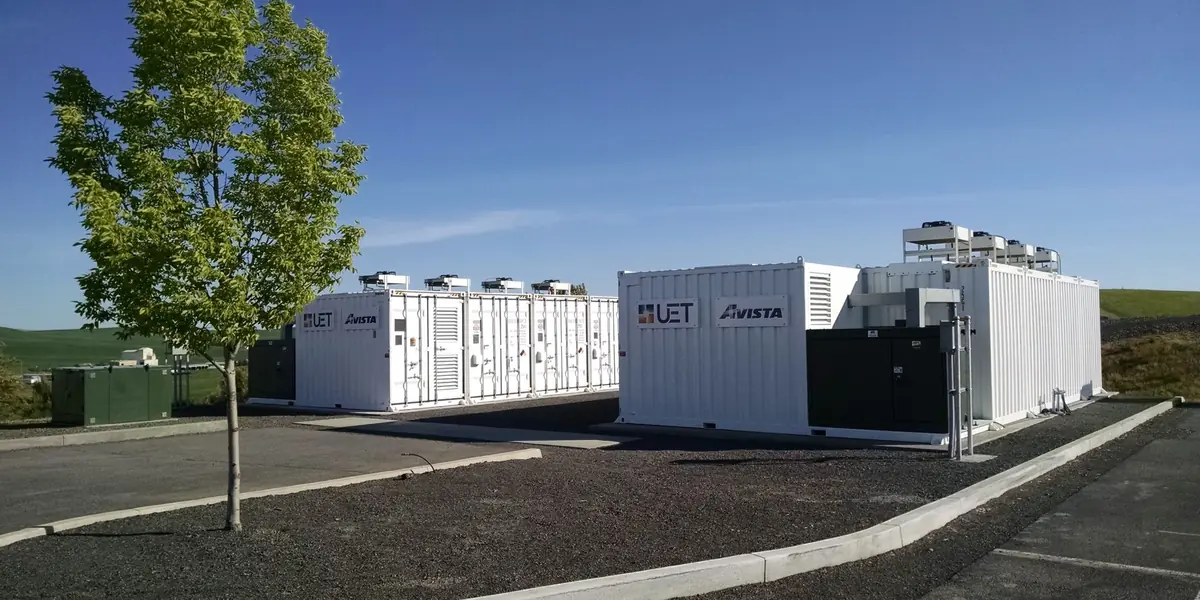
In Oslo, ECO STOR operates a containerised 1 MW / 700 kWh storage system built from forty used Nissan Leaf packs at a utility substation, deferring grid upgrades; each pack works under its own dedicated pack controller — the bridge approach, deployed at scale. In the US, Redwood Materials has around 10,000 GM EV packs in its repurposing pipeline, with about a hundred packs set to deliver 1.5 MW / 7.2 MWh at a GM plant in Michigan, and GM packs also feed Redwood’s Sparks, Nevada installation — described by the company as the largest repurposed-battery storage system in the world. Every one of those installations is, at heart, the subject of this article: a replacement brain persuading car batteries to do a building’s work.
Frequently asked questions
Can you run a lithium battery without a BMS?
In a car, no — and in a second-life installation, even more emphatically no. Aged cells diverge from each other, which is exactly the condition in which an unmanaged battery overcharges one cell while undercharging another. Every standard that covers repurposed batteries expects a validated management system with working cut-offs.
What happens to an EV battery after about 8 years?
Typically it reaches the carmaker’s end-of-life threshold — around 70–80% of original capacity — and leaves the vehicle. Graded healthy, it can work for up to another decade in stationary duty under a second-life BMS; graded D, it goes to recycling, where its metals are recovered instead.
Is the original BMS ever reused?
Sometimes, in whole-pack projects: an added pack controller can translate for the original unit and supervise it. But the common route — and the one standards and insurers are most comfortable with — is a new, purpose-built BMS fitted after grading.
Conclusion
A second-life BMS is not the car’s brain transplanted; it is a new brain, hired for a different job, after the battery has passed an exam.
That is the whole answer in one line. The old unit stays with the car because it speaks the car’s language and trusts the car’s history; the new one earns its place by measuring everything itself — grading first, then chemistry-agnostic control, hard balancing, honest health estimates, and fluency in the language of inverters and grids. Get that right, and a battery the car retired at 80% has a decade of work left in it.
