
Passive vs Active Cell Balancing: What’s the Difference?

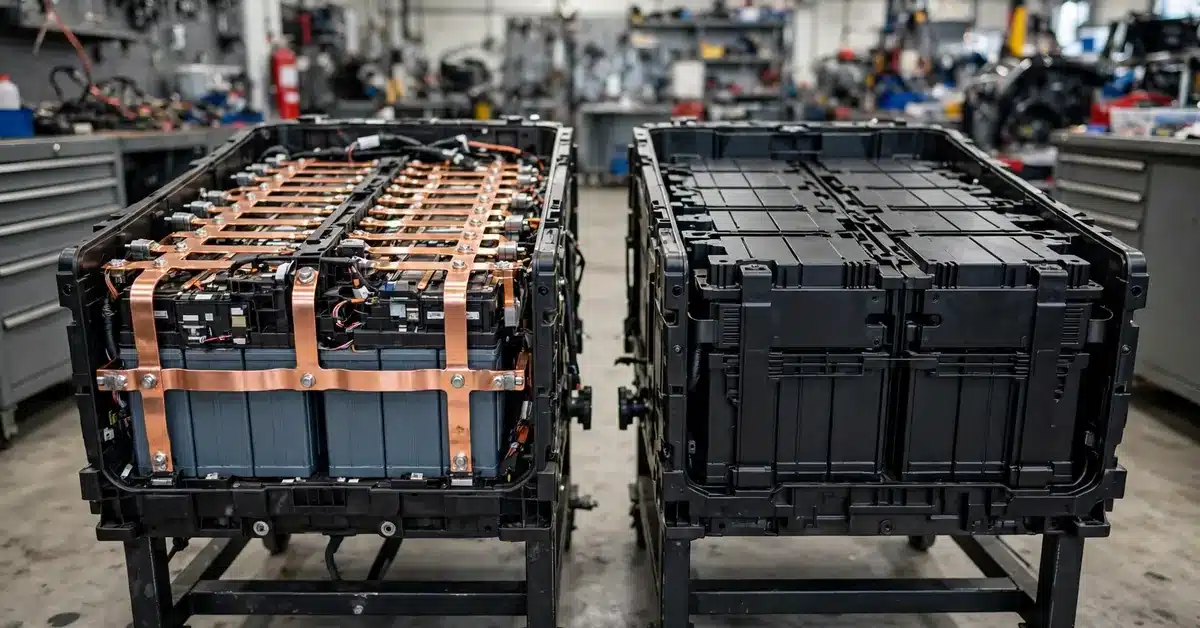
Passive cell balancing removes excess energy from higher-charged cells as heat through a resistor, while active cell balancing transfers that excess energy to lower-charged cells instead of wasting it. Both achieve the same goal, an evenly balanced pack, but they differ significantly in efficiency, cost, and complexity.
The Core Difference in One Sentence
Passive balancing burns off the difference; active balancing moves the difference. That distinction drives every other tradeoff between the two approaches.
How Passive Balancing Works
When the BMS detects a cell sitting above the rest of the pack in voltage, it switches a resistor across that specific cell, dissipating its excess charge as heat until it matches its neighbors. This happens most visibly near the top of the charge window, where voltage differences between cells are easiest to detect and correct.
Why Passive Balancing Dominates Production EVs
It’s simple, reliable, and inexpensive to implement at scale. The hardware required is minimal, just switches and resistors, which keeps manufacturing cost down. This is the primary reason passive balancing remains the standard choice across most consumer electric vehicles today.
The Main Drawback
Every bit of energy removed through passive balancing is permanently lost as heat. It’s never recovered or reused, which represents a small but real efficiency loss, particularly in packs with larger voltage imbalances that require more aggressive correction.
How Active Balancing Works
Rather than dissipating excess charge, active balancing physically redistributes it, moving energy from higher-voltage cells to lower-voltage cells, or in some designs, back into the overall pack. This requires more sophisticated circuitry, typically involving inductors, capacitors, or DC-DC converters to manage the energy transfer.
Why Active Balancing Is More Efficient
Since no energy is wasted as heat, active balancing preserves more of the pack’s total usable capacity, an advantage that becomes more meaningful in large, high-performance battery systems where even small efficiency gains matter at scale.
Why It’s Still Less Common
The added components and control complexity increase both manufacturing cost and design difficulty. For most consumer EV applications, the efficiency gain hasn’t yet outweighed that added cost and complexity, which is why active balancing remains more common in specialized or high-performance systems than in mainstream production vehicles.
Comparing the Two Directly
| Factor | Passive Balancing | Active Balancing |
|---|---|---|
| How it works | Dissipates excess energy as heat | Transfers energy between cells |
| Efficiency | Lower — energy is wasted | Higher — energy is reused |
| Cost/complexity | Low | Higher |
| Common use | Most production EVs | High-performance/specialized systems |
| Heat generation | More noticeable | Minimal |
Does the Choice Actually Affect Driving Range?
In most consumer EVs, the efficiency difference between the two methods is small enough that it doesn’t meaningfully change day-to-day range. The bigger real-world benefit of either method is protecting usable capacity and pack longevity over years of use, not a noticeable difference in a single charge’s range.
Conclusion
Passive and active cell balancing both keep an EV battery pack’s cells working in sync, but they take fundamentally different approaches: passive wastes the excess as heat, while active moves it where it’s useful. Passive balancing’s simplicity and low cost keep it the standard in most production EVs, while active balancing remains reserved for systems where its added efficiency justifies the extra complexity.
FAQs
Which method is safer?
Both are considered safe and mature technologies; the difference lies in efficiency and cost, not safety.
Can an EV use both methods together?
Some advanced designs combine approaches, though most production vehicles rely on one primary method.
Does active balancing extend battery life more than passive?
Both help the pack age more evenly; active balancing’s efficiency advantage doesn’t necessarily translate into a dramatically longer lifespan for typical consumer use.
