
What Happens to an EV Battery at End of Life?

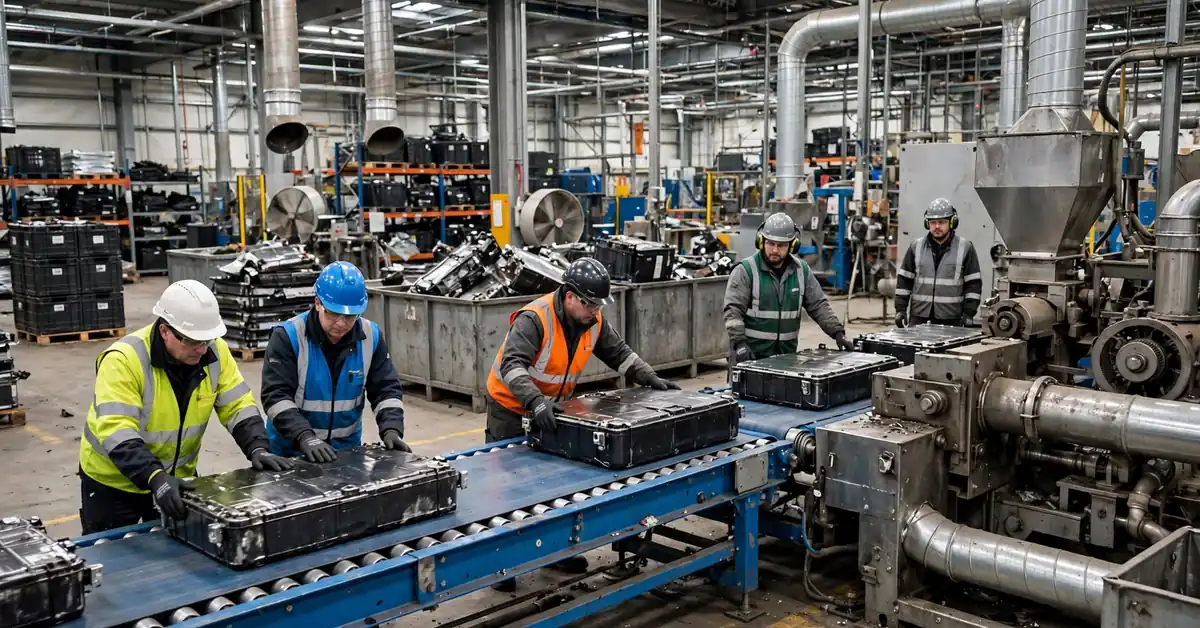
An EV battery reaching “end of life” doesn’t mean it stops working — it means the pack has dropped below the capacity threshold considered acceptable for automotive use, typically around 70–80% of original capacity. At that point, the battery still holds a substantial amount of energy and has real remaining value. This guide covers what actually happens next: reconditioning, second-life reuse, and residual value.
What “End of Life” Actually Means for an EV Battery
End of automotive life is a threshold decision, not a hard technical failure. A pack at 70% capacity still functions — it simply provides less range than most drivers want for daily use, and it’s the point most manufacturers use as their warranty replacement trigger. The battery is far from “dead”; it has typically lost only 20–30% of its original energy storage and can continue operating safely for years, just not necessarily in the vehicle it came from.
Can a Degraded EV Battery Be Reconditioned?
Partially, in some cases. Reconditioning typically involves module-level repair rather than restoring the entire pack’s original capacity:
- Module replacement: If degradation or failure is concentrated in a few weak modules rather than spread evenly, technicians can sometimes replace just those modules, restoring much of the pack’s capacity at a fraction of full-pack replacement cost
- Cell balancing and BMS recalibration: Sometimes perceived degradation is partly a BMS calibration issue rather than true capacity loss; a proper recalibration can improve the accuracy of range estimates without any physical repair
- What reconditioning cannot do: True chemical degradation spread evenly across all cells cannot be reversed — no reconditioning process restores lost lithium-ion capacity at the cell level
Reconditioning is most viable and cost-effective on packs with modular designs (rather than fully sealed, monolithic packs) and is more commonly offered by independent EV specialists than by original manufacturers, who generally prefer full-pack replacement.
What Is Second-Life Use for EV Batteries?
Second-life use means removing a battery from automotive service once it no longer meets driving range needs and repurposing it for a less demanding application — most commonly stationary energy storage. A pack at 70–80% capacity is still an excellent fit for applications that don’t require frequent deep cycling or high power density, since the remaining capacity and cycle life comfortably outlast most stationary storage use cases.
Can an Old EV Battery Be Used for Home Energy Storage?
Yes — this is the most common second-life application. A used EV pack can be integrated into a home battery storage system, storing solar power or off-peak grid electricity for later use, similar in concept to purpose-built home batteries. Several automakers and specialist companies run formal second-life programs that repackage retired EV modules into stationary storage products, and independent installers occasionally source used packs directly for custom builds, though this requires specialized integration knowledge and appropriate safety certification.
How Long Does a Second-Life EV Battery Last?
Stationary storage applications are far less demanding than automotive use — no need for rapid high-power discharge, no towing loads, and typically fewer full cycles per year than daily driving. As a result, a battery repurposed at 70–80% automotive capacity can often provide another 8–12 years of useful stationary storage life before its capacity drops low enough to no longer be economically worthwhile, though this varies by chemistry and how heavily the second-life system cycles it.
What Is the Residual Value of a Degraded EV Battery?
A degraded pack retains real economic value through three channels:
- Second-life resale: Companies building stationary storage products will pay for retired packs with sufficient remaining capacity, though prices vary widely based on chemistry, condition, and market demand
- Material recovery value: Even a pack too degraded for second-life use retains recoverable value in its lithium, nickel, cobalt, and copper content — see EV battery recycling cost for how this offsets recycling expenses
- Module harvesting: Individual healthy modules from a retired pack can be sold to repair shops performing the module-level reconditioning described above
In practice, most individual EV owners won’t directly monetize their retired pack — this value is typically captured by the dealer, recycler, or manufacturer when the pack is turned in as part of a warranty replacement, rather than paid out to the owner. The economic value is real at an industry level, even if it rarely reaches the original vehicle owner directly.
Conclusion
“End of life” for an EV battery is really “end of automotive suitability” — the pack still holds most of its original energy and has years of useful life ahead of it. Between module-level reconditioning, second-life stationary storage, and material recovery for recycling, very little of a retired EV battery’s value or capacity goes to waste. As more EVs from the 2015–2020 generation reach this stage over the coming years, second-life and recycling infrastructure is scaling rapidly to absorb the growing supply.
