
Calendar Aging vs. Cycle Aging in EV Batteries

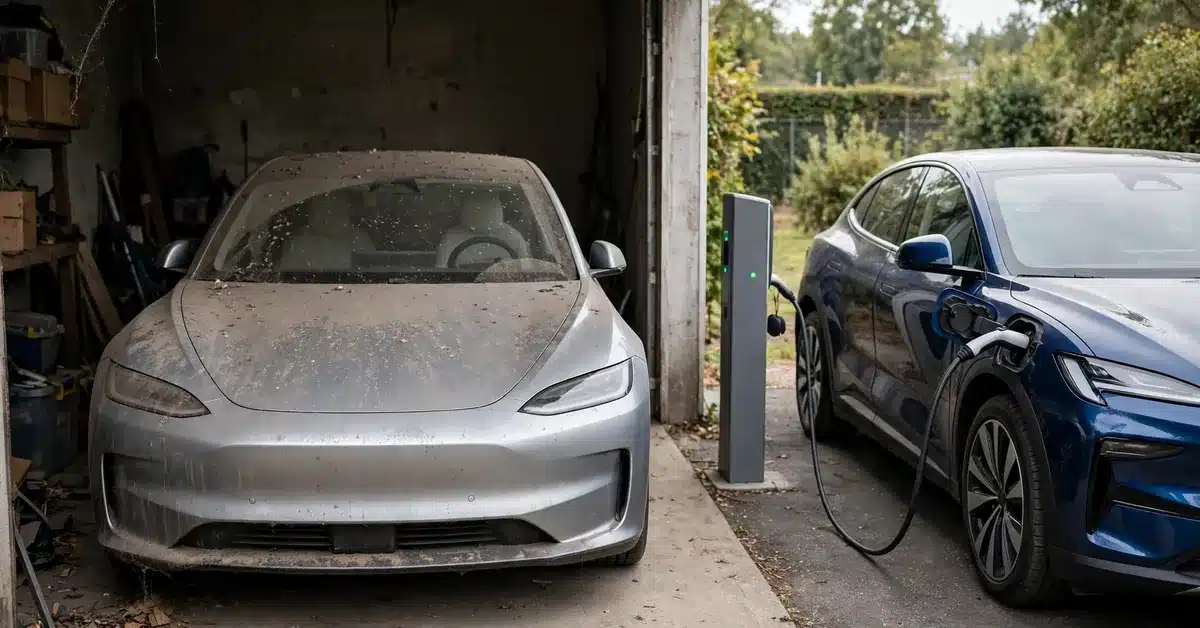
Every EV battery degrades through two separate mechanisms working at the same time: calendar aging, which happens purely from the passage of time, and cycle aging, which happens from actually charging and discharging the battery. Understanding the difference explains why a rarely-driven EV still loses some capacity, and why a heavily-driven EV doesn’t degrade proportionally faster.
What Is Calendar Aging in EV Batteries?
Calendar aging is capacity loss that occurs simply from time passing, independent of how much the battery is used. It’s driven by slow chemical side-reactions inside the cell — primarily continued growth of the solid electrolyte interphase (SEI) layer on the anode — that occur even while the battery sits idle. Two identical batteries, one driven daily and one left completely unused in storage for the same period, will both show some capacity loss purely from calendar aging.
What Accelerates Calendar Aging
- High state of charge during storage: A battery stored at 100% ages faster than one stored at 50%
- High ambient temperature: Heat accelerates the chemical side-reactions that drive calendar aging, even with zero cycling
- Time itself: Unlike cycle aging, there’s no way to avoid calendar aging entirely — it accrues on any calendar day the battery exists, used or not
What Is Cycle Aging in EV Batteries?
Cycle aging is capacity loss that accumulates specifically from charge and discharge cycles — the mechanical and chemical stress of lithium ions repeatedly moving between the anode and cathode. Each full cycle (or combination of partial cycles adding up to one full equivalent) causes a small amount of permanent wear, primarily through electrode material degradation and continued SEI growth accelerated by ion movement.
What Accelerates Cycle Aging
- Deep discharge cycles: Regularly running from 100% to near 0% stresses cells more than shallow, partial cycles
- Fast charging: High current during DC fast charging generates heat and stress beyond what Level 2 charging causes per cycle
- High cycle count: More total cycles over the vehicle’s life means more cumulative cycle aging — see how many charge cycles an EV battery has for typical lifetime cycle counts by chemistry
Calendar Aging vs. Cycle Aging: Which Does More Damage?
For most modern EVs under typical use, the two contribute roughly comparable amounts of total degradation over the vehicle’s life, though the balance shifts depending on driving pattern:
| Usage Pattern | Dominant Aging Type | Why |
|---|---|---|
| Low-mileage daily driver (under 8,000 mi/yr) | Calendar aging | Few cycles accumulate; time-based wear dominates |
| Average commuter (12,000–15,000 mi/yr) | Roughly balanced | Moderate cycle count combined with normal calendar exposure |
| High-mileage / rideshare (40,000+ mi/yr) | Cycle aging | Cycle count accumulates far faster than calendar time passes |
| Vehicle in long-term storage | Calendar aging (100% of total) | Zero cycles occur; all degradation is time- and SOC-based |
This is why a rarely-driven EV parked for years can still show meaningful capacity loss despite almost no charge cycles — and why a heavily-driven EV with many more cycles doesn’t degrade proportionally worse, since it’s compressing calendar-aging time into fewer years even as it adds more cycle-aging stress.
Does an EV Battery Degrade When Not in Use?
Yes. Because calendar aging is entirely independent of usage, a battery sitting unused still loses a small amount of capacity every month. The rate depends heavily on state of charge and storage temperature — a battery stored at 100% in a hot climate ages considerably faster in storage than one stored at 50% in a cool, temperature-controlled garage. This is why long-term storage guidance (covered in EV Battery Degradation Explained) recommends storing at 50–70% state of charge rather than full or empty.
Why This Matters for Owners
Understanding both mechanisms explains two things owners often find counterintuitive: why a nearly-new EV that’s been sitting on a dealer lot for a year can already show a small amount of degradation (pure calendar aging, often at a high state of charge), and why driving an EV more doesn’t necessarily accelerate its percentage-based degradation rate as much as expected (because cycle aging and calendar aging partially trade off against each other over the same time period).
Conclusion
EV batteries age from two independent processes running simultaneously — calendar aging from time and storage conditions, and cycle aging from actual use. Neither one dominates universally; the balance depends on how much and how the vehicle is driven. The practical takeaway is the same either way: keep the battery away from prolonged high states of charge, avoid unnecessary deep cycling, and manage temperature — steps that slow both aging mechanisms at once.
