
Buying a Used EV: How to Evaluate Battery Health Before You Buy

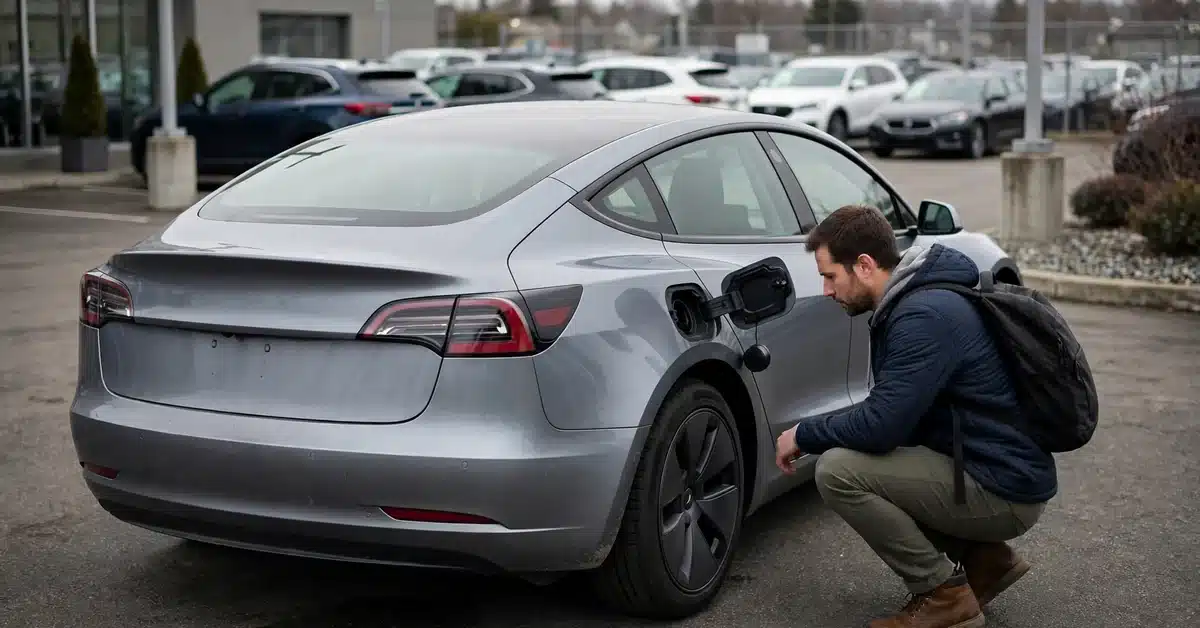
The battery is the single most expensive component in a used EV, and it’s also the hardest thing for a casual buyer to evaluate at a glance. This guide walks through exactly what to check, what’s considered acceptable degradation, and how to use that information to negotiate a fair price.
How to Check Battery Health Before Buying
Before test-driving, ask the seller for a battery health report or run your own check using the methods in how to check your EV battery health. At minimum:
- Charge to 100% (or ask for the last recorded 100% range) and compare against the original EPA rating
- Request a dealer or third-party SOH report if the seller has one — this is common for CPO (Certified Pre-Owned) listings
- Cross-check the vehicle’s charging history if available — heavy reliance on DC fast charging is a red flag even if current SOH looks acceptable
- For Tesla and Nissan specifically, pull data via a compatible app (Tessie/TeslaFi or LeafSpy) during the test drive if the seller permits it
How Much Battery Degradation Is Acceptable in a Used EV?
Acceptable degradation scales with age and mileage. Use this as a rough screening guide:
| Age | Typical Mileage | Acceptable SOH Range | Investigate Further Below |
|---|---|---|---|
| 1–2 years | Under 30,000 | 95–100% | 90% |
| 3–5 years | 30,000–80,000 | 88–95% | 82% |
| 6–8 years | 80,000–130,000 | 80–90% | 75% |
| 9+ years | 130,000+ | 72–82% | 68% |
Falling below the “investigate further” threshold doesn’t automatically mean walk away — it means ask why. Heavy fast-charging history, hot-climate storage, or a history of commercial use (rideshare, delivery) can all explain faster-than-average wear without indicating a defective pack.
Does a High-Mileage Used EV Still Have Good Battery Life?
Often, yes — high mileage is a weaker predictor of battery health than most buyers assume. A 120,000-mile EV that was mostly highway-driven and charged on Level 2 overnight can have better SOH than a 40,000-mile EV that was fast-charged daily in a hot climate. Tesla’s own fleet reporting shows Model 3/Y packs retaining around 85% capacity at 200,000 miles on average — evidence that mileage alone is not the dominant factor. Always weigh mileage alongside charging history and climate exposure rather than using it as a standalone red flag.
Is a 5-Year-Old EV Battery Still Reliable?
Generally yes. At the 5-year mark, fleet data suggests most liquid-cooled EV batteries retain 88–94% of original capacity — well above any functional concern for daily driving. Reliability concerns at this age are far more likely to come from 12V auxiliary battery issues, charging port wear, or software glitches than from the main traction battery itself. A 5-year-old EV with documented moderate charging habits and no reported BMS fault codes is a reasonably safe purchase from a battery-health standpoint.
Does Battery Health Affect Resale Value?
Yes, increasingly so as the used-EV market matures. Buyers and appraisal tools like Recurrent now factor documented SOH directly into valuation, similar to how mileage and accident history affect a gas car’s resale value. A used EV with a verified, above-average SOH for its age can command a meaningful price premium over an otherwise identical vehicle with undocumented or below-average battery health — sometimes several thousand dollars on higher-value vehicles.
How to Negotiate Price Based on Battery Health
If a battery health check reveals below-average SOH for the vehicle’s age and mileage, use these levers in negotiation:
- Quantify the gap: Compare the vehicle’s SOH against the benchmark table above and calculate the approximate remaining usable range difference
- Price against a replacement estimate: If SOH is near the warranty replacement threshold, reference likely near-term replacement costs (see EV battery replacement cost) as negotiating leverage
- Confirm remaining warranty: A vehicle still within its battery warranty term carries less risk regardless of current SOH — factor this into how hard to push on price
- Get it in writing: If the seller agrees to a price adjustment based on battery health, document the SOH reading and source in the sale paperwork
Which Used EVs Have the Best Battery Retention?
Based on aggregated fleet degradation data, vehicles with liquid-cooled LFP or well-managed NMC packs tend to show the strongest long-term retention. Tesla Model 3/Y (both chemistries), and LFP-equipped models generally (Tesla Standard Range trims, BYD models where available) consistently rank among the best performers for capacity retention at high mileage, thanks to robust thermal management and, for LFP, inherently longer cycle life. Earlier air-cooled models — most notably early Nissan Leaf generations — rank at the opposite end, which is covered in detail in our Nissan Leaf battery degradation guide.
Conclusion
Evaluating a used EV’s battery doesn’t require expensive equipment — a documented SOH reading, cross-checked against age and mileage benchmarks, tells most of the story. High mileage alone isn’t disqualifying, and a 5-year-old battery is very likely still reliable. What matters most is verifying the number rather than trusting a seller’s word, and using any below-benchmark reading as concrete, quantified negotiating leverage rather than a reason to walk away outright.
