
What Is a Digital Twin in EV Battery Management?

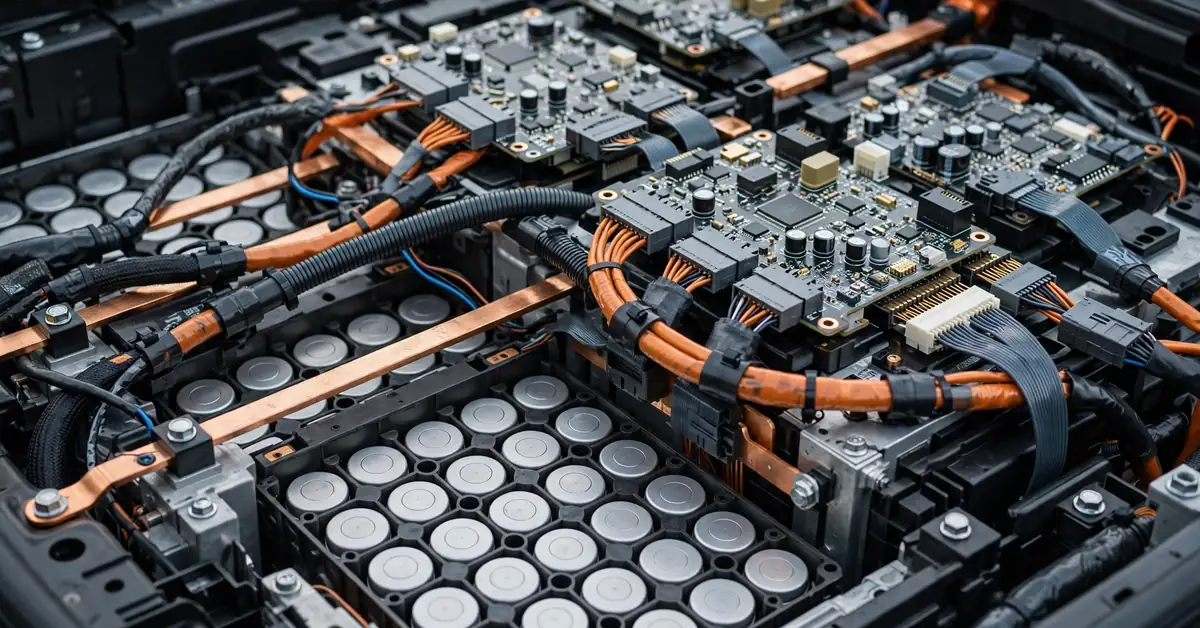
A digital twin in EV battery management is a virtual, continuously updated replica of the physical battery pack, synchronized with real-time sensor data, used to simulate battery behavior, predict problems before they occur, and offload computation the vehicle’s onboard controller couldn’t handle alone. It’s the battery equivalent of a live, running model that mirrors exactly what the real pack is experiencing.
What Makes a Digital Twin Different From a Standard Model
A traditional battery model runs a fixed set of equations. A digital twin goes further: it stays continuously connected to the physical battery through live sensor data, updating its virtual state in near real time so it reflects what’s actually happening in the pack right now, not just a generic prediction based on average behavior.
The Three Core Elements of a Digital Twin
The Physical System
This is the real battery pack itself, collecting voltage, current, and temperature data through its sensors and computing the real-time quantities needed for normal operation.
The Virtual Representation
A software model, often incorporating electrochemical, thermal, and sometimes mechanical simulation, that mirrors the physical battery’s behavior with enough fidelity to make meaningful predictions.
The Connection Between Them
Sensor data flows continuously from the physical system to the virtual model, typically via cloud connectivity, keeping the digital twin synchronized with real-world conditions rather than drifting into a purely theoretical simulation.
What a Digital Twin Actually Does for Battery Management
Enhanced SOC and SOH Estimation
By running more sophisticated simulation than a vehicle’s onboard controller could handle alone, a digital twin can refine SOC and SOH estimates with more nuance, incorporating a fuller picture of aging, thermal history, and usage patterns.
Predictive Fault Detection
Some digital twin implementations have demonstrated the ability to identify incipient thermal deviations with high classification accuracy and anticipate failure onset with a meaningful early margin, functioning as a genuine predictive safety layer rather than a purely reactive one.
Distributing Computational Load
Running detailed multi-physics simulations, electrochemical, thermal, and mechanical, requires significant computing power. A digital twin lets that heavy computation happen in the cloud rather than straining the vehicle’s onboard hardware.
Real-Time Adaptive Response
In practice, this can mean the vehicle automatically adjusting power consumption across various systems as a battery approaches its range limits, similar in concept to a smartphone’s power-saving mode, but driven by a continuously updated model of actual battery condition.
Tiered Digital Twin Frameworks
More advanced digital twin architectures are structured in tiers, moving from basic descriptive modeling, to predictive forecasting, to prescriptive optimization, and finally to autonomous closed-loop control, where the digital twin doesn’t just predict outcomes but actively informs real-time decisions back in the physical vehicle.
Industry Collaboration Behind the Technology
Digital twin development for EV batteries has involved partnerships between simulation software companies, automakers, and cloud infrastructure providers, reflecting how genuinely cross-disciplinary this technology is, spanning electrochemistry, thermal engineering, and large-scale data infrastructure.
| Digital Twin Function | Benefit |
|---|---|
| Enhanced SOC/SOH estimation | More accurate range and health reporting |
| Predictive fault detection | Earlier warning of developing problems |
| Cloud-offloaded computation | Enables sophisticated modeling beyond onboard limits |
| Real-time adaptive response | Dynamic power management as conditions change |
Conclusion
A digital twin in EV battery management is a continuously synchronized virtual model of the physical battery pack, used to run sophisticated simulations, predict problems earlier, and inform real-time decisions that a vehicle’s onboard controller couldn’t handle alone. As cloud connectivity and computing power continue expanding, this technology is becoming a meaningful part of how the next generation of EV battery systems achieves both better performance and earlier safety detection.
FAQs
Does every EV have a digital twin for its battery?
Not yet universally — it’s an emerging technology increasingly adopted by manufacturers investing in advanced battery management capabilities.
Does a digital twin require constant internet connectivity to work?
Full functionality typically relies on cloud connectivity, though the vehicle’s onboard BMS continues basic real-time protection independently.
Can a digital twin predict battery failures before they happen?
Advanced implementations have shown meaningful ability to anticipate developing thermal issues with an early warning margin, functioning as a predictive safety layer.
