
What Is BMS Firmware and How Is It Updated?

Built from NHTSA recall records, UNECE Regulation No. 156, manufacturer update releases (Volkswagen, Porsche, Chevrolet) and Battery University’s estimation references (November 2026).
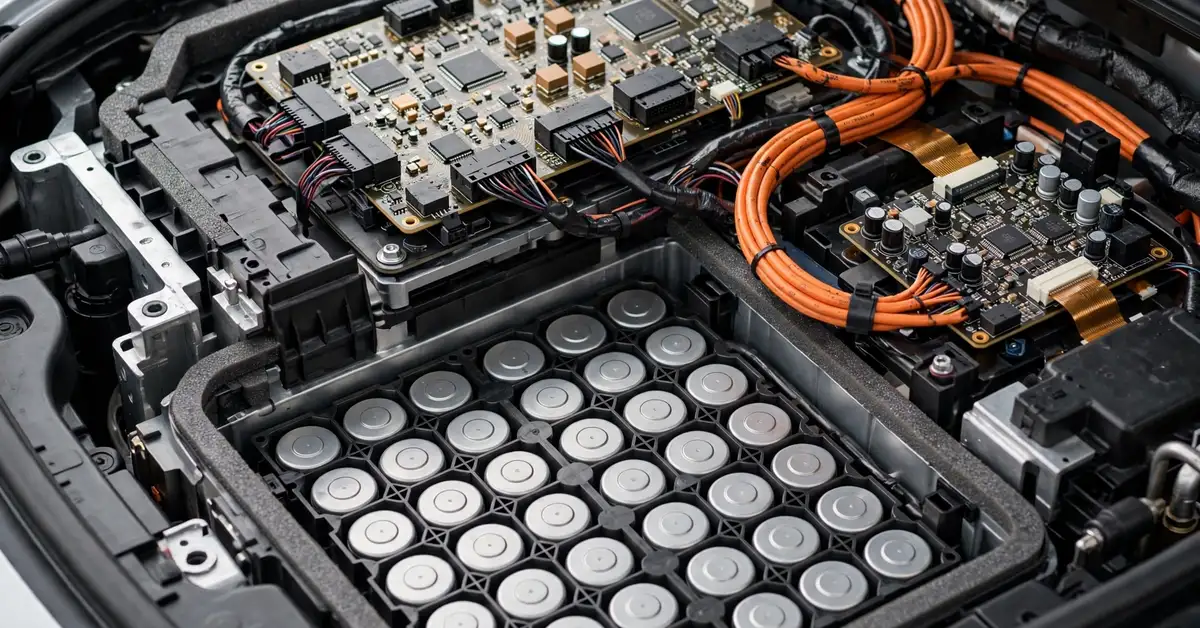
Every EV battery pack has a guard that never sleeps: a small computer called the battery management system, watching each cell’s voltage and temperature hundreds of times per second, deciding how fast you may charge and when to open the contactors and cut the power.
The guard’s instructions live in firmware — software embedded in the controller itself. And here is the distinction almost nobody explains: when a dealer or a download “updates your BMS,” it usually does not replace that code. It rewrites the calibration — the thresholds and limits the existing code works to. NHTSA’s own service-bulletin language says it outright: “EV BMS Calibration Update.”
This page explains what BMS firmware is, what it does all day, how updates actually reach it (there are two roads in, and they are not equal), and the documented cases where an update changed what owners could see — range, charging speed, even how full the car would let them charge. Whether the BMS itself can be updated over the air, brand by brand, has its own page on this site; this one is the firmware layer itself.
BMS firmware is the embedded software running on your EV’s battery management controller — it estimates charge and health, balances cells, controls the contactors and enforces every safety limit. It is updated two ways: a dealer’s wired flash during service or a recall, or over the air on cars whose makers include the BMS in their OTA scope. Most real-world “BMS updates” change the calibration (limits and thresholds) rather than the code — and yes, they can change displayed range and charging behaviour, because they change what the controller believes and allows.
Key figures: ~100 ms — the watchdog window after which a stalled BMS opens the contactors · 6,200 miles — the clean-driving distance after which GM’s diagnostic software restores a Bolt’s 100% charge limit
What the Firmware Actually Does All Day
Four jobs, running continuously: measure, estimate, balance, protect.
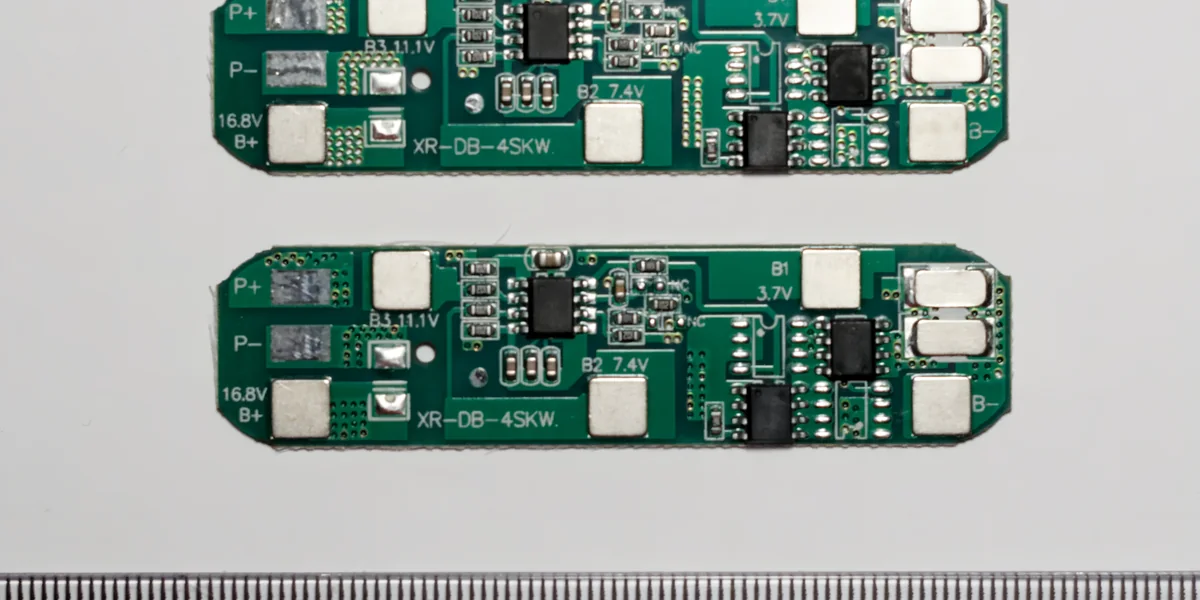
The firmware’s first job is measurement: sampling every cell group’s voltage and the pack’s temperatures and current, over and over, for the life of the car. Its second is estimation — turning those measurements into the two numbers your dashboard lives on: state of charge (how full) and state of health (how worn). Estimation is algorithms, not sensing: there is no fuel gauge inside a cell, so the firmware counts charge in and out (coulomb counting) and corrects itself against voltage curves — which is why estimates drift, and why updates that improve the maths change what your range display says without touching a single cell.
Third, balancing: bleeding or shuttling charge so cell groups age together. Fourth, protection: enforcing the voltage, temperature and current limits, and opening the contactors — the pack’s main switches — when a limit is breached. Underneath all four sits a watchdog: if the firmware itself stalls, the hardware watchdog forces the contactors open within roughly a tenth of a second. A dead BMS does not leave a live pack connected; the system’s failure mode is a car that will not move, by design.
Firmware, Calibration and Car Software: Three Different Layers
Most update confusion dissolves once the three layers are separated.
- Firmware — the embedded code on the BMS controller: the estimation algorithms, the protection logic, the balancing strategy. Changed rarely, and only by a full flash.
- Calibration (parameters) — the numbers the code works to: charge limits, thermal thresholds, taper curves, buffer sizes. Changed often — this is what most dealer “BMS updates” and most recall remedies actually rewrite.
- Car software — the app-layer the owner sees: screens, apps, navigation. An infotainment update can arrive without the BMS being touched at all.
When a headline says an update “gave” a car more range or “took” charging speed away, the change is almost always in layer two — the window the controller is allowed to use — occasionally in layer one’s estimation maths. It is never new hardware, which is why the honest cases below all involve limits, estimates and curves, not new capacity.
Why Makers Update It
The triggers are mundane more often than dramatic: bugs, better maths, safety campaigns, and features.
Estimation improves as makers collect fleet data — a better degradation model means the buffer can shrink safely and usable capacity grows. Safety campaigns arrive as calibrations when the fix is a limit (a charge cap, a monitoring threshold) rather than a part. Charging curves get re-shaped when field data shows cells tolerating more — or less — than the launch calibration assumed. And occasionally an update is pure protection for the maker’s warranty exposure: a tighter limit today is cheaper than replacements tomorrow, which is why owners rightly ask whose interest a given update serves. The case file next is the honest record of each kind.
The Two Roads In: Dealer Flash and Over-the-Air
A wired flash at the dealer remains the default for battery work; OTA reaches the BMS only where the maker engineered it to.
The dealer road is the older one: the car connects by cable to the maker’s diagnostic system, the technician selects the campaign or bulletin, and the controller is reflashed under controlled conditions — stable power supply on the 12-volt system, car parked, sometimes hours of bay time (Porsche’s big 2020 Taycan control-unit update was dealer-only, free, and quoted at up to two business days).
The OTA road depends entirely on whether the BMS sits inside the maker’s over-the-air scope: Tesla’s does, routinely; other makers vary by model and year — and some battery updates are explicitly not OTA-able: Mercedes-Benz’s 2024 recall 24V-372 (14,912 EQE/EQS cars whose BMS software could shut the high-voltage battery down) required a dealer update, stated as such in the recall record.
Hyundai’s Kona history shows both roads in one model: a 2021 interim battery update owners applied through the infotainment system, and 2026 campaigns (61D004/61D018) remedying a BMS that could miss cell-voltage fluctuations while parked — that one at the dealer. The brand-by-brand OTA map lives on our OTA BMS page; the hardware the firmware runs on is on the BMS hardware page.
The Case File: Updates That Changed What Owners Could See
Five documented cases — each dated, each from the record, each changing a limit, a curve, or an estimate rather than the battery.
| Case | What the update did | Source of record |
|---|---|---|
| Chevy Bolt, Nov 2020 → 2023 | Recall software first capped charging at 90%; the later Advanced Diagnostic Software capped it at 80% — then automatically restored 100% after ~6,200 miles of clean diagnostics | NHTSA recalls; Chevrolet |
| VW ID. models, Software 3.0 (Q2 2022) | Free OTA: 77 kWh cars’ DC peak rose 125 → 135 kW; added Battery Care Mode (80% cap) | Volkswagen press release |
| Tesla Model S/X 60/70, Sep 2017 | For Hurricane Irma evacuations, Tesla remotely unlocked the full 75 kWh of software-locked packs — +30–40 miles, temporarily | Electrek; confirmed by Tesla |
| Hyundai Kona, 2021 → 2026 | 2021: interim battery monitoring update; 2026 campaigns: dealer BMS update for missed parked cell-voltage fluctuations | NHTSA 21V-127; Hyundai NZ campaigns |
| Mercedes EQE/EQS, 2024 (24V-372) | BMS software could shut down the HV battery; remedy = dealer software update, not available OTA | NHTSA recall record |
Read the five together and the pattern is exact: software moved the window, never the walls. The Bolt’s caps were limits. VW’s gain was a curve the cells could already survive. Tesla’s Irma unlock released capacity that was physically present and software-locked (the permanent unlock was a paid option, $4,500–$9,000 — the maker had sold the same battery twice).
Nothing in the record shows an update creating capacity, repairing a degraded cell, or exceeding a sensor’s hardware limits. Where an update appears to “restore” range, the mechanism is estimation: coulomb counting drifts, the learned-capacity figure in the gauge goes stale, and a recalibration — sometimes helped by a full charge cycle — redraws the number. The battery did not heal; the bookkeeping caught up. Usage-limit questions (does the BMS cap charging to protect life?) are answered on our charging-limits page, and the usable-window arithmetic behind the Irma case is on the usable vs total capacity page.
Why the Ceremony: Signing, Rollback and the Law
A failed infotainment update loses your radio presets; a failed BMS update can strand the car — so battery updates are wrapped in procedure.
Update images for safety-critical controllers are cryptographically signed — the controller refuses unsigned code — and modern practice keeps two flash banks: the new image lands in the spare bank and is only committed after it boots and passes checks, leaving the previous version available to roll back to.
Since 2021 this is also law in most markets: UNECE Regulation No. 156 requires a maker’s update process to be able to restore the previous version or put the vehicle in a safe state if an update fails, to ensure enough power to complete the update including a rollback, and to inform the user before and after
The regulation even standardises a software identification number (RXSWIN) readable through the OBD port — the paper trail that lets a dealer, or an inspector, prove which version a car’s controllers run. That is the framework behind the dealer road’s ceremony: stable 12-volt power, verified version numbers, no driving off mid-flash. What failure itself looks like from the driver’s seat is covered on our BMS failure page.
The Owner’s Checklist: Before, During, After
What an owner actually controls in all this is small — but it is real.
- You usually cannot choose the calibration. Recall and campaign updates are applied at service; refusing a safety-recall remedy leaves the recall open on the car’s record.
- OTA updates can usually be deferred, not refused forever — makers let you schedule or postpone; the car will keep asking.
- Preconditions are real: updates want the car parked, a healthy 12-volt battery, and often a state-of-charge window; Tesla installs while unplugged and pauses charging during installation — follow your own car’s prompts, not generic advice.
- Dealer flashes are normally free when they are recall or campaign work (the Mercedes and Taycan cases above were); out-of-warranty discretionary flashes can carry labour charges — ask before authorising.
- Prove it happened: version screens, the app, or the invoice’s campaign code. Post-update range changes in the first days are usually estimation recalibrating, not the battery changing.
Frequently Asked Questions
What is BMS firmware in simple terms?
The instruction set of the battery’s guard computer. It watches every cell, estimates charge and health, balances the pack, and enforces the safety limits — and it runs on a controller inside or beside the pack, not on the car’s touchscreen computer.
Is a BMS update the same as a software update?
Partly. A car’s “software update” may touch only screens and apps. A BMS update reaches the battery controller — and most of the time it changes the calibration (limits and thresholds inside the existing firmware) rather than replacing the code itself. NHTSA’s bulletins literally call these “BMS Calibration Updates.”
Can a firmware update increase my EV’s range?
It can increase displayed and usable range — by releasing buffer, improving the estimation maths, or lifting a cap — as VW’s and GM’s cases show. It cannot add capacity the cells do not have: Tesla’s Irma unlock worked because the larger battery was already in the car, software-locked.
Can an update reduce range or charging speed?
Yes — safety campaigns do exactly that on purpose (the Bolt’s 90% and later 80% charge caps). The honest ones say so in the recall letter and, in the Bolt’s diagnostic-software case, restore full capacity automatically after enough clean miles.
Does the BMS itself receive over-the-air updates?
On some brands, yes (Tesla routinely); on others the BMS is dealer-only, and some recalls state explicitly that the fix is not OTA-able (Mercedes 24V-372). The brand-by-brand picture is on our OTA BMS page.
Can a failed update brick my car?
The safeguards are designed to prevent it: signed images, dual flash banks, and UNECE R156’s restore-or-safe-state requirement. A failed BMS flash can leave the car immobile until a dealer completes it — which is why updates demand stable power and a parked car — but permanent “bricking” is not the documented pattern.
How do I know if my BMS was updated?
Check the car’s software version screen or app after a service visit, look for the campaign code on the dealer invoice, and watch for the maker’s notification before and after an OTA (R156 requires the user be informed). A sudden change in displayed range after service is often the estimation recalibrating.
How long does a BMS update take?
An OTA calibration can take minutes; a dealer flash ranges from under an hour to exceptional cases like the Taycan’s 2020 control-unit update, quoted at up to two business days. Duration follows how many controllers the campaign touches, not just the BMS.
Conclusion
BMS firmware is the quiet layer that decides what your battery is allowed to be — and the update history proves it: caps imposed and lifted, curves raised, buffers released, all in software, none of it touching a cell. Understand the three layers — code, calibration, car software — and every update headline decodes itself: ask which layer changed, whose record documents it, and whether the change moved a limit, an estimate, or a curve. It will always be one of those three.
