What Is the Tesla Supercharger Network?

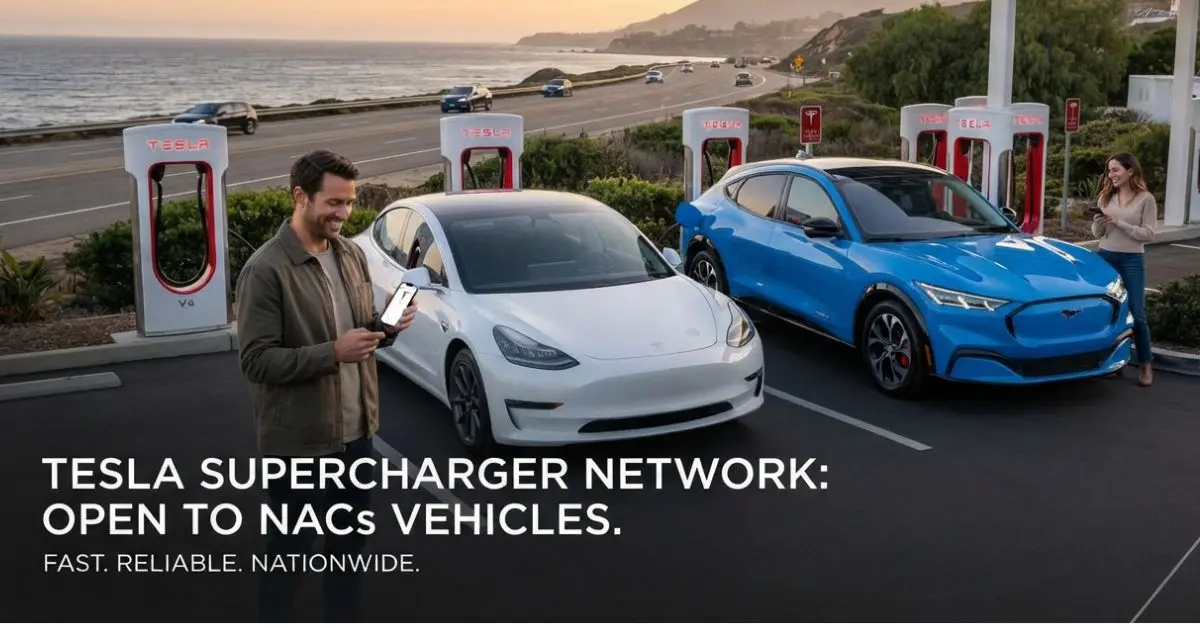
The Tesla Supercharger Network is the largest and most reliable fast-charging system in the United States. As of mid-2026, it includes about 3,088 stations and over 37,400 charging ports. These chargers provide up to 250 kW of power, which adds over 200 miles of range in just 15 to 20 minutes for compatible electric vehicles.
Tesla previously allowed only its own cars to use these stations. However, the network opened to all vehicles with a North American Charging Standard (NACS) port between 2024 and 2025. Now, almost every new electric car sold in North America can use this network.
Tesla Supercharger Network: Key Facts
| Specification | Detail |
|---|---|
| US stations | ~3,088 (June 2026) |
| US charging ports | 37,400+ |
| Global stations | ~7,000+ |
| Connector standard | NACS (North American Charging Standard) |
| Supercharger V3 peak power | 250 kW per stall |
| Supercharger V4 peak power | 250 kW per stall (some V4 cabinets support higher) |
| Typical stalls per station | 8–24 stalls |
| Cost (non-Tesla NACS users) | ~$0.32–$0.50/kWh |
| Payment methods | Tesla app, credit card (some V4 stations) |
| Open to non-Tesla EVs? | Yes — all NACS vehicles (no adapter needed) |
Tesla Supercharger Hardware Generations
Supercharger V1 and V2 (2012–2019)
The original hardware delivered up to 72–145 kW per stall. V1 and V2 stations share power between paired stalls, so charging speed drops when two vehicles use the same pair. These stations are still available at many older Tesla-only locations.
Supercharger V3 (2019–Present)
V3 is the current standard and delivers up to 250 kW per stall without power sharing. Each charging stall operates independently, allowing compatible vehicles to charge at full speed.
Supercharger V4 (2022–Present)
V4 is the newest generation. It features larger charging equipment, improved accessibility, and support for higher future charging power. Some V4 cabinets also support CCS1 connectors for older non-NACS EVs.
How to Use a Tesla Supercharger With a Non-Tesla EV
Step 1: Download the Tesla App
Download the Tesla app, create a free account, and add a payment method such as a credit card or PayPal.
Step 2: Plug In Your Vehicle
Connect the NACS charging cable to your vehicle. NACS-equipped EVs (2024 and newer models) can plug in directly.
Step 3: Start the Charging Session
The Tesla app automatically detects your vehicle and starts the charging session. You can also scan the QR code on the charging stall to begin charging.
Step 4: Monitor Charging and Unplug
Track charging progress in the Tesla app or on your vehicle’s display. Unplug your vehicle when charging is complete to avoid idle fees at busy stations.
Tesla Supercharger Costs in 2026
Supercharger pricing depends on the location, time of day, and whether you drive a Tesla or a non-Tesla EV. Non-Tesla NACS users typically pay about $0.32–$0.50 per kWh, which is similar to or slightly higher than standard Tesla owner pricing.
Tesla owners with Full Self-Driving or certain subscriptions may receive charging credits. Idle fees usually apply if your vehicle remains connected after charging is complete while other drivers are waiting. These fees are typically $0.50 per minute when station occupancy exceeds 50%. The Tesla app sends a notification when your charging session ends.
Why the Tesla Supercharger Network Is So Reliable
Complete Network Control
Tesla designs, builds, operates, and maintains the entire Supercharger Network without relying on third-party operators. This allows faster repairs and consistent performance.
More Charging Stalls
Most stations have between 8 and 24 charging stalls. If one charger is unavailable, drivers can usually use another stall without a long wait.
Real-Time Availability
The Tesla app shows live charger availability before you arrive, helping drivers avoid crowded stations and reduce waiting times.
Tesla Supercharger Network Coverage
The Tesla Supercharger Network includes about 3,088 stations across the United States. These stations cover nearly every major highway and most urban areas.
The network also stretches across Canada, with over 700 stations, and across Europe, with over 2,000 stations. Tesla operates many more stations in China and other global markets. Since 2023, Tesla has expanded quickly by adding thousands of new charging stations each year through its NEVI-supported expansion program. New V4 locations focus on major highways and busy urban areas to support the growing number of non-Tesla EV drivers.
Conclusion
The Tesla Supercharger Network leads the industry in fast charging. It offers over 37,400 ports in the U.S. and provides 250 kW of power per stall. This reliable network is now open to all North American Charging Standard (NACS) vehicles, including most new EVs sold in North America since 2024.
Supercharger access makes road trip planning easier for all EV owners. You can use this network if your car has a NACS port or a Combined Charging System (CCS) adapter. Simply download the Tesla app and add a payment method to start charging your vehicle.
FAQs
Can non-Tesla EVs use Tesla Superchargers?
Yes. Most new NACS-equipped EVs can use Tesla Superchargers without an adapter. Some older CCS-equipped EVs can also charge at compatible stations by using an approved adapter.
How fast can a Tesla Supercharger charge an EV?
V3 and V4 Superchargers deliver up to 250 kW, allowing many compatible EVs to add more than 200 miles of driving range in about 15–20 minutes.
Do Tesla Supercharger prices vary by location?
Yes. Charging costs depend on the station location, time of day, and vehicle type. Non-Tesla users generally pay around $0.32–$0.50 per kWh.
