
Car Battery Voltage Too High: Causes, Symptoms & How to Fix It


This guide covers what happens when your car battery voltage exceeds safe limits. If your car battery voltage is too high, it’s like giving it too much of something nice. Instead of improving your car’s performance, it can actually cause serious problems — the battery can wear out faster, other car parts can be damaged, and in some cases, it can even explode. Let’s find out why this happens and how to fix it.
What Is The Normal Voltage of A Car Battery?
A healthy car battery should typically have a resting voltage of around 12.6 volts when the engine is off. When you start the car, a part called the alternator starts working. The alternator is like a little power-making machine that recharges the battery while you drive. When the engine runs, and the alternator charges the battery, the voltage usually rises between 13.5 and 14.5 volts.
If the voltage is lower than usual, that’s a different problem. It means your battery might be weak or not charging properly — and it’s a common reason drivers end up needing a jump-start. Interestingly, an EV’s 12V battery works on the same basic principle, separate from its large high-voltage traction pack.
Understanding High Voltage In Car Batteries
What does “too high” mean for a car battery? If the voltage stays above 15 volts for a long time, things can start to go wrong. It’s like turning the water pressure in a hose way too high — it might start to leak or even burst!
There’s the alternator that makes the power, a little helper called the voltage regulator that tries to keep the power level just right, and all the tiny rooms inside the battery called cells. This regulation task is handled by a more sophisticated system in EVs — see what is a car Battery Management System for how that works. EVs also run their traction system at a much higher voltage than a 12V accessory battery — see what is a 400V vs 800V EV battery architecture to understand why.
Why Would a Car Battery Get Too Much Power?
How does a car battery end up with too much voltage? Here are a few reasons.
1. Alternator Failure
Remember that power-making machine, the alternator? If it doesn’t work properly, it can send too much power to the battery. It’s like a water pump that gets stuck on “full” when we don’t want it.
2. The Voltage Regulator is Broken
The voltage regulator is a small part that stops the alternator from making too much power. If it breaks, the alternator can send out too much electricity.
3. Loose Wires
Loose or dirty battery wires can block the flow of power and increase the voltage, like a kink in a water hose building up pressure.
4. Wrong Charger
A mismatched battery charger pumps too much power into your car battery, overcharging it. It’s like trying to fill a small balloon with a giant air pump — the pressure is simply too great!
Different battery chemistries handle charging and voltage levels differently, which is why understanding options like LFP vs NMC Batteries can help explain how lithium-based batteries manage power and safety.
5. Cold Weather
In cold weather, your car’s battery charger might act strangely when you first start the car. The voltage might go a little higher for a short time, but it should come back down to normal pretty fast.
Is 15 Volts Too Much For A Car Battery?
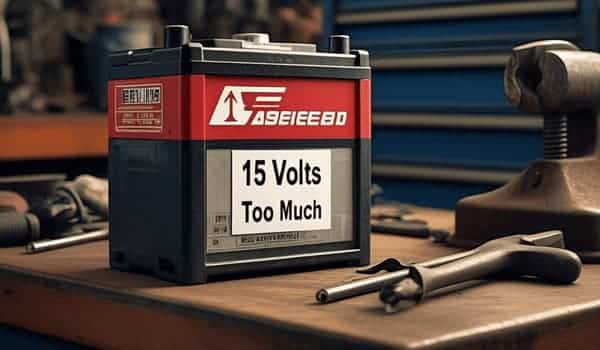
Your car has a system to keep the battery charged while the engine runs. With the alternator, the system usually sends about 13.8 to 14.0 volts to the battery, and it’s normal.
When the voltage rises to 15 volts, it’s like giving the battery too much power. It can make the battery do something called gassing, where the electrolyte breaks down into hydrogen and oxygen gas. Too much gas damages the plates inside the battery, decreasing how long the battery lasts.
A good regulated charger knows when the battery is full. It will then send less power (around 13.5 to 13.8 volts) to prevent overcharging. If the voltage stays at 15 volts, the battery is being overcharged and can be quickly destroyed, especially sealed batteries.
So, 15 volts is definitely too high for your car battery. If you see voltage this high when the engine is running, have your car checked immediately.
How To Check If Your Car Battery Voltage Is Too High
1. Using a Multimeter
This is a special tool that measures the voltage of your battery. Touch the little probes to the battery posts and it will show the reading on a screen.
2. Checking the Alternator
Sometimes, we need to test the alternator itself to see if it’s putting out too much power.
3. OBD-II Scanner
Many cars have a special plug that allows you to connect a scanner. The scanner can read information from the car’s computer, including the battery voltage.
4. Smart Battery Monitors
Some newer cars have built-in systems that monitor the battery and can tell you if the voltage is too high right on the dashboard.
What Can Go Wrong If Battery Voltage Is Too High?
1. Shorter Battery Life
Just like overcharging your phone wears it out faster, too much voltage makes your car battery die sooner than it should.
2. Damaged Car Parts
All the electrical parts in your car — the main computer (ECM), sensors, and safety fuses — are made to work with just the right amount of power. Too much voltage can fry them, like when you put too much electricity into a light bulb, and it burns out. These parts can be expensive to fix.
3. Risk of Explosion or Fire
In very rare cases, if the voltage gets extremely high, the battery can overheat and potentially explode or catch fire. That’s why high-voltage problems need to be fixed quickly.
How Do You Fix Too Much Voltage In A Car Battery?
1. Check and Replace the Alternator/Regulator
If the alternator or the voltage regulator is broken, it will likely need to be replaced. That’s usually the main cause of high-voltage problems.
2. Clean the Wires
Make sure all the wires connected to your battery are clean and tight. Loose or dirty connections can cause voltage spikes.
3. Use the Right Charger
If you are using a separate charger, make sure it’s the right one for your type of battery. Using the wrong charger can pump too much power and cause damage.
4. Get a New Battery
If the high voltage has already damaged your battery, you might need a replacement. Once a battery has been severely overcharged, it often can’t return to normal.
Conclusion
Keeping your car battery voltage in the correct range — usually between 13.7 and 14.7 volts when driving — is essential for your car’s health. Too much power can damage the battery and other expensive parts. Regularly checking your car and ensuring the charging system works correctly can help you avoid these problems and keep your car running safely for longer.
FAQs
Want to understand why EVs use high voltage by design? See: Why Do Electric Cars Use High Voltage? (400V vs 800V Explained) →
