
Tesla vs Ford vs Chevy: Which EV Battery Lasts Longest?

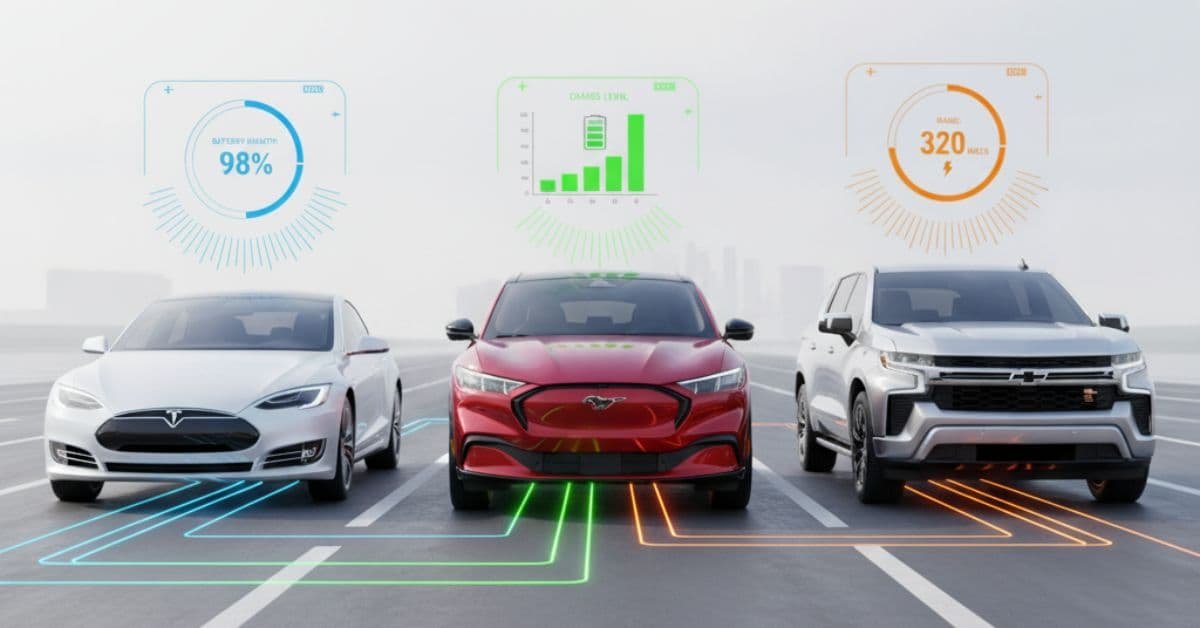
If you are choosing between a Tesla, a Ford, or a Chevrolet electric vehicle, battery longevity is probably your biggest question. These three brands dominate EV sales in the United States — and they take very different approaches to battery chemistry, thermal management, and long-term durability.
This guide compares real-world degradation data, warranty terms, and battery technology side by side so you can see exactly how they stack up.
Understanding Battery Longevity: The Key Factors
To really compare Tesla, Ford, and Chevy, we must first understand what makes a battery last. Long life is not just about the years; it is about how much power the battery loses over time. People call this loss degradation.
1. Battery Chemistry and Design
The materials inside the battery cells are very important.
Tesla: The company uses different chemicals. Older cars and long-range cars use Nickel-Cobalt-Aluminum (NCA) or Nickel-Manganese-Cobalt (NMC). Newer, standard-range cars use Lithium Iron Phosphate (LFP). LFP batteries are known to be very strong. You can charge them to 100% every day without harming the battery much.
Check out: Tesla Battery Comparison: NCA vs. NMC vs. LFP.
Ford: The Mustang Mach-E and F-150 Lightning mostly use Nickel-Manganese-Cobalt (NMC) batteries. Ford focuses on building the battery pack safely and for good performance.
Chevrolet: The Bolt EV/EUV uses NMC batteries. Newer cars like the Equinox EV and Silverado EV use the advanced Ultium platform. Ultium is a flexible, pouch-style battery. Chevy says it is built for long life and easy fixing.

2. Thermal Management System (TMS)
Heat is the number one enemy of a battery. A good TMS keeps the battery cool in the summer and warm in the winter.
Tesla: Tesla is famous for its smart liquid-cooling system. The car’s computer always runs this system. The system is a big reason why Tesla batteries stay healthy for a long time, even in very hot or cold places.
Ford: The Mach-E uses a liquid-cooling system that works very well. Ford’s Battery Management System (BMS) learns how the driver drives. It then manages the battery’s temperature based on those habits.
Chevrolet: The Ultium platform has a unique heat system that runs the whole length of the battery pack. Chevy says the system keeps the battery cells at their best temperature. This helps the battery last longer.
Read about: Does Extreme Weather Affect Tesla Battery Life?
3. Battery Management System (BMS)
The BMS is the “brain” that controls how the battery charges and gives out power.
All three companies use advanced BMS software to prevent the battery from overcharging or discharging too much. These are the main things that damage a battery. The BMS also balances the power across all the small cells. This makes sure that no single cell wears out faster than the others.
When the battery management system detects abnormalities, owners may notice common Tesla battery problems before a fault becomes serious.
4. Real-World Data: Degradation Comparison
All three brands give strong warranties, but real-world data shows us how the batteries truly hold up over time.
1. Tesla: Tesla has the most long-term battery data of any EV manufacturer. Studies across thousands of vehicles show an average annual degradation of 1 to 2% after the first year, with many high-mileage cars retaining 85 to 90% capacity beyond 200,000 miles. For a full breakdown of Tesla degradation by model and year, see our Tesla Battery Degradation guide.
2. Ford: The Ford Mustang Mach-E has been driven long enough to provide reliable data. Owners are saying very good things:
Average Degradation: Early reports say the Mach-E is losing power at a rate similar to some Tesla cars, or even a little better, in the first few years. One owner said the car lost only 4% of power after driving 100,000 miles.
BMS Optimization: Ford’s BMS is very good at protecting the battery, even when drivers use DC fast charging often.
3. Chevrolet: Chevrolet’s older Bolt EV had a battery problem that people know about, but the new Ultium platform is a completely new design. We are still collecting long-term data, but the design promises a great long life:
Modular Design: Ultium’s design allows people to replace individual parts more easily. This could make future repairs cheaper.
Projected Life: Chevy’s warranty and design suggest a battery life that will easily go past the 8-year/100,000-mile warranty. Many experts think the battery will last 15 to 20 years.
Manufacturer | Key Models | Battery Chemistry | Average Annual Degradation | Warranty (Years / Miles) |
|---|---|---|---|---|
Tesla | Model 3, Model Y, Model S, Model X | NCA, NMC, LFP, 4680 | 1.0% – 2.0% (after year 1) | 8 years / 100,000 – 150,000 miles |
Ford | Mustang Mach-E, F-150 Lightning | NMC | 1.5% – 2.5% | 8 years / 100,000 miles (70% capacity guarantee) |
Chevrolet | Bolt EV/EUV, Equinox EV, Silverado EV | NMC, Ultium (NMC/NCA) | 1.8% – 2.2% (Ultium = newer data) | 8 years / 100,000 miles (70% capacity guarantee) |
You can also compare EV battery warranties: Tesla vs Ford vs Mercedes across major manufacturers in more detail.
What the Data Tells Us Across All Three Brands
Tesla’s advantage is time — with over a decade of real-world data, their degradation curve is the most predictable of the three. Ford is closing the gap fast, with Mach-E owners reporting degradation rates that rival early Tesla numbers. Chevrolet’s Ultium platform is the newest of the three and lacks long-term data, but its modular design and thermal management approach suggest it is built for the long haul.
The honest answer for any buyer: all three brands now build batteries that will outlast most people’s ownership period. The difference is not whether the battery will last — it is how each brand handles the edge cases: extreme cold, frequent fast charging, and high-mileage use.
For practical tips on extending your Tesla battery life specifically, see our Tesla battery care guide.
Conclusion: Tesla vs Ford vs Chevy
Tesla leads in battery durability because the company has been building electric vehicles the longest. Their annual degradation of 1 to 2 percent after the first year sets the industry standard. High-mileage cars still hold 85 to 90 percent capacity at 200,000 miles.
Ford challenges this lead strongly. The Mustang Mach-E matches or beats early Tesla rates in the first 100,000 miles. The F-150 Lightning uses V2H capability for power, which places extra demands on the battery. Long-term data for this feature still comes in slowly.
Chevrolet uses the Ultium platform as a modern design for modular repair and thermal efficiency. This platform lacks enough miles for a confident long-term claim. However, the warranty terms match Tesla and Ford as a good sign.
If driving distance is equally important, compare Tesla battery range across every model before choosing an EV.
