
NMC 532 vs NMC 622 vs NMC 811: What’s the Difference?

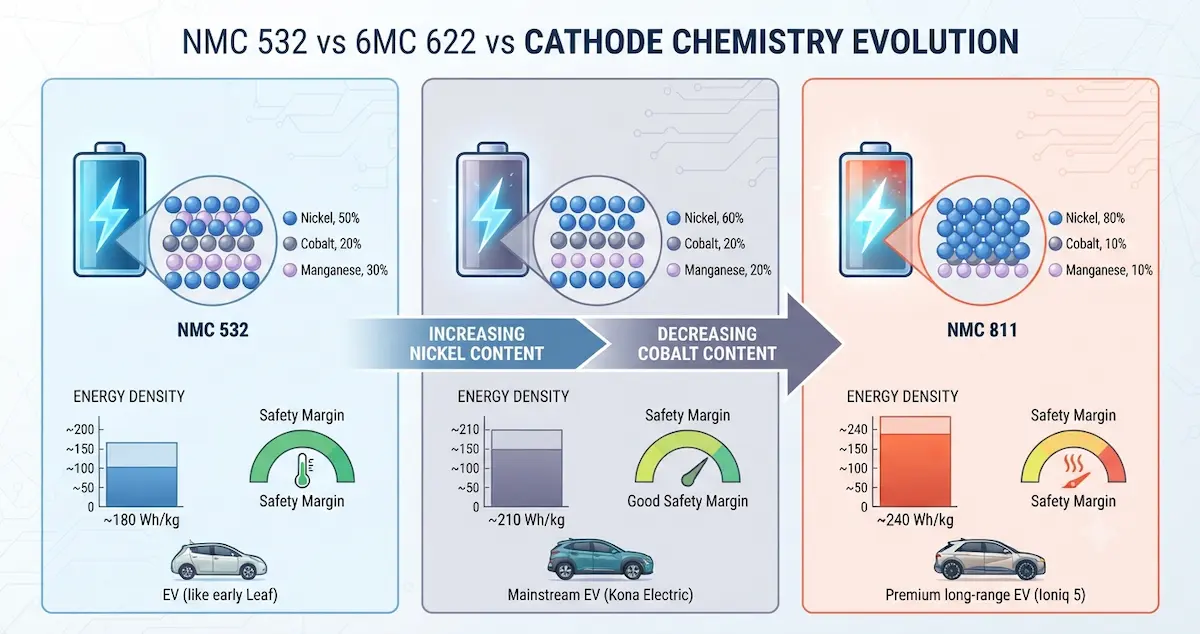
NMC 532, NMC 622, and NMC 811 are three formulations of the same NMC chemistry — each with a different ratio of nickel, manganese, and cobalt. Higher nickel = more range. Lower nickel = more stability and longer life. The EV industry has progressively shifted from NMC 532 toward NMC 811 over the past decade to maximize energy density and reduce cobalt content — and the trend is continuing toward even higher nickel ratios with NCMA and cobalt-free variants.
New to NMC chemistry itself? Start with our full explainer on what NMC battery chemistry is.
Understanding the NMC Numbering System
The three digits in NMC battery names represent the ratio of Nickel (Ni) : Manganese (Mn) : Cobalt (Co) in the cathode material:
- NMC 532: 50% Ni, 30% Mn, 20% Co
- NMC 622: 60% Ni, 20% Mn, 20% Co
- NMC 811: 80% Ni, 10% Mn, 10% Co
All three use the same layered oxide crystal structure (LiNixMnyCozO₂) and the same graphite anode. The ratio change shifts the performance balance between energy density, thermal stability, cycle life, and cost.
NMC 532 vs 622 vs 811: Full Comparison
| Feature | NMC 532 | NMC 622 | NMC 811 |
|---|---|---|---|
| Nickel content | 50% | 60% | 80% |
| Cobalt content | 20% | 20% | 10% |
| Manganese content | 30% | 20% | 10% |
| Energy density | ~170–190 Wh/kg | ~190–220 Wh/kg | ~220–260 Wh/kg |
| Thermal stability | Best among NMC | Good | Lower — needs better cooling |
| Cycle life | Longest among NMC | Good | Shorter than 532 |
| Cobalt cost exposure | High (20%) | High (20%) | Lower (10%) |
| Manufacturing difficulty | Easier | Moderate | Harder — higher-Ni more reactive |
| Primary EV use | Older/budget EVs | Mainstream EVs | Premium long-range EVs |
NMC 532: The Balanced Original
NMC 532 was the mainstream EV chemistry through the mid-2010s. With equal parts manganese and cobalt (30%/20%), it offers the best thermal stability and cycle life in the NMC family. Energy density of ~170–190 Wh/kg made it suitable for vehicles targeting 150–250 miles of range. The early Nissan Leaf (later generations), early BMW i3, and many hybrid models used NMC 532. Its high cobalt content (20%) is now its biggest drawback — cost and supply chain concerns have pushed manufacturers toward lower-cobalt formulations.
NMC 622: The Transitional Chemistry
NMC 622 boosted nickel to 60% while maintaining 20% cobalt and reducing manganese to 20%. This delivered meaningful energy density improvement (~190–220 Wh/kg) without the manufacturing challenges of NMC 811. It became the mainstream EV chemistry from roughly 2018–2021, used in second-generation long-range EVs. The Hyundai Kona Electric, early Kia EV6, and several GM EV models used NMC 622. It is now largely being superseded by NMC 811 in new premium EV launches.
NMC 811: The High-Performance Standard
NMC 811 is now the dominant NMC variant for premium long-range EVs. At 80% nickel, it delivers the highest energy density (~220–260 Wh/kg) of any commercial NMC formulation. Cobalt content is cut to 10% — significantly reducing the cobalt cost and supply chain concern vs earlier formulations. The tradeoffs are real: NMC 811 is more thermally reactive (cathode decomposition begins at ~210°C), more prone to cation mixing degradation over cycles, and requires more advanced thermal management systems. Major users include:
- Hyundai Ioniq 5 and Ioniq 6 (SK On NMC 811)
- Kia EV6 and EV9
- BMW i4 and iX (Samsung SDI)
- Tesla Model 3/Y Long Range (CATL NMC 811)
- Mercedes EQS and EQE
For the full technical picture of why 811 outperforms older ratios, see our breakdown of why NMC 811 has more range than older NMC.
Beyond 811: NCMA and Ultra-High Nickel
The industry is pushing beyond NMC 811 with NCMA (adding aluminium to NMC 811 to improve stability) and ultra-high nickel formulations targeting 90%+ nickel content. GM’s Ultium battery uses NCMA chemistry from LG Energy Solution. Samsung SDI and CATL are developing 9-series NMC variants. Each step up in nickel content requires increasingly sophisticated thermal management and BMS to maintain safety and cycle life.
Frequently Asked Questions
What is the difference between NMC 532, 622, and 811?
The numbers represent the ratio of nickel, manganese, and cobalt. NMC 532 has the most balanced composition (50/30/20) with best stability but lowest density. NMC 622 (60/20/20) improves density moderately. NMC 811 (80/10/10) delivers maximum energy density (~220–260 Wh/kg) with 10% cobalt — enabling 300–400+ mile EVs but requiring superior thermal management.
Which NMC variant is safest?
NMC 532 is the most thermally stable NMC variant — its higher manganese content provides better structural stability and a slightly higher thermal runaway threshold than NMC 811. However, all NMC variants are less thermally stable than LFP. For maximum safety within the NMC family, NMC 532 is preferred for applications where thermal risk is a primary concern.
Why did the industry move from NMC 532 to NMC 811?
Two reasons drove the shift: energy density and cobalt reduction. NMC 811 delivers ~40% more energy per kilogram than NMC 532 — enabling significantly longer range from the same pack weight. Simultaneously, reducing cobalt from 20% to 10% lowered materials cost and reduced exposure to DRC cobalt supply chain volatility. These benefits outweighed the added manufacturing complexity and thermal management requirements.
Conclusion
NMC 532, 622, and 811 represent three generations of NMC chemistry evolution — each trading some thermal stability and cycle life for higher energy density and reduced cobalt content. The industry has moved decisively toward NMC 811 for premium long-range EVs, enabled by advanced thermal management systems that manage the higher-nickel cathode’s greater reactivity. Beyond 811, NCMA and ultra-high-nickel variants are pushing energy density even higher—continuing the trend of more range per kilogram with less cobalt dependence.
All of this extra nickel comes with a heat cost — see our explainer on why NMC battery needs active cooling.
