
What Is LMFP Battery Chemistry?

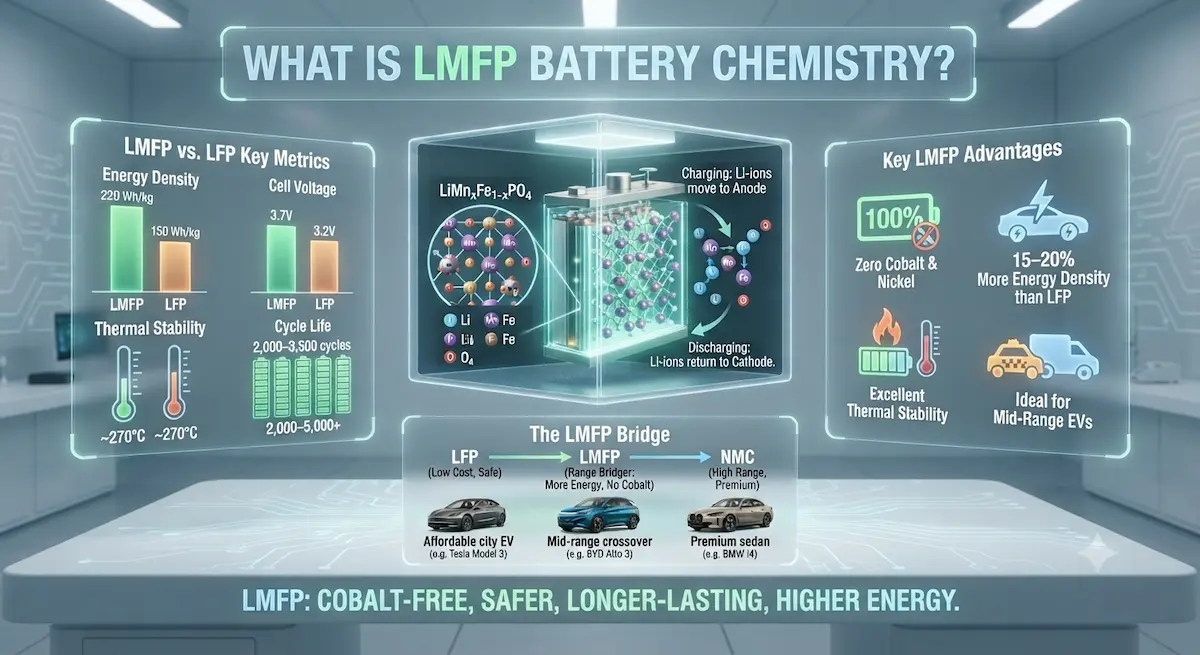
LMFP (Lithium Manganese Iron Phosphate) is a next-generation EV battery chemistry that adds manganese to the standard LFP (lithium iron phosphate) cathode. The result: 15–20% higher energy density than LFP, the same zero-cobalt and zero-nickel composition, and thermal stability nearly as good as LFP. As of 2026, LMFP is entering commercial production — used in BYD’s second-generation Blade Battery — and is positioned as the chemistry that bridges the gap between LFP’s low cost and NMC’s higher range.
New to the base chemistry it improves on? Start with our guide on what LFP battery chemistry is in electric cars.
What Is LMFP Battery Chemistry?
LMFP uses a lithium manganese iron phosphate cathode with the chemical formula LiMnxFe1-xPO₄ — where manganese partially replaces iron in the standard LFP olivine structure. This substitution raises the cathode’s operating voltage from ~3.2V (LFP) to ~3.7V (LMFP) — the same as NMC. Since energy density = voltage × capacity, this directly improves energy density by approximately 15–20%. Gotion claims its LMFP cells achieve 240 Wh/kg gravimetric and 525 Wh/L volumetric energy density — approaching NMC 622 territory while remaining completely cobalt- and nickel-free.
LMFP vs LFP: The Key Improvements
| Feature | LFP | LMFP |
|---|---|---|
| Cathode material | LiFePO₄ | LiMnₓFe₁₋ₓPO₄ |
| Cell voltage | ~3.2V | ~3.7V |
| Cell energy density | 90–170 Wh/kg | 160–240 Wh/kg |
| Energy density improvement | Baseline | ~15–20% better |
| Cycle life | 2,000–5,000+ | ~2,000–3,500 |
| Thermal stability | Excellent (~270°C) | Excellent (similar to LFP) |
| Cobalt content | Zero | Zero |
| Nickel content | Zero | Zero |
| Cold weather performance | Weak below 0°C | Better than LFP (higher voltage) |
BYD’s Gen 2 Blade Battery: LMFP in Action
BYD launched its second-generation Blade Battery in March 2026 using LMFP cathode chemistry combined with a silicon-carbon composite anode. Key improvements over Gen 1 (standard LFP): internal resistance reduced by 50%, heat generation reduced by 50%, 10% to 70% charge time of 5 minutes on BYD’s 1,500 kW Flash chargers, and 10% to 97% in 12 minutes at -30°C.
Wondering if the upgrade is worth it over standard LFP? See our full breakdown of LMFP vs LFP: is manganese-enhanced LFP worth it.
LMFP vs NMC: The Strategic Comparison
LMFP is not yet competitive with NMC 811 on peak energy density — NMC 811 still delivers ~220–260 Wh/kg vs LMFP’s ~160–240 Wh/kg. But LMFP offers zero cobalt and nickel, better thermal safety (~270°C), longer cycle life (2,000–3,500 cycles vs NMC’s 1,000–2,500), and lower cost. For mid-range EVs targeting 250–350 miles, LMFP is becoming a compelling alternative to both LFP (more range) and NMC (lower cost, safer, no cobalt).
Frequently Asked Questions
What is LMFP battery chemistry?
LMFP (Lithium Manganese Iron Phosphate) is an advanced version of LFP that adds manganese to the olivine cathode structure. Manganese raises the cell voltage from ~3.2V to ~3.7V, boosting energy density by 15–20% vs standard LFP while maintaining zero cobalt, zero nickel, and excellent thermal stability. BYD’s 2026 Gen 2 Blade Battery is the most prominent commercial LMFP application.
Is LMFP better than LFP?
LMFP offers higher energy density (15–20% more), better cold-weather performance, and similar safety vs standard LFP. The tradeoffs are slightly shorter cycle life (~2,000–3,500 vs LFP’s 2,000–5,000+) and slightly higher manufacturing complexity. For range-critical applications, LMFP is superior. For ultra-high-cycle commercial fleet use, standard LFP retains an advantage.
Which EVs use LMFP batteries?
BYD’s second-generation Blade Battery (launched March 2026) uses LMFP cathode chemistry. CATL’s M3P battery incorporates manganese and phosphate consistent with LMFP-family chemistry. Multiple Chinese automakers using BYD-supplied Gen 2 Blade batteries are the first commercial LMFP EV users.
Curious what’s driving the wider industry shift toward phosphate chemistries? See our guide on why so many new EVs are switching to LFP batteries.
Conclusion
LMFP battery chemistry is the most important evolution in lithium iron phosphate technology since the olivine structure was first developed — delivering 15–20% more energy density than LFP while maintaining zero cobalt, zero nickel, excellent thermal safety, and low cost. As BYD’s Gen 2 Blade Battery and CATL’s M3P enter commercial production, LMFP is positioned to become the dominant chemistry for mid-range EVs through the late 2020s. For a full picture of where LMFP fits alongside NMC, NCA, sodium-ion, and solid-state, see our complete guide: EV Battery Chemistry Explained: NMC, LFP, NCA & Beyond.
