
What Is NCMA Battery Chemistry and Who Uses It?

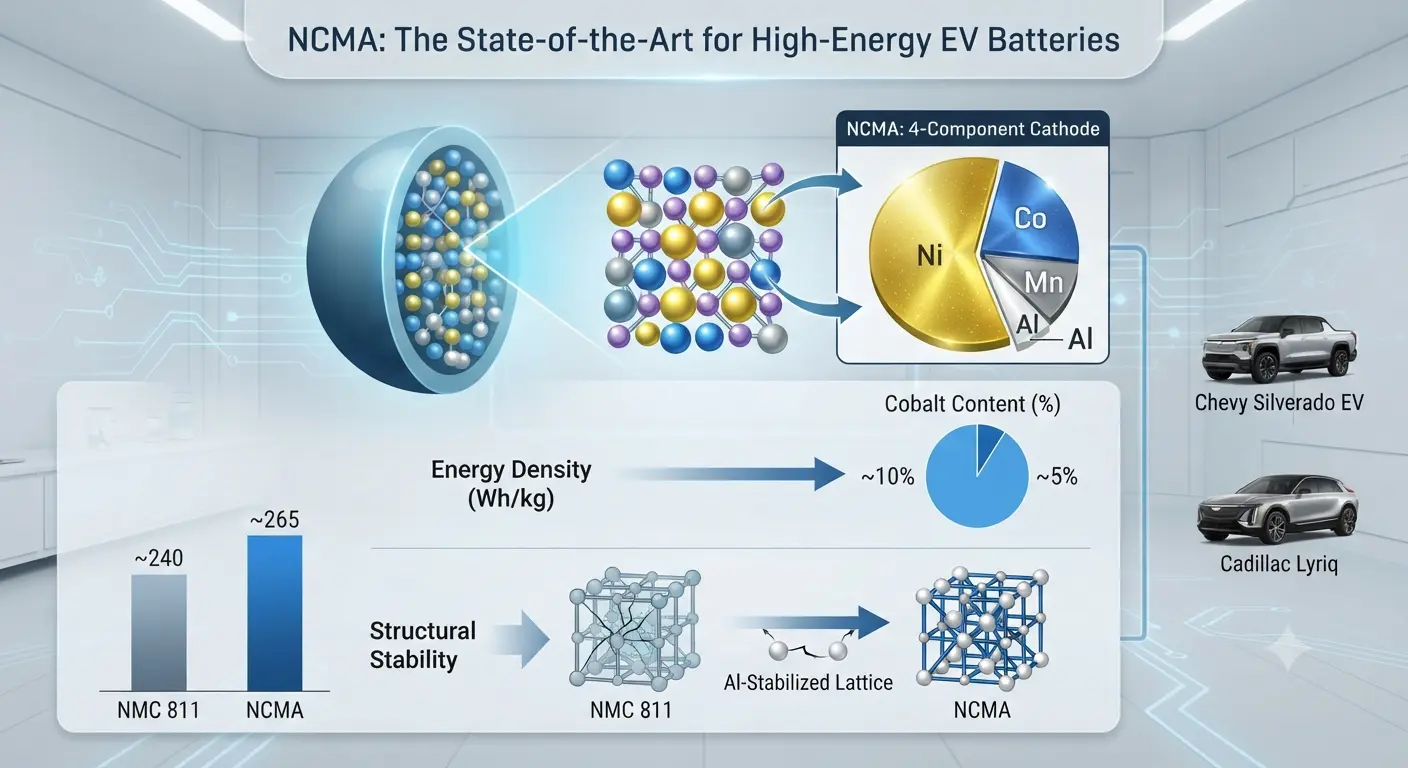
NCMA (Nickel Cobalt Manganese Aluminum) is a next-generation lithium-ion battery chemistry that adds aluminum to the standard NMC cathode — combining the best elements of both NMC and NCA chemistry. It delivers high energy density, reduced cobalt content, and improved structural stability compared to NMC 811 alone. GM’s Ultium platform is the most prominent commercial user of NCMA, supplied by LG Energy Solution. NCMA represents the current state-of-the-art for high-energy-density EV batteries targeting maximum range with reduced cobalt.
New to the broader high-nickel category NCMA belongs to? Start with our full explainer on what high-nickel cathode battery chemistry is.
What Is NCMA Chemistry?
NCMA uses a layered oxide cathode containing four metals: Nickel, Cobalt, Manganese, and Aluminum — hence the acronym. The chemical formula is LiNixCoyMnzAlwO₂. Typical NCMA composition in GM’s Ultium cells: approximately 89% nickel, 5% cobalt, 5% manganese, 1% aluminum.
The rationale: adding small amounts of aluminum to a high-nickel NMC cathode improves structural stability at high charge voltages — similar to how aluminum improves NCA vs standard NMC. Aluminum occupies transition metal sites in the lattice, reducing the phase transformations that cause capacity fade in high-nickel NMC 811.
NCMA vs NMC 811: Key Differences
| Feature | NMC 811 | NCMA (~89/5/5/1) |
|---|---|---|
| Nickel content | ~80% | ~89% (higher) |
| Cobalt content | ~10% | ~5% (lower) |
| Manganese content | ~10% | ~5% (lower) |
| Aluminum content | Zero | ~1% (added) |
| Energy density | ~220–260 Wh/kg | ~250–280 Wh/kg (higher) |
| Cobalt reduction vs NMC 811 | Baseline | ~50% less cobalt |
| Structural stability | Good | Improved (Al stabilizes lattice) |
| Primary user | Hyundai, BMW, VW | GM Ultium, LG Energy Solution |
Why GM Chose NCMA for Ultium
GM’s VP of Battery Technology Kurt Kelty explained the rationale: NCMA’s higher nickel content (~89%) delivers more energy density than NMC 811 (~80% Ni), while the aluminum addition stabilizes the high-nickel cathode — preventing the structural degradation that would otherwise occur at such high nickel levels. Simultaneously, cobalt content drops to just ~5% — reducing the cobalt supply chain exposure that plagues standard NMC.
The result: GM’s Ultium NCMA cells enable the Chevy Silverado EV’s 492-mile EPA range — the longest of any production electric truck — while using significantly less cobalt than NMC 811 would require for equivalent energy density.
Which EVs Use NCMA Batteries?
- Chevy Silverado EV (GMC Sierra EV) — flagship Ultium NCMA application, 492-mile range
- GMC Hummer EV (Extended Range)
- Cadillac Lyriq and Celestiq
- Chevy Blazer EV and Equinox EV (higher trims — base uses LFP)
NCMA’s Relationship to NCA
NCMA can be thought of as NMC with aluminum added — or as a hybrid between NMC and NCA. NCA uses aluminum and nickel without manganese. NMC uses nickel, manganese, and cobalt without aluminum. NCMA combines all four. The convergence reflects the industry’s recognition that each metal contributes something valuable: nickel provides energy, manganese and aluminum provide structural stability from different mechanisms, and cobalt maintains conductivity at minimal doses.
GM is already pivoting toward an even more manganese-dominant chemistry for its next generation — see our explainer on what LMR battery chemistry is in EVs.
Frequently Asked Questions
What is NCMA battery chemistry?
NCMA (Nickel Cobalt Manganese Aluminum) is a high-energy-density cathode chemistry that adds aluminum to standard NMC to stabilize the high-nickel lattice. GM’s Ultium platform uses NCMA cells from LG Energy Solution with approximately 89% nickel content — enabling the Chevy Silverado EV’s 492-mile range while reducing cobalt to just ~5%.
Is NCMA better than NMC 811?
NCMA offers higher energy density (~250–280 Wh/kg vs NMC 811’s ~220–260 Wh/kg) through its higher nickel content (~89% vs 80%), and aluminum stabilization reduces structural degradation at high nickel levels. Cobalt is cut by ~50% vs NMC 811. The tradeoffs are higher manufacturing complexity and the need for even more advanced thermal management due to the greater nickel reactivity.
Who uses NCMA batteries?
GM is the primary commercial user of NCMA through its Ultium platform with LG Energy Solution. GM vehicles using NCMA include the Chevy Silverado EV, GMC Hummer EV (Extended Range), Cadillac Lyriq and Celestiq, and higher-trim Blazer EV and Equinox EV models. Tesla also receives some NCMA cells from LG Energy Solution for certain model variants.
See the full picture of GM’s Ultium battery strategy in our guide on what battery chemistry GM uses in the Ultium battery.
Conclusion
NCMA battery chemistry is the current frontier of high-nickel EV cell technology — combining the energy density of NCA’s aluminum stabilization with the supply chain diversity of NMC’s manganese content. GM’s Ultium NCMA cells enable record range in electric trucks while reducing cobalt by 50% vs NMC 811. As GM pivots toward LMR for the next generation, NCMA represents the pinnacle of nickel-rich cathode engineering — a chemistry that pushed the boundary of what’s achievable before the industry’s attention turns to the manganese-dominant future.
