
What Is a Lithium Metal Anode Battery?

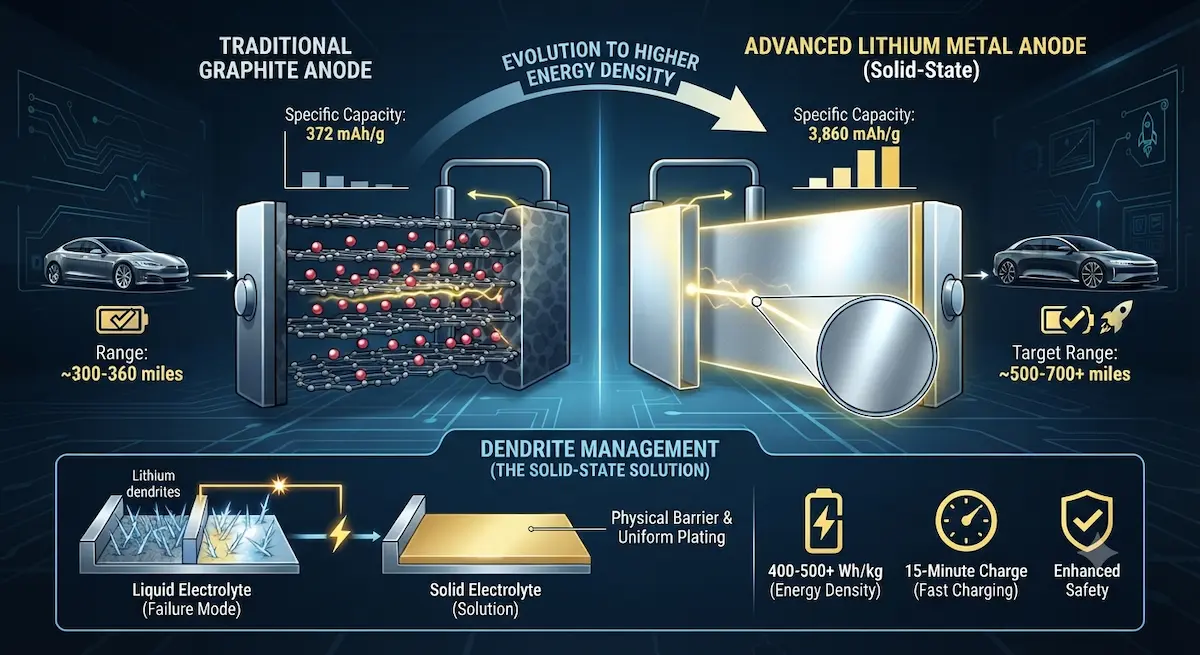
A lithium metal anode battery uses a thin sheet or in-situ plated layer of pure lithium metal as the negative electrode — rather than graphite or silicon. Lithium metal stores 10x more energy per gram than graphite (3,860 mAh/g vs 372 mAh/g) and is the foundation of both solid-state battery technology and advanced lithium metal liquid electrolyte cells. It is the ultimate high-energy-density anode concept — but managing the formation of lithium dendrites (needle-like lithium growths that cause short circuits) has been the defining engineering challenge that has prevented lithium metal anodes from being used in commercial EVs until solid-state electrolyte solutions are sufficiently mature.
This is the same dendrite risk that also affects intermediate technologies — see our explainer on what lithium dendrite growth is and why it’s dangerous.
What Is a Lithium Metal Anode?
A lithium metal anode uses elemental lithium (Li⁰) — the same element that travels as ions (Li⁺) through the electrolyte during charging — as the physical anode material. There are two implementation approaches:
- Pre-formed lithium metal foil: A thin sheet of metallic lithium is laminated to the current collector as the anode. Used in some experimental cells and early solid-state designs.
- Anode-free design: No physical lithium anode exists before the first charge. During the first charge, lithium ions plate onto the current collector (typically copper) and form the lithium metal anode in-situ. This is QuantumScape’s approach — simplifying manufacturing by eliminating the need to handle reactive lithium metal before cell assembly.
In both cases, the key advantage is lithium metal’s extraordinary theoretical capacity of 3,860 mAh/g — 10x graphite’s 372 mAh/g. Combined with the elimination of the graphite anode’s weight and volume, lithium metal anodes enable the 400–500+ Wh/kg energy densities that solid-state batteries target — roughly 2x current production NMC 811 cells.
Why Lithium Metal Anodes Are Dangerous in Liquid Electrolyte
Lithium metal is chemically very reactive — it reacts spontaneously with virtually all liquid electrolyte components. When lithium metal contacts the organic carbonate solvents used in current liquid electrolyte batteries, it forms a thick, resistive, and chemically complex SEI layer that is far less stable than the SEI on graphite. This liquid electrolyte-lithium metal reaction consumes lithium and electrolyte continuously — rapidly degrading capacity. More critically, when lithium deposits on a lithium metal anode during charging, it doesn’t deposit uniformly. Instead, lithium preferentially plates in certain areas — creating small protrusions that grow into dendrites: needle-like structures of lithium metal extending through the electrolyte toward the cathode.
If a dendrite grows long enough to bridge the gap between anode and cathode, it creates an internal short circuit — generating heat that can trigger thermal runaway. This dendrite growth mechanism is why lithium metal batteries — despite being commercialized in single-use primary batteries — have never been successfully commercialized in rechargeable EV batteries using liquid electrolyte. The 1980s saw several attempts at rechargeable lithium metal batteries; all failed due to dendrite-induced short circuits and fires after a relatively small number of charge cycles.
How Solid Electrolytes Suppress Dendrites
Solid electrolytes were initially believed to mechanically block dendrite growth — being physically rigid enough that lithium dendrites couldn’t propagate through them. Research from 2017 onward (particularly from Stanford and MIT) showed this assumption was overly optimistic: lithium dendrites can actually propagate through grain boundaries and defects in ceramic solid electrolytes under typical charging conditions. However, the same research identified solutions:
- Stack pressure: Applying mechanical pressure to the cell assembly (typically 1–10 MPa) reduces void formation at the lithium-electrolyte interface and suppresses dendrite nucleation by keeping the lithium surface in intimate contact with the electrolyte at all points
- Dense, defect-free electrolyte films: Solid electrolytes with near-zero porosity and no grain boundaries (achieved through advanced sintering or thin-film deposition) mechanically block dendrite propagation more effectively
- Anode-free design: By plating lithium onto a smooth, flat current collector (QuantumScape’s approach) rather than onto a pre-formed rough lithium surface, lithium deposition is more uniform — reducing dendrite nucleation sites
- Electrolyte-lithium interface engineering: Artificial SEI layers created by pre-treating the current collector with specific coatings promote uniform lithium deposition
Lithium Metal Anode Performance Advantages
| Metric | Graphite Anode | Silicon-Carbon Composite | Lithium Metal Anode (target) |
|---|---|---|---|
| Specific capacity | 372 mAh/g | 600–2,000 mAh/g | 3,860 mAh/g |
| Cell energy density (cell) | ~200–260 Wh/kg (NMC) | ~240–350 Wh/kg (NMC) | ~400–500+ Wh/kg (target) |
| EV range (sedan, same pack) | ~300–360 miles | ~370–480 miles | ~500–700+ miles (target) |
| Dendrite risk (liquid) | Low (managed with BMS) | Low (graphite-like behavior) | High — requires solid electrolyte |
| Volume expansion | ~10% (benign) | ~50–150% (managed) | ~100% (but no intercalation limit) |
| Commercial EV use | Universal now | Entering 2026 | 2027–2030 (solid-state only) |
Who Is Commercializing Lithium Metal Anode Batteries?
Every solid-state battery program targeting commercial EV deployment uses lithium metal anodes — the energy density benefit is the primary justification for solid-state development’s enormous cost and complexity:
- QuantumScape: Anode-free design (lithium plates in-situ during first charge) with LLZO oxide ceramic solid electrolyte. Demonstrated 15-minute charging at 800+ cycles in automotive validation cells. Commercial deployment targeted 2028+ with VW/PowerCo.
- Toyota: Pre-formed lithium metal anode with sulfide-based solid electrolyte. Targeting 620+ miles range and 10-minute charging in 2027–2028 commercial production.
- Samsung SDI: Lithium metal anode with sulfide electrolyte. BMW collaboration for automotive deployment. Targeting 2027.
- Solid Power: Lithium metal anode with sulfide electrolyte. BMW and Ford collaboration. Pilot production in 2025, automotive validation through 2026–2027.
- Factorial Energy: Lithium metal anode — partnered with Mercedes-Benz, Stellantis, and Hyundai/Kia. Semi-solid electrolyte approach targeting 2026–2027 pilot vehicles.
Lithium Metal Anode in Non-EV Applications Today
While lithium metal anodes await solid-state electrolytes for EV use, they are already commercialized in specific high-value applications where weight is critical, and cycle count requirements are modest:
- Military applications: Lightweight lithium metal primary (non-rechargeable) batteries power communication equipment, night-vision devices, and other military electronics where energy density per kilogram is critical, and replacement is practical
- Medical devices: Some implantable devices (pacemakers, defibrillators) use lithium metal primary batteries — the high energy density enables smaller devices with longer service intervals
- Aerospace and defense: Rechargeable lithium metal with specialized ionic liquid or solid electrolytes in some niche applications
- See our full guide on what a silicon anode battery is, the intermediate step most EVs are taking before lithium metal
Frequently Asked Questions
What is a lithium metal anode battery?
A lithium metal anode battery uses pure lithium metal (Li⁰) as the negative electrode instead of graphite. Lithium metal stores ~10x more energy per gram (3,860 vs 372 mAh/g), enabling 400–500+ Wh/kg energy density in combination with high-energy cathodes — the target for solid-state batteries. Dendrite formation in liquid electrolyte environments has prevented commercial EV use, making solid-state electrolytes the critical enabler for lithium metal anode EVs.
Why are lithium metal anodes not used in current EVs?
Lithium metal reacts aggressively with liquid electrolytes, forming unstable SEI layers and growing dendrites — needle-like lithium growths that cause internal short circuits and thermal runaway. Liquid electrolyte environments cannot suppress this dendrite growth reliably over thousands of cycles. Solid electrolytes physically and chemically manage dendrite formation more effectively — which is why all current lithium metal anode EV programs are paired with solid-state electrolyte development.
When will lithium metal anode EVs be commercially available?
Toyota (2027–2028), QuantumScape (2028+), and Samsung SDI (2027) are the most advanced programs. Initial commercial deployment will be ultra-premium vehicles at high price points. Mainstream EV adoption of lithium metal anodes is a 2030–2033 timeline as manufacturing costs fall toward competitive levels with advanced liquid lithium-ion cells.
Conclusion
Lithium metal anodes represent the highest energy density electrochemical anode available — storing 10x more lithium per gram than graphite and enabling the 400–500+ Wh/kg cell energy density that solid-state batteries target. The dendrite problem that blocked lithium metal anodes in liquid electrolyte for decades is being addressed through solid electrolytes, stack pressure management, anode-free designs, and interface engineering. Every major solid-state battery program — Toyota, QuantumScape, Samsung SDI, Solid Power, Factorial — uses lithium metal anodes as the foundation for their energy density claims. When these solid-state batteries reach commercial production in 2027–2030, lithium metal anodes will finally deliver on a potential that has been understood since the 1980s — transforming EV range from good to extraordinary.
See the full head-to-head breakdown of the current intermediate step in our guide on silicon vs graphite anode: which is better for EVs.
