
What Are Zinc-Ion Batteries and Can They Power EVs?

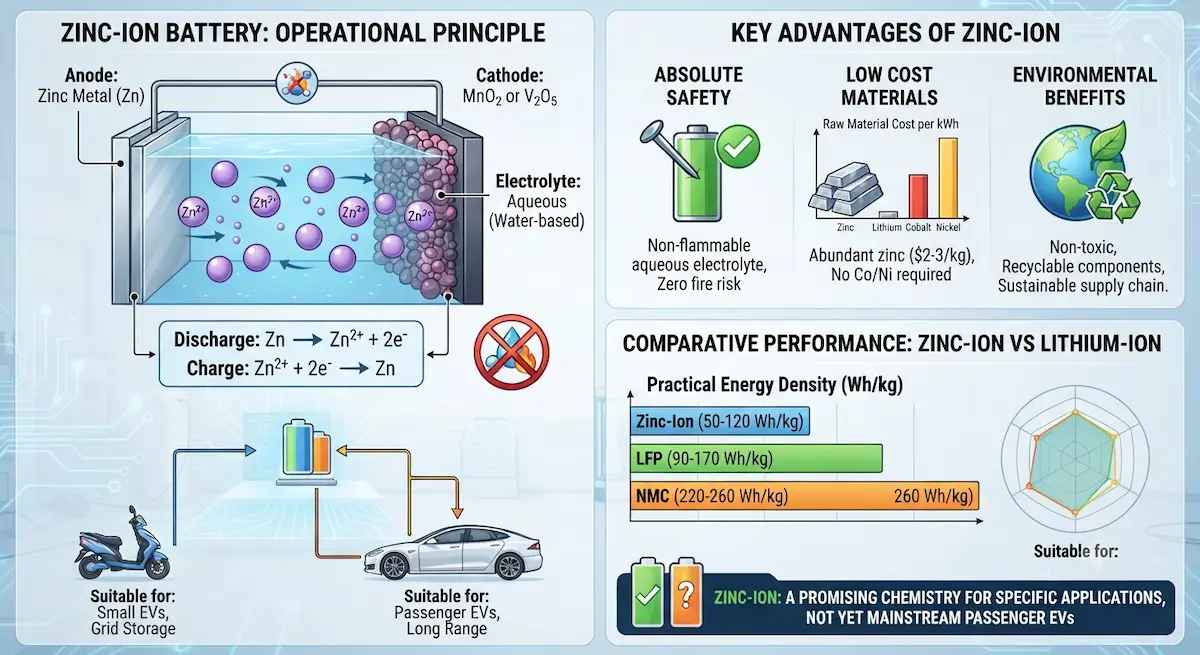
Zinc-ion batteries (ZIBs) are rechargeable batteries that use zinc metal as the anode and a water-based (aqueous) electrolyte to conduct zinc ions between electrodes during charging and discharging. They are among the safest, cheapest, and most environmentally benign battery chemistries under active development — with non-flammable aqueous electrolytes, abundant zinc raw materials, and no lithium, cobalt, or nickel required. However, zinc-ion batteries face significant challenges in energy density and cycle life that have prevented commercial EV deployment so far. As of 2026, zinc-ion batteries are commercially used in stationary grid storage and emerging in small EV applications (electric two- and three-wheelers in developing markets) — but cannot yet realistically power passenger EVs in mainstream consumer applications due to energy density limitations.
Another safe, low-cost metal-air chemistry chasing similar grid and early-EV niches is explored in our guide on what iron-air batteries are and whether they’re for EVs.
How Zinc-Ion Batteries Work
Zinc-ion batteries operate on a similar shuttling principle as lithium-ion — ions travel between cathode and anode through an electrolyte during charging and discharging. The key differences are in the choice of charge carrier and electrolyte:
- Anode: Zinc metal (Zn) — zinc is oxidized during discharge (Zn → Zn²⁺ + 2e⁻), releasing two electrons per zinc atom compared to lithium’s one. This divalent charge carrier gives zinc higher theoretical charge per atom but creates different intercalation chemistry.
- Cathode: Typically manganese dioxide (MnO₂), vanadium oxide (V₂O₅), or other zinc-compatible cathode materials that can reversibly accommodate Zn²⁺ ions
- Electrolyte: Aqueous (water-based) — typically zinc sulfate (ZnSO₄) or zinc bis(trifluoromethanesulfonyl)imide (Zn(TFSI)₂) dissolved in water. This water-based electrolyte is the technology’s defining safety advantage — water is inherently non-flammable, eliminating the primary fire risk of organic-solvent lithium-ion batteries
During discharge, zinc atoms at the anode dissolve as Zn²⁺ ions, travel through the aqueous electrolyte, and intercalate into the cathode. During charging, the process reverses — Zn²⁺ ions de-intercalate from the cathode and plate back onto the zinc metal anode. The aqueous electrolyte’s safety advantage is profound: no flammable organic solvents means no fire risk even in severe damage scenarios. Zinc-ion batteries pass nail penetration and crushing tests without fire or explosion that would cause NMC batteries to ignite dramatically.
Zinc-Ion Advantages That Are Compelling
- Absolute safety: Aqueous electrolytes are non-flammable under any conditions. This eliminates thermal management systems for fire prevention — a significant cost and weight reduction. The thermal management system required in lithium-ion EVs (liquid cooling, fire-suppression, BMS monitoring) can be dramatically simplified with zinc-ion chemistry.
- Low cost: Zinc costs approximately $2–3/kg — far cheaper than lithium carbonate ($15,000–80,000+/tonne), nickel ($16–18/kg), or cobalt ($30–40/kg). The aqueous electrolyte eliminates expensive LiPF₆ salt and organic solvents. Total material cost per kWh is potentially dramatically lower than any lithium-ion chemistry.
- Environmental advantages: Zinc is non-toxic, abundantly available, and has a well-established recycling industry (galvanizing, alloys). Aqueous electrolytes contain no toxic organic compounds. A fully spent zinc-ion battery has a significantly lower environmental footprint than NMC during both production and end-of-life.
- Abundant supply chain: Zinc is produced globally in large quantities — approximately 13 million tonnes per year — with no supply chain concentration comparable to lithium’s Chile/Australia/China dependence or cobalt’s DRC dependence.
- Compatibility with water-sensitive environments: Zinc-ion batteries can potentially be used in underwater, high-humidity, or outdoor environments where liquid lithium-ion batteries require extensive moisture protection.
Zinc-Ion Current Limitations for EV Applications
Energy Density Gap
Current aqueous zinc-ion battery cells achieve practical energy densities of approximately 50–120 Wh/kg — well below even LFP’s 90–170 Wh/kg and far below NMC 811’s 220–260 Wh/kg. The fundamental energy density limitation comes from two factors. First, zinc ions (Zn²⁺) are larger and heavier than lithium ions (Li⁺), requiring more mass to achieve equivalent charge transport. Second, aqueous electrolytes have a narrow electrochemical stability window (~1.23V for water decomposition) — limiting cell voltage to approximately 1.2–1.8V vs lithium-ion’s 3.2–4.2V. Since energy density scales with voltage squared relative to lithium-ion, the narrow voltage window creates a fundamental energy density disadvantage that materials innovation cannot fully overcome. A practical 150-mile EV using zinc-ion would require a battery pack weighing 3–4 times more than an equivalent NMC pack — adding hundreds of kilograms to vehicle weight, negating efficiency gains, and increasing chassis cost.
Zinc Dendrite Formation
Like lithium metal, zinc metal deposits unevenly during charging — forming dendrites that grow through the electrolyte toward the cathode. In aqueous electrolytes, zinc dendrites grow more slowly than lithium dendrites and are less catastrophically dangerous (no fire risk from aqueous electrolyte), but they still cause progressive capacity loss and eventual internal short circuits after many cycles. Managing zinc dendrite formation through electrolyte engineering (zinc salt selection, additive packages) and three-dimensional anode designs is one of the primary research directions in zinc-ion battery development. The University of Adelaide’s decoupled dual-salt electrolyte (DDSE) approach — using two different zinc salts with complementary functions — showed significant improvement in dendrite suppression and temperature range performance in 2025 research.
Cycle Life Limitations
Current zinc-ion cells typically achieve 500–2,000 cycles before significant capacity loss, depending on design and cycling conditions. This is improving — some research cells have demonstrated over 5,000 cycles with advanced electrolyte formulations — but standard production zinc-ion cells do not yet match the 2,000–5,000+ cycles LFP achieves routinely. For high-cycle commercial fleet applications (taxis, buses, delivery vehicles), zinc-ion’s cycle life limitations impose more frequent battery replacement and higher total cost of ownership than LFP despite lower upfront cost.
Where Zinc-Ion Batteries Are Being Deployed
While zinc-ion batteries are not ready for mainstream passenger EV applications, they are finding commercial deployment in specific scenarios that play to their strengths:
- Grid-scale energy storage: Weight and energy density are irrelevant; cost per kWh and safety are primary. Zinc-ion’s low cost and fire-free operation make it genuinely competitive for utility-scale stationary storage. Aquion Energy planned a 1 GWh zinc-ion factory in Pennsylvania for 2025 production targeting stationary storage markets.
- Electric two- and three-wheelers in developing markets: Smaller vehicles, shorter range requirements, lower energy density tolerance. A research review in Communications Materials found zinc-air batteries achieving 140–200 Wh/kg practical in two and three-wheeler EV applications in India and Southeast Asia — adequate for 60–100 km range where that is the primary use case. Zinc-based batteries at the cost of lead-acid (currently used) with improved performance represent a compelling upgrade path in these markets.
- Delivery robots, drones, and logistics: Short-range applications where the safety and cost advantages outweigh energy density limitations
- Backup and UPS power systems: Non-flammable, low-cost zinc-ion or zinc-air for indoor building power backup where LFP fire risk requires expensive suppression systems
Zinc-Ion vs Lithium-Ion: Where Each Wins
| Factor | Zinc-Ion | LFP | NMC 811 |
|---|---|---|---|
| Energy density | ~50–120 Wh/kg (low) | ~90–170 Wh/kg | ~220–260 Wh/kg (highest) |
| Safety | Excellent — non-flammable aqueous | Very good | Good but flammable electrolyte |
| Cost (materials) | Potentially lowest ($2–3/kg Zn) | Low ($81/kWh pack) | High ($128/kWh pack) |
| Cycle life | 500–2,000+ cycles (improving) | 2,000–5,000+ | 1,000–2,500 |
| Operating temp | Good — aqueous allows wide range | Poor in cold | Moderate in cold |
| Fire risk | Zero — non-flammable electrolyte | Very low | Low with cooling; higher without |
| Cobalt/Nickel/Lithium | None required | Lithium only, no Co/Ni | All three required |
| Commercial EV use | Two/three-wheelers, grid storage | Mass market passenger EVs | Mass market passenger EVs |
The Research Frontier: Pushing Zinc-Ion Energy Density Higher
Academic research on zinc-ion batteries is advancing rapidly. Key directions in 2025–2026 include:
- High-voltage non-aqueous zinc-ion: Using organic electrolytes (similar to lithium-ion but with zinc salt) to escape water’s 1.23V stability window and achieve higher cell voltages — potentially reaching 2.5–3.0V per cell and significantly better energy density. The challenge is zinc metal’s compatibility with organic solvents is more complex than with aqueous systems.
- Zinc-sulfur batteries: Pairing zinc anodes with sulfur cathodes — combining zinc’s safety advantages with sulfur’s high theoretical capacity (~1,675 mAh/g). Case Western Reserve University researchers improved zinc-sulfur capacity 20% with two electrolyte additives in 2024 research.
- 3D zinc anode architectures: Three-dimensional porous zinc anode structures that provide more uniform zinc deposition and suppress dendrites — directly addressing the primary cycle life limitation. See our full explainer on a much higher-density (but still lab-stage) air-cathode chemistry: what a lithium-air battery is
Frequently Asked Questions
What are zinc-ion batteries and can they power EVs?
Zinc-ion batteries use zinc metal as the anode and water-based (aqueous) electrolyte — offering non-flammable operation, low cost ($2–3/kg zinc), and no lithium, cobalt, or nickel requirement. Current practical energy density of 50–120 Wh/kg is too low for mainstream passenger EVs (which need 150–260+ Wh/kg). Zinc-ion is commercially deployed in grid storage and electric two/three-wheelers in developing markets where its safety and cost advantages dominate over energy density limitations.
Why don’t EVs use zinc-ion batteries instead of lithium-ion?
The primary barrier is energy density — zinc-ion cells achieve 50–120 Wh/kg vs NMC’s 220–260 Wh/kg. An EV using zinc-ion would need a battery pack 2–4x heavier than NMC for equivalent range — impractical for most passenger vehicles. The aqueous electrolyte’s limited voltage window (1.2–1.8V vs lithium-ion’s 3.2–4.2V) creates a fundamental energy density ceiling that materials innovation cannot fully overcome at the physics level. Zinc-ion will remain a grid storage and low-speed EV chemistry rather than a passenger car technology for the foreseeable future.
Are zinc-ion batteries safer than lithium-ion?
Yes — categorically safer in fire terms. The water-based electrolyte is inherently non-flammable, eliminating the primary fire risk in lithium-ion batteries. Zinc-ion batteries pass nail penetration and crush tests without fire or explosion. This absolute fire safety makes zinc-ion highly attractive for indoor stationary storage, building backup power, and applications where thermal management systems would be impractical — even at the cost of lower energy density.
Conclusion
Zinc-ion batteries offer genuinely compelling advantages — non-flammable aqueous electrolytes, low raw material costs, abundant zinc supply, and no lithium/cobalt/nickel requirements. Their commercial deployment in grid storage and two/three-wheeler EVs in developing markets demonstrates real-world viability in applications where their strengths dominate. The energy density gap (50–120 Wh/kg vs NMC’s 220–260 Wh/kg) and cycle life limitations prevent mainstream passenger EV use — not as a temporary manufacturing maturity issue but as a fundamental physics constraint of aqueous, low-voltage chemistry. Zinc-ion’s commercial future lies in the vast grid storage market, cost-sensitive two-wheeler markets, and specialized safety-critical applications — while lithium-ion and eventually solid-state batteries power mainstream passenger EVs. Both technologies will coexist in a multi-chemistry energy storage future.
Curious about another emerging cell architecture entirely? See our explainer on what a dual-ion battery chemistry is.
