
LFP vs NCA Battery: Which Has More Range?

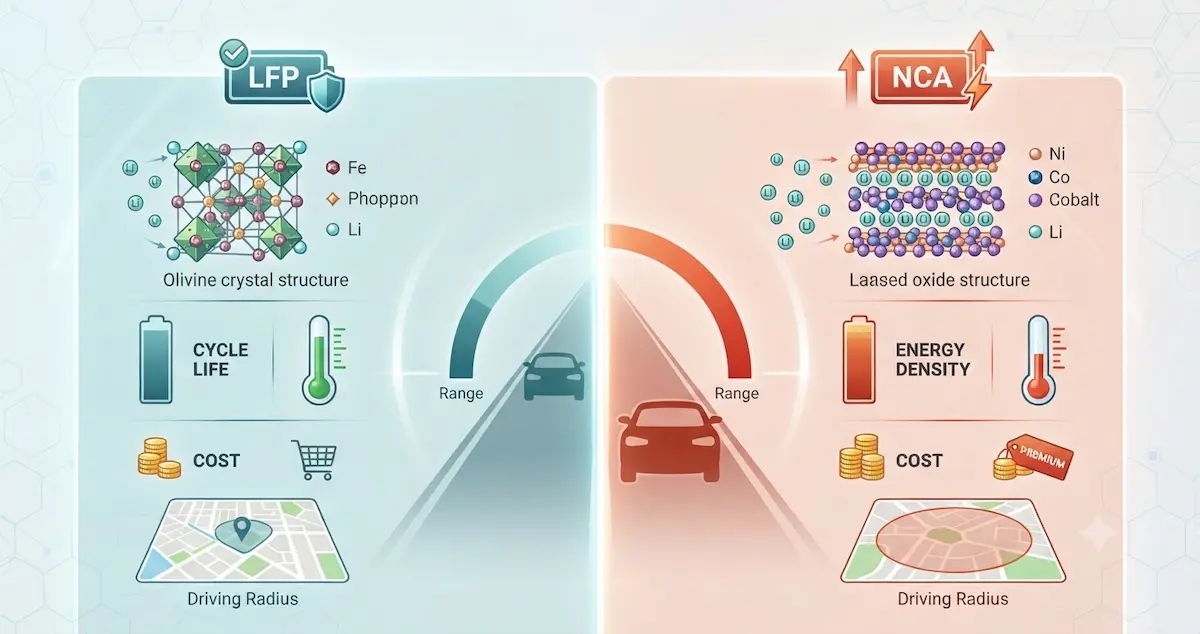
LFP (Lithium Iron Phosphate) and NCA (Nickel Cobalt Aluminum) are at opposite ends of the EV battery chemistry spectrum — LFP prioritizes safety, longevity, and low cost; NCA prioritizes maximum energy density and range. In a direct range comparison, NCA wins decisively: Tesla’s NCA-powered Model S achieves 405 miles EPA range while comparable LFP vehicles achieve 250–300 miles EPA from similar-size packs. However, for driving ranges below 300 miles where LFP is competitive, the range-per-dollar advantage shifts strongly toward LFP — and LFP’s superior safety, cycle life, and charging simplicity make it the better chemistry for all but the highest-range premium applications.
New to either chemistry? Start with our explainers on what LFP battery chemistry is and what NCA battery chemistry is.
LFP vs NCA: Full Chemistry Comparison
| Property | LFP | NCA |
|---|---|---|
| Full name | Lithium Iron Phosphate | Lithium Nickel Cobalt Aluminum |
| Cathode formula | LiFePO₄ (olivine structure) | LiNiCoAlO₂ (layered oxide) |
| Cell energy density | 90–170 Wh/kg | 220–322 Wh/kg (Panasonic/Tesla: ~322) |
| Pack energy density | 120–165 Wh/kg (with CTP design) | 200–260 Wh/kg |
| Cell voltage | ~3.2V nominal | ~3.6–3.65V nominal |
| Cycle life (to 80%) | 2,000–5,000+ | 1,000–2,000 |
| Thermal runaway onset | ~270°C | ~180–210°C |
| Pack cost (2025) | ~$81/kWh | ~$130–150/kWh |
| Daily charge recommendation | 100% (recommended) | 80–90% max |
| Cold weather performance | Poor — 30%+ range loss at -20°C | Better — 15–25% range loss at -20°C |
| Cobalt content | Zero | ~15% |
| Nickel content | Zero | ~80–85% |
| Primary commercial users | Tesla Standard Range, BYD, CATL mainstream | Tesla Model S, Model X (Panasonic cells) |
Range Comparison: Real EPA Numbers
NCA’s energy density advantage (322 Wh/kg at cell level for Panasonic NCA) vs LFP (90–170 Wh/kg) translates directly to range difference in real vehicles:
- Tesla Model S Long Range (NCA, ~100 kWh pack): 405 miles EPA — the longest-range production EV globally
- Tesla Model S Plaid (NCA, ~100 kWh pack): 396 miles EPA
- Tesla Model 3 Standard Range (LFP, ~60 kWh pack): 272 miles EPA
- Tesla Model Y Standard Range (LFP, ~60 kWh pack): 260 miles EPA
- BYD Atto 3 (LFP, 60.5 kWh): ~260 km / 162 miles EPA-equivalent (market-dependent figures)
- Model 3 Long Range (NCA, ~82 kWh): 358 miles EPA — comparison shows ~30–40% more range with NCA than LFP in same body size
The range gap between NCA and LFP in equivalent vehicle platforms is approximately 30–50% — consistent with the energy density difference between the chemistries at the pack level (accounting for pack design optimization). For vehicles targeting 400+ miles, NCA is essentially the only practical chemistry among current production options. For 250–300 miles targets, advanced LFP Cell-to-Pack designs are increasingly competitive.
Where LFP Wins Over NCA
Despite NCA’s decisive energy density advantage, LFP is a significantly better choice for many real-world EV buyers:
- Lower cost: LFP at $81/kWh vs NCA at $130–150/kWh — a 37–46% cost advantage that translates to $4,000–8,000 lower vehicle price for equivalent battery size. For budget-conscious buyers, this cost advantage is often worth a 50-mile range reduction.
- Superior safety: LFP’s thermal runaway onset at 270°C vs NCA’s 180–210°C provides a much larger safety margin. LFP cathodes release no oxygen under thermal stress, while NCA releases oxygen — eliminating the self-sustaining fire reaction. LFP passes nail penetration and crush tests that NCA fails.
- Better cycle life: LFP lasts 2,000–5,000+ cycles vs NCA’s 1,000–2,000. For commercial fleet operators (taxis, delivery vehicles), this cycle life advantage is worth far more than the range gap.
- Simpler charging: LFP can be charged to 100% daily without capacity degradation — eliminating the 80% daily limit management that NCA requires. For drivers without home charging who depend on public DC fast chargers, LFP’s ability to maximize each charge is operationally simpler.
- No cobalt or nickel: LFP’s zero cobalt and zero nickel composition eliminates supply chain risk, ethical concerns about DRC mining, and the price volatility of transition metals that affects NCA manufacturing cost.
The Cold Weather Paradox: LFP’s Biggest Practical Disadvantage
LFP’s poor cold-weather performance is its most significant real-world limitation vs NCA. At -20°C (-4°F), LFP loses approximately 30–40% of rated range vs NCA’s 15–25%. For a Minnesota driver with a 260-mile LFP EV, a -20°F January morning can reduce effective range to approximately 156–182 miles — tight for drivers with longer commutes or less frequent charging access. The same NCA EV at 400 miles would retain 300–340 miles — comfortably adequate in any winter scenario. This cold-weather gap explains why LFP dominates in moderate climates (California, Texas, South Korea, China’s south) while NMC and NCA remain preferred in cold climates (Minnesota, Michigan, Scandinavia, Canada).
For NCA’s other real tradeoffs beyond cost, see our full breakdown of the downsides of NCA batteries.
Who Should Choose LFP vs NCA?
| Buyer Profile | Better Choice | Primary Reason |
|---|---|---|
| Budget-conscious buyer (under $45K EV) | LFP | $4,000–8,000 cheaper; 260–280 miles adequate |
| Premium buyer wanting maximum range | NCA | 405-mile range impossible with LFP today |
| Commercial fleet (taxi, delivery) | LFP | Cycle life and cost dominate; range per trip acceptable |
| Cold climate driver (below -10°C winters) | NCA or NMC | LFP’s 30%+ winter range loss vs NCA’s 15–25% |
| Hot climate driver (Arizona, Texas) | LFP | No cobalt/nickel degradation risk; safer thermal profile |
| Frequent road tripper (300+ mi single leg) | NCA/NMC | Fewer charging stops; more range buffer |
Frequently Asked Questions
Does LFP have more range than NCA?
No — NCA has significantly more range than LFP in comparable vehicles. NCA’s 220–322 Wh/kg cell energy density vs LFP’s 90–170 Wh/kg means NCA stores 50–80% more energy per kilogram of battery. The Tesla Model S Long Range (NCA) achieves 405 miles vs comparable LFP vehicles at 250–300 miles — a gap of 100–150 miles from the same pack size. The only way to close this gap with LFP is to use a significantly larger pack.
Is LFP safer than NCA?
Yes — significantly. LFP’s thermal runaway onset (~270°C) is 60–90°C higher than NCA’s (~180–210°C). LFP releases no oxygen under thermal stress, while NCA releases oxygen that sustains battery fires. LFP passes nail penetration tests that NCA fails. Both are dramatically safer than gasoline vehicles per mile driven, but LFP offers a meaningful safety margin advantage over NCA.
Does Tesla use LFP or NCA?
Tesla uses both. Standard Range Model 3 and Model Y use LFP (from CATL and BYD) globally. Long Range and Performance Model 3 and Model Y in the U.S. use NCA (from Panasonic in Nevada). Model S and Model X exclusively use NCA. The Cybertruck uses 4680 format NMC cells manufactured in-house at Gigafactory Texas.
Conclusion
LFP vs NCA range comparison has a clear winner by chemistry: NCA delivers 50–80% more range per kilogram of battery, enabling the 400+ mile range that LFP cannot match in standard-size packs. But range is not the only metric that matters. LFP’s dramatically lower cost, superior safety, better cycle life, simpler charging, and zero cobalt/nickel requirements make it the better chemistry for the majority of EV buyers who don’t need 400-mile range and would benefit from a more affordable, safer, longer-lasting battery. NCA belongs in premium long-range vehicles where maximum miles-per-charge is the primary buyer priority. LFP belongs everywhere else — which is why it now accounts for more than 50% of global EV battery deployments despite NCA’s undeniable energy density advantage.
Curious how NCA stacks up against its closest chemical cousin instead? See our comparison of NCA vs NMC battery: key differences.
