
What Battery Chemistry Does Rivian Use?

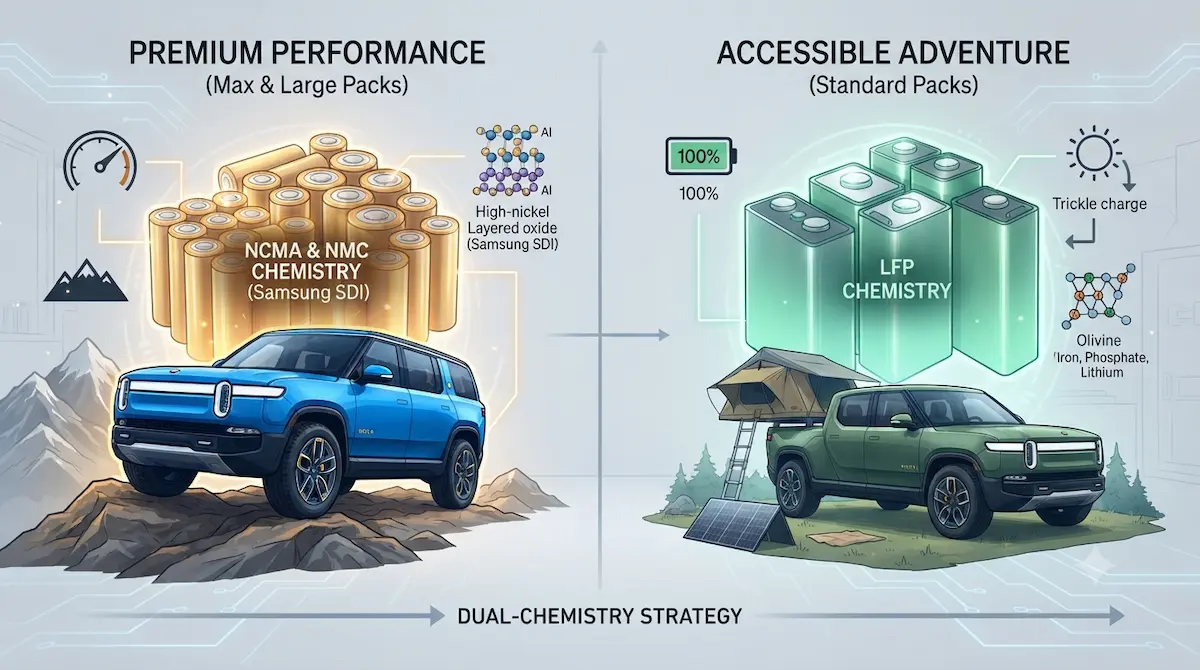
Rivian uses a dual-chemistry battery strategy: NMC or NCMA (Nickel Cobalt Manganese Aluminum) from Samsung SDI for Large and Max Pack variants of the R1T and R1S, and LFP (Lithium Iron Phosphate) for Standard and Standard+ packs.
The newer R2 uses next-generation 4695 cylindrical cells from LG Energy Solution. This chemistry split reflects Rivian’s deliberate effort to serve both premium buyers who prioritize maximum range and cost-conscious buyers who prefer lower prices and simpler charging — within the same vehicle platforms. Understanding which Rivian pack uses which chemistry directly changes how you should charge, what range to expect in cold weather, and how battery longevity will perform over years of ownership.
New to NCMA chemistry itself? Start with our full explainer on what NCMA battery chemistry is and who uses it.
Quick answer Rivian uses two chemistries. The R1T and R1S run LFP in their Standard packs and nickel-rich NMC/NCMA (Samsung SDI 2170 cells) in Large and Max packs, while the R2 uses bigger 4695 cells from LG Energy Solution. Key figures: R1S Max Pack — 140 kWh usable, 410 miles EPA, 70% daily charge limit; R2 launch pack — 87.9 kWh usable, about 330 miles EPA; LFP Standard packs charge to 100% daily.
Rivian Battery Chemistry by Pack (2025–2026)
| Model / Pack | Chemistry | Cell Format | Supplier | Daily Charge Limit | EPA Range (est.) |
|---|---|---|---|---|---|
| R1T / R1S Standard (Gen 2) | LFP | Prismatic | Undisclosed | 100% recommended | ~270 miles |
| R1T / R1S Standard+ (Gen 2) | LFP | Prismatic | Undisclosed | 100% recommended | ~315 miles |
| R1T / R1S Large Pack (Dual) | NMC | 2170 cylindrical (53G) | Samsung SDI | 70% daily | ~350–380 miles |
| R1T / R1S Max Pack | NCMA (~89% Ni + Al) | 2170 cylindrical (53G) | Samsung SDI | 70% daily (Rivian recommends) | ~410 miles |
| R2 (launched June 2026) | Nickel-rich (reported NCMA) | 4695 large cylindrical | LG Energy Solution | TBD | ~330 miles (87.9 kWh usable) |
| Amazon EDV delivery van | LFP | Cylindrical | Multiple suppliers | 100% | Fleet use |
Rivian’s NMC/NCMA Chemistry: Samsung SDI Partnership
Rivian’s primary performance battery partnership is with Samsung SDI — supplying 2170-format cylindrical cells (21mm diameter, 70mm height) for the Large and Max packs of both the R1T pickup and R1S SUV. The Gen 2 Rivian refresh uses Samsung SDI’s upgraded “53G” cells — an advanced 2170-format cell with significantly higher energy density vs the original 50G cells used in Gen 1 vehicles. Moving from 50G to 53G increased the Max Pack’s total energy content by approximately 8.5 kWh at the same cell count — delivering meaningful range gains without changing cell format or pack architecture.
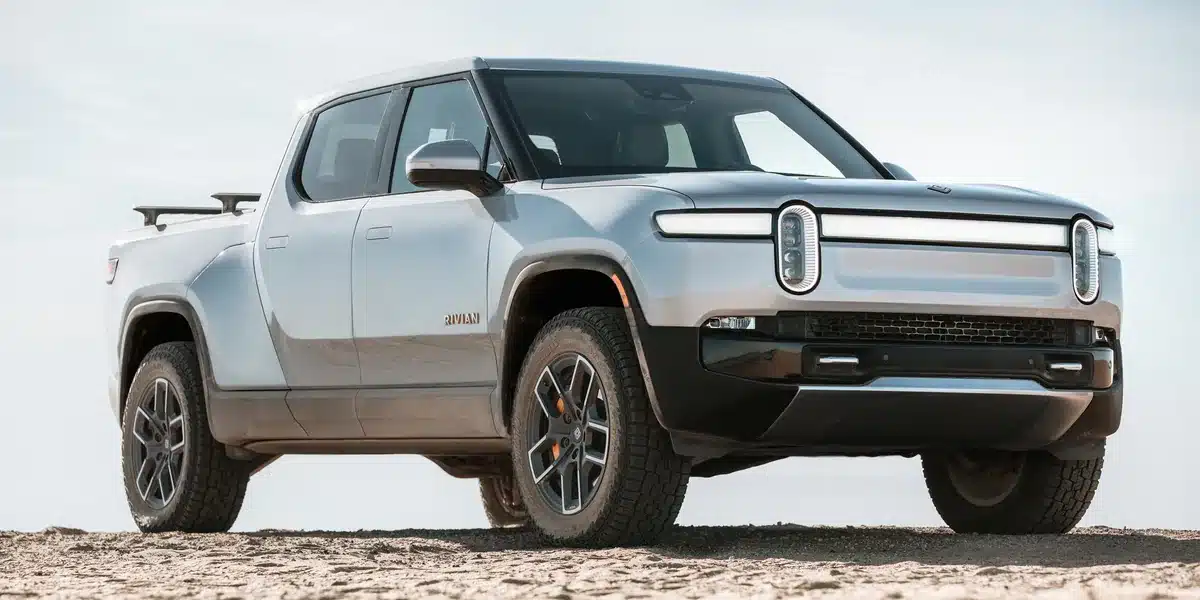
The 2025 R1S Max Pack uses NCMA (Nickel Cobalt Manganese Aluminum) chemistry — approximately 89% nickel with aluminum stabilization. The aluminum substitution stabilizes the ultra-high-nickel cathode at higher nickel content than standard NMC 811 (80% Ni), enabling cell energy density of approximately 250–280 Wh/kg. This powers the R1S Max Pack’s 140 kWh usable capacity and the 410-mile EPA range — placing it among the longest-range production SUVs globally as of 2026.
Rivian recommends setting the daily charge limit to 70% for Max Pack NCMA batteries — more conservative than the 80% most NMC EV brands recommend. This reflects NCMA’s higher sensitivity to voltage-induced degradation at ultra-high nickel content. The recommendation is practical, not limiting: 70% of 140 kWh provides 98 kWh of accessible charge — more than the full pack of most mainstream EVs, enough for 280+ miles of real-world driving before needing to charge.
Why NCMA Outperforms Standard NMC 811
The chemistry difference between Rivian’s NCMA and the standard NMC 811 used by Hyundai, BMW, and others is meaningful for real-world performance. NMC 811 uses 80% nickel, 10% manganese, 10% cobalt. NCMA uses approximately 89% nickel, 5% cobalt, 5% manganese, and 1% aluminum. The higher nickel content directly increases cathode capacity — more lithium ions can be stored per gram of cathode material, delivering higher energy density at the cell level. The aluminum substitution for some manganese stabilizes the crystal structure at this extreme nickel content, preventing some of the phase transition behavior that accelerates degradation in very high nickel cells without aluminum.
This is why the R1S Max Pack achieves 410-mile EPA range while competing NMC 811 SUVs (Hyundai Ioniq 5, BMW iX) typically achieve 250–300 miles from similar-size packs. NCMA’s energy density is on par with the best NMC 811, and the aluminum’s real contribution is stability at very high nickel content.
Rivian’s LFP Standard Packs: Charging Simplicity and Longevity
The Gen 2 Rivian refresh introduced LFP chemistry in Standard and Standard+ pack variants — a strategic move to offer more accessible price points while maintaining full Rivian adventure capability. LFP chemistry advantages for Standard pack Rivian owners are distinct and genuinely compelling:
- Charge to 100% daily: LFP batteries handle full daily charging without significant degradation — Rivian actively recommends this for Standard pack owners. This maximizes available range every day without the management overhead of NMC/NCMA’s 70–80% daily limit.
- Lower purchase cost: LFP’s approximately $81/kWh vs NCMA’s approximately $125–140/kWh contributes to a meaningfully lower starting price for Standard pack configurations, making Rivian accessible to a broader range of buyers.
- Superior cycle life: LFP’s 2,000–5,000+ cycles vs NCMA’s roughly 1,500–2,000 is particularly valuable in a truck like the R1T that may see high-mileage commercial or frequent off-road use where pack cycling is intensive.
- Better safety margin for off-road use: LFP’s ~270°C thermal runaway onset vs NCMA’s ~195–210°C provides meaningful additional safety margin for off-road scenarios where pack damage from rock strikes or trail debris is a realistic risk.
- Solar charging compatibility: LFP’s ability to accept trickle charging all the way to 100% makes it ideal for drip-charging from roof-mounted solar panels during multi-day overlanding trips — a core Rivian use case that matches LFP’s charge behavior perfectly.
Standard pack range is about 270 miles EPA for the R1S Standard and about 315 miles for the Standard+ — sufficient for the vast majority of adventure and daily driving needs. The main compromise is that very long road trips with legs beyond 250 miles require more frequent charging stops compared to the Max Pack.
New to LFP itself? See our full explainer on what LFP battery chemistry is in electric cars.
Cold Weather Performance: Chemistry Matters for Mountain Driving
For Rivian owners who adventure in cold climates — a core buyer profile — the chemistry difference in cold weather creates real range differences that matter in the field. At -20°C (-4°F), NMC/NCMA retains approximately 75–85% of rated capacity while LFP retains approximately 65–80%.
Practical examples for a Rivian owner in Montana in January at -20°C:
- R1S Max Pack NCMA (410 miles rated): 75–85% retention = 308–349 miles effective range — comfortably covers most mountain driving scenarios with adequate buffer
- R1S Standard LFP (270 miles rated): 65–80% retention = 176–216 miles effective range — adequate for most day trips but requires more careful planning for remote trail access where charging is 100+ miles away
The gap — roughly 90–130 miles in extreme cold — matters most for Rivian owners who regularly drive long mountain routes in winter where charging infrastructure is sparse. LFP Standard pack owners in cold climates should prioritize enabling preconditioning (warming the battery to 25°C before departure from home) and planning conservatively for 30–40% range reduction in extreme cold.
Read more: how EV battery preconditioning restores charging speed in the cold.
The Rivian R2: LG Energy Solution 4695 Large-Format Cells
The Rivian R2 — a mid-size SUV targeting broader market appeal at a lower price point than the full-size R1S — uses LG Energy Solution’s 4695 cylindrical cells (46mm diameter, 95mm height). Key R2 battery details:
- 67 GWh supply agreement signed with LG Energy Solution — one of the largest battery supply contracts for an EV startup, representing commitment to significant R2 production volumes
- 6x capacity per cell vs current 2170 cells as stated by LG Energy Solution at announcement — enabling higher energy density at the pack level through fewer, larger, better-utilized cells
- Deliveries beginning Spring 2026 with the R2 Performance (Launch Package) starting at $57,990
- Target range: 300+ miles — competitive with mainstream mid-size SUVs
- Chemistry: Presumed NMC based on LG Energy Solution’s cylindrical cell portfolio — Rivian has not publicly confirmed cathode chemistry
The 4695 large-format cylindrical cell (similar concept to Tesla’s 4680 but longer — 95mm vs 80mm height) reduces total cell count per pack, improves volume utilization, and lowers cell-to-pack assembly costs through fewer weld points and connections. This contributes to lower pack manufacturing cost — directly enabling the R2’s more accessible price point compared to the R1 lineup.
Deliveries of the R2 began on June 9, 2026, starting with the Performance Launch Package at $57,990 (plus $1,495 destination). Its launch pack holds 87.9 kWh usable for about 330 miles of EPA range. A Premium trim follows in late 2026, and the $45,000 Standard version is due in summer 2027. Rivian does not publish the R2’s cathode recipe; its LG Energy Solution 4695 cells are widely reported to use a nickel-rich NCMA chemistry.
Read more: the Rivian R2 battery complete guide.
Why Rivian Chose Cylindrical Cells
Rivian’s use of cylindrical cells (for NMC/NCMA packs and R2) vs the prismatic blade design used by BYD or the pouch cells used by GM reflects specific advantages for an adventure-focused truck platform:
- Mechanical robustness: Cylindrical cells’ rigid steel casing withstands mechanical impacts from rock strikes, trail debris, and off-road abuse significantly better than pouch cells with their flexible aluminum-laminate packaging — directly relevant for a truck designed for demanding trail use and rock crawling
- Thermal management: Cylindrical cells allow intimate coolant contact around each cell’s full cylindrical surface, achieving excellent heat management for vehicles that may be pushed hard in extreme conditions or parked in severe cold during overnight camping
- Cell-level protection: Individual fuse connections in cylindrical cell pack architectures isolate any failed cell without cascading pack failure — particularly important in large packs like the 141.5 kWh Max Pack where managing individual cell failures safely is critical
- Proven automotive manufacturing: Samsung SDI and LG Energy Solution have decades of experience producing 2170 and large-format cylindrical cells at automotive quality and scale — reducing new technology risk in Rivian’s supply chain
Frequently Asked Questions
What battery chemistry does Rivian use?
Rivian uses two chemistries: NCMA (Nickel Cobalt Manganese Aluminum) from Samsung SDI 2170 cylindrical cells in Max Pack configurations, NMC from Samsung SDI for Large Pack, and LFP in prismatic cells for Standard and Standard+ packs. The R2 uses LG Energy Solution 4695 large cylindrical cells. Amazon delivery vans use LFP. Chemistry depends on the specific pack configuration selected.
Should I choose Rivian Standard (LFP) or Max Pack (NCMA)?
Standard LFP: lower price, 100% daily charging simplicity, better cycle life, stronger safety margin for off-road, solar charging compatible. Max Pack NCMA: 410 miles vs 270–315 miles rated range, better cold-weather retention (75–85% vs 65–80% at -20°C), required for quad motor (Gen 2) configurations. Choose Standard LFP if you drive under 200 miles daily and prioritize simplicity and cost. Choose Max Pack NCMA for long road trips, cold climate adventure driving, or maximum range assurance.
What cells does the Rivian R2 use?
The R2 uses LG Energy Solution 4695 cylindrical cells (46mm diameter, 95mm height) — large-format cells with approximately six times the capacity per cell vs current 2170 cells. R2 deliveries began in June 2026, with the Performance Launch Package at $57,990, targeting 300+ miles of range. LG Energy Solution signed a 67 GWh multi-year supply agreement for these cells, representing one of the largest battery commitments to an EV startup globally.
Who makes Rivian’s batteries?
Samsung SDI supplies the 2170 NCMA cells for the R1 Large and Max packs. The R2’s 4695 cells come from LG Energy Solution, under a five-year, 67 GWh deal, with the cells made in Arizona. Rivian has not named the supplier of its LFP Standard-pack cells.
Does the Rivian R2 use 4680 batteries?
No. The R2 uses LG’s larger 4695 cells — 46 mm wide and 95 mm tall — which hold roughly six times the energy of the 2170 cells in the R1 packs. Tesla’s 4680 is a different cell from a different maker.
Conclusion
Rivian’s dual-chemistry battery strategy — NCMA/NMC for maximum range and performance, LFP for cost efficiency, charging simplicity, and off-road safety — serves genuinely different buyer needs within the same R1 platform. Samsung SDI’s NCMA chemistry in the Max Pack delivers the 410-mile range and cold-weather resilience that make the R1S one of the most capable long-range EVs available.
LFP Standard packs bring the R1T and R1S to a more accessible price with 100% daily charging, exceptional cycle life, and better safety margins for demanding off-road use. The R2’s LG Energy Solution 4695 large-format cells extend Rivian’s reach into the more price-competitive mid-size SUV market. For Rivian buyers, chemistry choice is not technical trivia — it directly determines charging habits, winter range planning, and the ownership experience across years of ownership.
See the full six-factor framework behind decisions like this in our guide on how EV battery chemistry is chosen by automakers.
