
Jeep Avenger Electric Battery: Complete Guide

Researched from Jeep and Stellantis technical documents, EV Database measurements, Euro NCAP’s published test report and UK pricing records, November 2026.
Quick answer
The Jeep Avenger Electric uses a 54 kWh battery (51 kWh usable) with NMC811 cells supplied by CATL — not LFP. It is rated at 249 miles WLTP, manages roughly 190 miles in real mixed driving and about 160 in cold weather, and charges at up to 100 kW. Two things catch buyers out: the heat pump was standard at launch but became a £500 option in 2025, and the car scored 3 stars in Euro NCAP testing. UK battery warranty is 8 years or 100,000 miles.
Jeep Avenger Electric Battery Specs at a Glance
One battery, one motor, unchanged since launch — the table below is the whole powertrain story.
| Item | Specification |
|---|---|
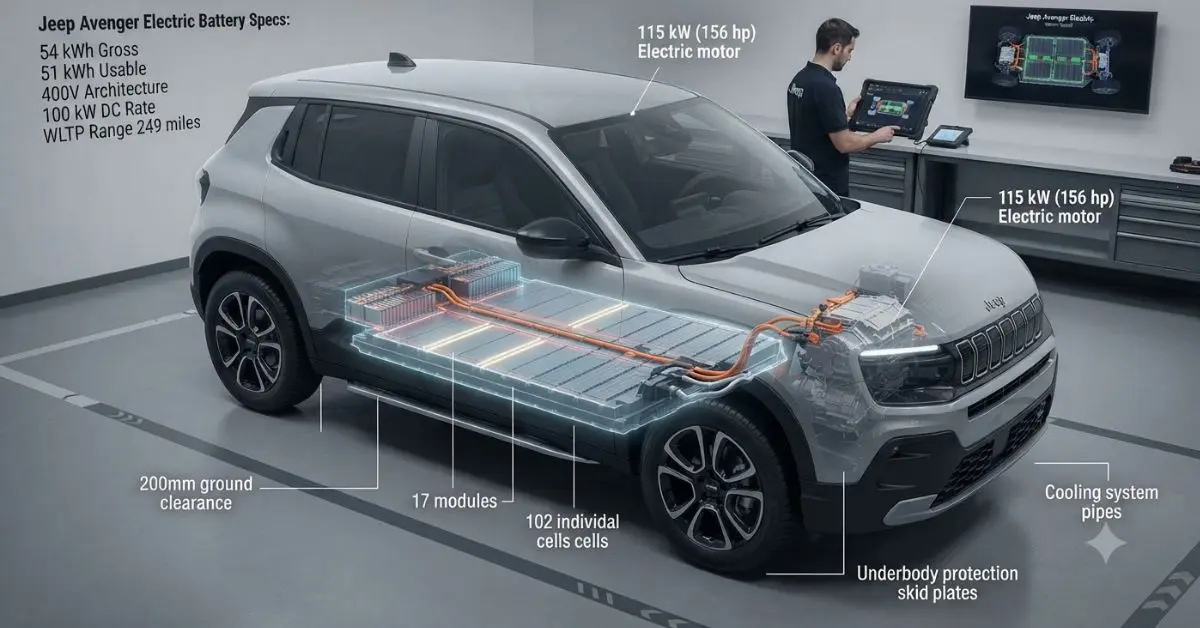
| Battery (gross / usable) | 54.0 kWh / 51 kWh (EV Database lists 50.8 usable) |
| Chemistry / supplier | NMC811 / CATL |
| Cells / layout | 102 prismatic cells, 17 modules, 377 V nominal |
| Motor | 115 kW (156 hp), 260 Nm, front-wheel drive |
| Range (WLTP) | 400 km / 249 miles (239 miles at the TEH rating) |
| DC / AC charging | 100 kW claimed / 11 kW three-phase |
| Vehicle-to-load | 3.6 kW |
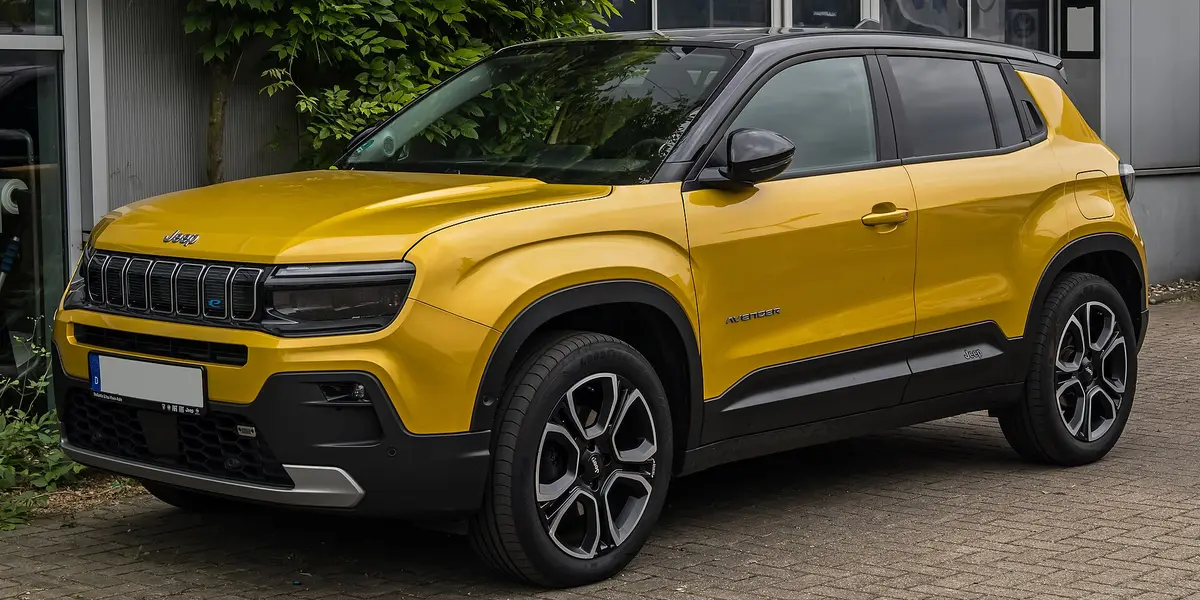
The Avenger Electric sits on Stellantis’s e-CMP platform and shares this exact battery with the Peugeot E-2008, Vauxhall Mokka Electric, Fiat 600e and Alfa Romeo Junior Elettrica. Jeep launched the car in 2023, and — unusually for this platform family — the battery has not changed since: the 2027-model-year facelift (new trims, same car underneath) carries the identical 54 kWh pack and 115 kW motor. Petrol and hybrid Avengers exist, including the 4xe; they share the body, not the battery, and this guide covers only the electric car.
The Battery: NMC811, and No, It Is Not LFP
The chemistry question follows this car around, so here is the sourced answer: nickel-manganese-cobalt, 8:1:1 — there is no LFP Avenger.
Searchers regularly ask whether the Avenger’s battery is LFP, presumably because its Stellantis cousins on the cheaper Smart Car platform (the Citroën ë-C3 among them) do use LFP. The Avenger does not. Its cells are NMC in an 80/10/10 nickel-rich ratio — a step up from the 60/20/20 chemistry of the older 50 kWh e-CMP pack — and the supplier is CATL: Stellantis’s own press material for the platform-mate Peugeot E-208 GTi names “the CATL electric battery with a gross capacity of 54 kWh”, and the packs are assembled by Stellantis at Tychy in Poland.
Our LFP vs NMC comparison explains what that chemistry choice means in practice: better cold-weather manners and energy density than LFP, in exchange for preferring partial charges — a point the warranty section returns to.
The pack itself is conventional and serviceable in concept: 102 prismatic cells in 17 modules at 377 volts nominal, liquid-cooled, driving a single 115 kW Emotors unit at the front wheels. Nothing about it is exotic, which for a car at this price is a compliment — the interest in this car lies not in its battery hardware but in how honestly its numbers survive real roads, which the next two sections test.
Real-World Range: 190 Miles, or 160 in the Cold
Plan on about 190 miles in mixed driving and 160 miles in winter — the 249-mile WLTP figure is a laboratory best case, as it is for every car here.
The official ratings first: 400 km (249 miles) WLTP combined at the TEL rating, 239 miles at TEH, with per-trim figures of 400 km (Longitude), 393 km (Altitude) and 391 km (Summit) in the latest Spanish tariff, and an urban-cycle figure of 550 km that describes city driving only. EV Database’s real-range estimate works out at about 190 miles in mild weather and 160 miles in cold conditions, with cold highway driving nearer 135 miles and mild city driving up to 290.
Independent tests land inside that envelope. Electrifying measured 3.9 mi/kWh at about 9 °C — roughly 199 miles from the usable battery — and 4.9 mi/kWh in warm weather, which is the full 249. Carwow’s test averaged 3.5 mi/kWh, about 180 miles. The pattern is the familiar small-battery one: driven gently in mild weather the Avenger gets close to its rating; driven at motorway speed in January it gives back a third of it. That is not a defect, but it is the number a buyer doing winter motorway miles should budget with.
160 miles — the Avenger Electric’s estimated real range in cold combined driving, against 249 miles on the WLTP sticker: the gap to know before a winter motorway trip.
Charging: Three Honest Numbers
Jeep quotes 24 minutes, its own technical document says 27, and independent measurement says 28 — the disagreement is about windows, not dishonesty, so here are all three with their windows named.
The DC claim is 100 kW peak. For the time, Jeep’s marketing and the car’s Paris launch release quote 20–80% in 24 minutes; a Stellantis technical document for this identical powertrain quotes 27 minutes for the same 20–80% window; and EV Database, which measures charging curves, recorded a 107 kW peak, a 79 kW average and 28 minutes for 10–80% — a wider window than either official figure uses.
Read together: a 20–80% top-up on a warm battery takes roughly 25 minutes, and the average rate of about 79 kW is the figure that describes the experience. At home, the standard 11 kW three-phase charger refills the battery in about five and a half hours (single-phase homes will be slower), and the car can export 3.6 kW of vehicle-to-load power.
One genuine uncertainty deserves printing rather than smoothing over: preconditioning. EV Database records that the battery can be preconditioned manually or via the app, but not automatically through the navigation; at least one comparison source says the car has none. Treat winter rapid-charging speeds as weather-dependent either way — our preconditioning explainer covers why a cold pack charges slowly — and if fast winter charging matters to you, confirm the current software behaviour with a dealer before buying.
The Heat Pump: Standard, Then a £500 Option
If you are buying used, this is the section that matters: cars built before the 2025 equipment change have a heat pump fitted; newer cars may not, and the difference is winter range.
At the UK launch, the heat pump was standard across the Avenger Electric range. In 2025, alongside a round of price cuts, Jeep moved it to the options list at £500 — Electrifying’s summary is exact: the car was “offered with a heat pump as standard for the first couple of years, but a price drop and a change of equipment in 2025 means that a heat pump is now a £500 option.” Jeep credits the pump with up to about 10% more range in extreme temperatures, and on a 51 kWh battery that percentage is worth roughly 15–19 real winter miles.
So the used-buying rule is simple and checkable: on a 2023 or 2024 car, the heat pump is there; on a 2025-onwards car, verify it on the original order or spec sheet rather than assuming, because the brochure photographs will not tell you and most listings never mention it either way. It cannot be retrofitted at anything like the option price.
Safety: What the 3-Star Score Actually Says
The Avenger’s 3-star Euro NCAP result (September 2024) is real, and its reasons are specific — they are about child protection details and a warning tone, not about the car’s structure or its battery.
The scores: Adult Occupant 79%, Child Occupant 70%, Vulnerable Road Users 59%, Safety Assist 53%. Euro NCAP’s own report gives the causes. In the side barrier test, chest protection for the 10-year-old dummy was poor; the 6-year-old dummy’s head contacted the other dummy’s arm during excursion, drawing a further penalty. The car has no child presence detection system. And its forward-collision warning’s audio alert was judged ineffective — the one item Jeep has already addressed: the warning was changed in production from VIN ZACNJAC57RJK86260, and an update was made available to existing owners.
Balance matters in the other direction too: in the adult side-impact test the car scored maximum points. A 3-star family car is a legitimate reason to cross-shop — the rivals table below includes cars with better scores — but it is a decision to make on the actual findings above, not on the headline number alone, and it has nothing to do with the battery, which is not mentioned in the report’s criticisms.
UK Pricing: A Moving Target
The Avenger’s UK price has been cut, raised and re-granted so often that any single figure needs its date — here is the sequence, ending at today’s car.
- Early 2023: 1st Edition at £36,500; Longitude from £35,700 by June 2023
- December 2024: cut to £29,999 (the figure older guides still quote, often as £29,995)
- Pre-facelift run-out: £28,499 including the £1,500 Electric Car Grant
- 2027 model year (current): from £33,599 list, £32,099 after the £1,500 grant
On the continent, the current Spanish tariff starts at €32,916. The honest summary of that sequence: this car has been genuinely cheap at UK run-out prices and is merely competitive at the 2027 list price, where the platform siblings below — several of them discounted harder — press it closely.
Degradation, Warranty and Ownership Reality
The warranty is the standard Stellantis promise — 8 years, 100,000 miles in the UK, 70% capacity floor — and no measured degradation record for this car exists yet.
For Europe the same cover reads 8 years or 160,000 km. Because the pack is NMC, Jeep’s own owner’s manual gives the classic nickel-chemistry advice, and it is worth following rather than the “charge it full, it’s fine” guidance that applies to LFP cars: keep the battery below 80% as often as possible, store the car between 20% and 40% if it will sit, and limit fast charging. No fleet or state-of-health dataset for the Avenger has been published, so any per-year degradation percentage quoted for this model is a generic model wearing the car’s name.
Two ownership clarifications, because both circulate: there is no verified recall of the Avenger Electric’s high-voltage battery — the large 2026 Stellantis recall making headlines concerns petrol mild-hybrid models, not this car. And no source publishes a replacement price for the 54 kWh pack, which is normal for Stellantis; the practical protection is the warranty above, not a price list.
Avenger Electric vs Its Platform Siblings and Kona
Four cars share this battery; the differences are price, tuning and range at the margins — plus one Korean rival with a bigger battery for similar money.
| Car | Battery (usable) | WLTP range | Real range (est.) | UK price anchor |
|---|---|---|---|---|
| Jeep Avenger Electric | 51 kWh | 249 mi | ~190 mi | From £32,099 after grant (2027) |
| Peugeot E-2008 | 51 kWh (same pack) | 406 km / 252 mi | ~185 mi | — |
| Vauxhall Mokka Electric | 51 kWh (same pack) | ~252 mi | ~175 mi | From £31,005 incl. grant |
| Alfa Romeo Junior Elettrica | 51 kWh (same pack) | 412 km / 256 mi | ~195 mi | From £33,995 |
| Hyundai Kona Electric | 65.4 kWh | 319 mi | ~265 mi | From £31,250 after £3,750 grant |
The siblings are covered on this site in the same depth: the Alfa Romeo Junior Elettrica is the keenest-driving of the 54 kWh cars, and the Vauxhall Mokka Electric usually the cheapest to buy. The car that breaks the pattern is the Kona: a bigger battery and roughly 70 more real miles for Avenger money after its larger grant — the comparison every Avenger buyer should run before signing. And if the budget will not stretch to any of them, the LFP Citroën ë-C3 undercuts the whole group by thousands.
Frequently Asked Questions
Is the Jeep Avenger Electric battery LFP?
No. It is NMC811 — a nickel-rich chemistry — with cells supplied by CATL. The LFP Stellantis cars are the cheaper Smart Car platform models such as the Citroën ë-C3, not the Avenger.
How big is the Avenger Electric’s battery?
54 kWh in total, 51 kWh usable (EV Database lists 50.8 kWh usable). It has been the same pack in every Avenger Electric since the 2023 launch, including the 2027 facelift.
What range does the Avenger Electric get in the real world?
About 190 miles in mild mixed driving and roughly 160 miles in cold weather, against the 249-mile WLTP rating. Cold motorway driving can take it nearer 135 miles.
Does the Jeep Avenger Electric have a heat pump?
Cars built for the UK launch period have one fitted as standard. From the 2025 equipment change it became a £500 option — so on newer and used cars, check the original specification rather than assuming it is there.
Why did the Avenger score only 3 stars in Euro NCAP?
Specific findings, not structure: poor chest protection for the 10-year-old dummy in the side barrier test, a head-excursion penalty for the 6-year-old, no child presence detection, and an ineffective forward-collision audio warning (the last of these Jeep has since changed in production and offered as an update). Its adult side-impact score was maximum points.
How long does the Avenger Electric take to charge?
About 25 minutes for a 20–80% top-up on a 100 kW DC charger with a warm battery (Jeep quotes 24 minutes; independent measurement recorded 28 minutes for the wider 10–80% window at a 79 kW average). At home on the standard 11 kW charger, a full charge takes about five and a half hours.
How long will the Avenger’s battery last?
The UK warranty guarantees at least 70% capacity for 8 years or 100,000 miles (160,000 km in Europe). No measured degradation dataset for the model has been published. Jeep’s manual advises keeping the charge below 80% where possible, because the pack is NMC.
How much does a replacement Avenger battery cost?
No official price is published — Stellantis does not list one for this pack, and any exact figure quoted without a dealer invoice behind it is invented. In practice, capacity failures inside 8 years or 100,000 miles are the warranty’s problem, not the owner’s.
Conclusion
The Avenger Electric is a straightforward car wrapped in three confusing stories — a chemistry it doesn’t have, a heat pump it lost, and a safety score that needs its footnotes read.
The battery itself never changed and never pretended to be anything else: 54 kWh of CATL NMC, honest mid-pack charging, and real range that behaves exactly as small-battery physics says it should. Buy it with the right facts in hand — heat pump verified on newer cars, winter range budgeted at 160 miles, NCAP findings read rather than feared — and it remains what it was at launch: one of the most characterful small EVs on sale, at a price that depends entirely on which month’s tariff you catch.
