
BYD Tang Battery: Complete Guide


Researched from BYD Europe’s launch materials and Netherlands price lists, EV Database and EVKX model data, Euro NCAP’s December 2023 results, and China’s SAMR recall filings — November 2026.
The BYD Tang is the seven-seat flagship that carried BYD into Europe. It arrived in Norway in 2021 with an 86.4 kWh Blade Battery, then spread across the continent, and in late 2024 it was updated with a much larger 108.8 kWh battery and 530 km of WLTP range. Both versions are all-wheel drive, both use BYD’s LFP Blade Battery, and both are covered in this guide — separately, because their specifications differ in almost every row.
The Tang was never sold in the United States, the UK or Australia. In Europe it is now being wound down: Dutch price lists show stock-only availability, and order books closed during 2026 with no successor announced.
Key figures: 170 kW DC charging peak (updated car) · battery warranty 8 years / 250,000 km · Euro NCAP 5 stars (2023).
BYD Tang Battery Sizes and Specifications
Two European versions, one battery family — and the update changed the battery and charging, not the power.
| Tang (2021–2024) | Tang Flagship (2024– ) | |
|---|---|---|
| Battery | 86.4 kWh LFP Blade | 108.8 kWh LFP Blade |
| WLTP range | 400 km (528 km city) | 530 km (682 km city) |
| Power / torque | 380 kW (517 hp) / 680 Nm | 380 kW (517 hp) / 700 Nm |
| 0–100 km/h | 4.6 s | 4.9 s |
| DC charging peak | 110 kW (BYD figure) | 170 kW |
| AC charging | 7.4 kW, single-phase | 11 kW, three-phase |
| Top speed | 180 km/h | 190 km/h |
What do the two European Tangs share?
Both cars use the same formula: two motors, all-wheel drive, seven seats in a 2+3+2 layout, and a boot that runs from 235 litres with all seats up to 1,655 litres folded. The updated car is the heavier of the two at 2,705 kg, which is why it is slightly slower to 100 km/h despite the extra torque. It can tow 1,500 kg braked.
What is the difference between Cell-to-Pack and Cell-to-Body?
Every European Tang uses the LFP Blade Battery, whose long cells are built directly into the pack — the Cell-to-Pack design explained in our guide to what a Blade Battery is. That is not the same as the Seal’s Cell-to-Body construction, where the pack forms part of the car’s structure. The only Tang EV ever built with a nickel-based battery was the China-only Tang EV600 of 2019, which predates the Blade Battery entirely.
What are the gross and usable capacities?
BYD publishes one capacity figure per car and no official gross-versus-usable split. EV Database treats the headline figures as the usable capacity and estimates nominal capacities of about 88.0 kWh and 111.0 kWh respectively — those splits are the database’s estimates, not BYD figures. BYD does not publish the pack’s physical dimensions or, for the 108.8 kWh car, a cell count.
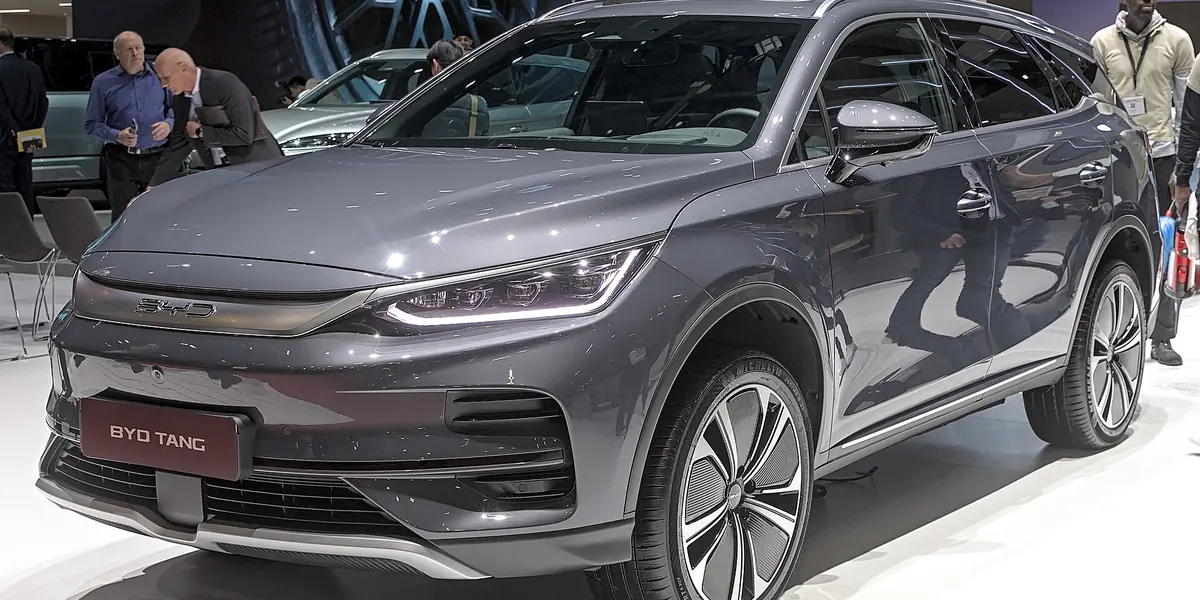
The Two European Tangs
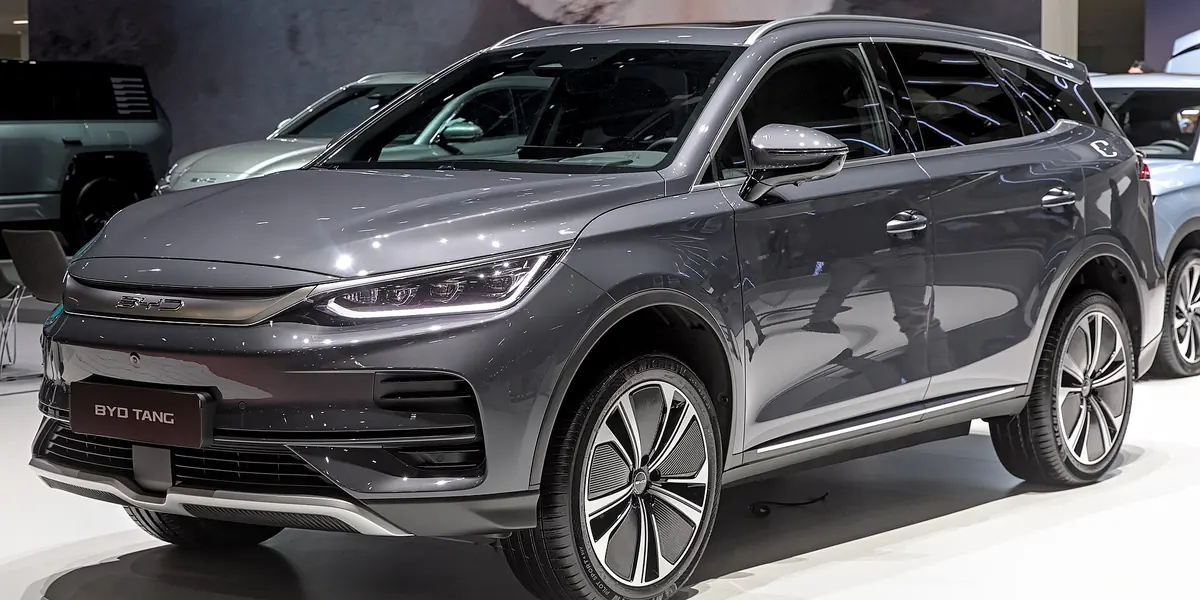
Norway got the Tang first, in 2021 — and the big-battery update arrived three years later.
BYD launched the Tang in Oslo in August 2021 at NOK 599,900 — the brand’s first passenger car in Europe. The wider European rollout followed in September 2022, with a German pre-sale price of €72,000 and sales starting in 2023.
The updated car replaced it during 2024. The Netherlands launched the single Flagship AWD trim in November 2024 at €67,390 — less than the original’s German launch price despite the bigger battery. By 2026 the Dutch list had the car at €67,400 with limited stock availability, and EV Database records orders closing in October 2026. Anyone buying a Tang in Europe now is buying from remaining stock or the used market.
Real-World Range
EV Database’s estimate for the updated car is 460 km — and the original car has properly measured test results.
For the 108.8 kWh Flagship, EV Database’s real-range estimate is 460 km in mixed driving, with about 410 km at motorway speed in mild weather and roughly 330 km on a cold motorway run; its cold-weather combined estimate is 395 km. These are the database’s modelled estimates, clearly labelled — no magazine or testing body has published an instrumented range test of the updated car.
The original 86.4 kWh car does have measured results: Norwegian tester Bjørn Nyland recorded about 386 km at 90 km/h and about 263 km at 120 km/h in his 2022 tests. EV Database’s estimate for that car is 355 km. A seven-seat SUV weighing 2.7 tonnes will always use energy quickly at speed; the heat pump fitted as standard to the updated car helps most in cold-weather, lower-speed driving.
Charging the Tang
The updated car’s headline is a 30-minute charge — but that figure is for 30% to 80%, not from empty.
How long does the updated Tang take to charge?
BYD claims the Flagship charges from 30% to 80% in 30 minutes at up to 170 kW. A 10–80% charge takes longer: BYD’s own figure, via EV Database, is about 46 minutes, and the database models roughly 48 minutes at an average near 100 kW. Plan journeys on the 10–80% number, not the headline.
How fast does the original Tang charge?
The original car’s peak is genuinely contested: BYD Europe’s launch material says 110 kW, while EV Database lists 120 kW. All sources agree its 10–80% charge takes about 35 minutes. At home the difference between the generations is stark — the original car’s 7.4 kW single-phase charger needs the best part of a day for a full charge, while the updated car’s 11 kW three-phase unit does it in about 11 hours 45 minutes.
What should owners know beyond the charging peaks?
Two ownership points matter more than the peaks. First, the updated Tang has no battery preconditioning for fast charging (the app preconditions the cabin only), so a cold pack charges slowly until it warms. Second, it does have a heat pump as standard and vehicle-to-load output of up to 3.7 kW.
Why does the Tang’s range estimate drift?
Finally, calibration — the most common Tang battery question of all. An LFP battery’s voltage barely changes across the middle of its charge range, so the car’s range estimate drifts unless the battery is charged to 100% periodically and occasionally run low. Owner reports of early Tang EVs shutting down or misreading range around 15% are the classic symptom. BYD’s guidance for Blade cars is to charge to 100% regularly — weekly is the usual advice — which both recalibrates the estimate and suits LFP chemistry.
Safety
The Tang earned five Euro NCAP stars in December 2023 — not 2024, as some coverage states.
Euro NCAP published the Tang’s five-star result on 6 December 2023, with scores of 87% for adult protection, 87% for child protection, 80% for vulnerable road users and 73% for safety assist. The car carries ten airbags on the Dutch specification, including a front centre airbag, and standard Child Presence Detection.
BYD Tang Prices
The updated car launched cheaper in the Netherlands than the original had in Germany — and it is now a stock-and-used purchase.
Norway launched the original Tang at NOK 599,900 in 2021, and Germany’s pre-sale price in September 2022 was €72,000. The updated Flagship launched in the Netherlands in November 2024 at €67,390, and the final Dutch lists priced it at €67,400 from stock. European equipment was generous for the money — a 15.6-inch rotating touchscreen, Nappa leather and a 12-speaker Dynaudio system are all on the standard list — which is why the Tang’s value argument was always equipment-led rather than price-led.
Replacement Cost: No Official Price Exists
BYD has never published a replacement price for a Tang battery pack, in any market.
The dollar figures quoted on some websites ($15,000–$25,000 is a typical invention) have no dealer or manufacturer source behind them. What actually exists is thinner: Chinese-market anecdotes for the old hybrid Tang put full-pack quotes in the ¥50,000–80,000 range, and on the European used-parts market a used 86.4-class Tang pack has been listed by an EV parts specialist at around €6,800 — a second-hand price for the earlier pack, not a new-part price for the Flagship.
For most owners the question stays theoretical while the warranty below applies. Our EV battery replacement cost guide explains how pack pricing works across brands.
Lifespan and Degradation
BYD claims the Blade Battery exceeds 3,000 charge cycles — no Tang-specific degradation study exists.
The 3,000-cycle figure is BYD’s own, from its January 2026 warranty announcement. No fleet operator has published measured degradation data for the Tang, and the percentages quoted on some ownership sites have no identifiable source, so they are not repeated here.
What owners can control is the standard LFP routine: charge to 100% regularly (which the calibration section above explains), and avoid leaving the car sitting at very low charge for long periods.
Warranty and Recalls
European Tang batteries now carry 8 years or 250,000 km of cover — an extension that also covers cars already sold.
On 15 January 2026 BYD extended its battery warranty across the EEA, Switzerland and the UK to 8 years or 250,000 km, with at least 70% capacity guaranteed, applying retroactively to existing owners. The Tang is covered; the only excluded model is a commercial van. Before that extension, cars were sold with a 200,000 km battery cap. The vehicle warranty is 6 years or 150,000 km, the drive unit is covered for 8 years or 150,000 km, and anti-perforation cover runs 12 years with unlimited mileage.
Two Chinese recalls involve the Tang name, and both are regularly misreported, so the details matter. In October 2025, China recalled 44,535 Tang-series cars built from March 2015 to July 2017 — first-generation cars, mostly the original plug-in hybrid — for a drive-motor controller fault that can disable electric drive; the remedy is a free dealer inspection and repair. The battery-sealing recall announced alongside it covered a different model, the Yuan Pro — it was not a Tang defect.
In September 2026, a second Chinese action covered 142,895 Tang-series vehicles including 7,023 China-market Tang EVs, for brake-pedal stopper pads that can crack and leave the brake lights on; dealers replace the pads free. That recall is China-only, and BYD has confirmed it does not affect cars sold outside China. No European recall for the European Tang was found in the records checked for this guide.
The Tang DM-i Plug-in Hybrids
China also sells hybrid Tangs with much smaller batteries — they are not the European electric car.
The Tang DM-i pairs a 1.5-litre turbo petrol engine with LFP Blade packs of 9.98 kWh (52 km of electric range on the NEDC cycle) or 21.5 kWh (112 km NEDC, and the version that supports DC fast charging). The all-wheel-drive DM-p uses a 45.8 kWh pack rated at 215 km NEDC and sprints to 100 km/h in 4.3 seconds. Later Chinese versions added a 26.6 kWh pack. None of these hybrids was sold in Europe, and their figures should never be mixed with the electric Tang’s.
Replacement pricing for the hybrid packs is no more official than for the electric car: the only numbers in circulation are Chinese owner anecdotes in the ¥50,000–80,000 class, including a reported BYD quote of about ¥50,000 for an earlier 18 kWh hybrid pack.
Tang L and the Next Tang
The Tang name is continuing in China — on different cars, with a new battery generation.
The Tang L, launched in China in April 2025, is a larger, separate model; outside China its hybrid version is sold under other names, including Sealion 8 in Australia. It is not a version of the European Tang.
A third-generation Tang EV is arriving in China for a late-2026 launch with second-generation Blade Battery packs of about 88.7 and 105.8 kWh and CLTC range ratings up to 850 km. That is where Blade Battery 2.0 reaches the Tang name — the European 108.8 kWh car uses the first-generation Blade Battery, and no European version of the new car has been announced.

Frequently Asked Questions
What size battery does the BYD Tang have?
The updated European Flagship has a 108.8 kWh LFP Blade Battery. The original European car (2021–24) has an 86.4 kWh pack. The Chinese plug-in hybrid versions use much smaller packs, from 9.98 to 45.8 kWh.
What are the dimensions of the BYD Tang battery?
BYD does not publish the pack’s physical dimensions. The car itself measures 4,970 mm long, 1,955 mm wide and 1,745 mm tall, with a 2,820 mm wheelbase, and the battery sits under the floor between the axles in the usual skateboard layout.
Is the BYD Tang battery LFP or NMC?
LFP. Every European Tang — both the 86.4 and 108.8 kWh versions — uses the LFP Blade Battery. The only nickel-based Tang EV was the China-only Tang EV600 of 2019, before the Blade Battery existed.
Does the BYD Tang have Blade Battery 2.0?
The European cars do not — they use the first-generation Blade Battery. Blade Battery 2.0 reaches the Tang name on the third-generation Tang EV launching in China in late 2026, which has not been announced for Europe.
How long does the BYD Tang take to charge?
The updated car charges at up to 170 kW DC. BYD’s claimed 30 minutes is for a 30–80% charge; a 10–80% charge takes about 46–48 minutes. The original car takes about 35 minutes for 10–80%. At home, allow roughly 11 hours 45 minutes on the updated car’s 11 kW charger, and much longer on the original’s 7.4 kW single-phase unit.
How do I calibrate a BYD Tang battery?
Charge to 100% regularly — weekly is the usual advice. LFP batteries give the range estimator very little voltage signal to work with in the middle of the charge range, so periodic full charges (and occasionally running the battery low) let the car recalibrate its estimate. Inaccurate range readings and shutdown warnings around 15% are the classic signs the calibration has drifted.
How much does a replacement BYD Tang battery cost?
There is no official price — BYD does not publish pack prices for the Tang. Used packs for the original car have been listed in Europe at around €6,800, and Chinese owner anecdotes for the hybrid versions run to ¥50,000–80,000, but neither is a dealer price for a new Flagship pack.
What warranty covers the BYD Tang’s battery?
In Europe: 8 years or 250,000 km, with at least 70% capacity guaranteed, since BYD’s January 2026 extension — which also applies to cars sold before it. Cars were originally sold with a 200,000 km cap.
Was the BYD Tang recalled?
In China, yes — twice, but neither action covers the European electric car as announced. The October 2025 recall covers 2015–17 first-generation Tangs for a motor-controller fault (the battery-sealing issue in the same announcement concerned the Yuan Pro, not the Tang). The September 2026 brake-pedal recall covers China-market cars only, and BYD confirms it does not affect cars sold outside China.
Can I buy a BYD Tang in the USA, UK or Australia?
No. The Tang was sold in China and in continental Europe. It was never launched in the UK or the US, and it was ruled out for Australia because the platform was never engineered for right-hand drive.
Conclusion
The Tang’s battery story is two cars, not one: an 86.4 kWh pioneer that opened Europe to BYD, and a 108.8 kWh flagship that fixed its range and charging just as the model began winding down.
For owners, the lasting news is the warranty — 8 years and 250,000 km of battery cover, applied retroactively — and a calibration habit that costs nothing. For readers comparing BYD’s flagship saloon on the same Blade Battery foundation, our BYD Han battery guide covers its very different set of versions.
