
BYD Sealion 7 Battery: Complete Guide

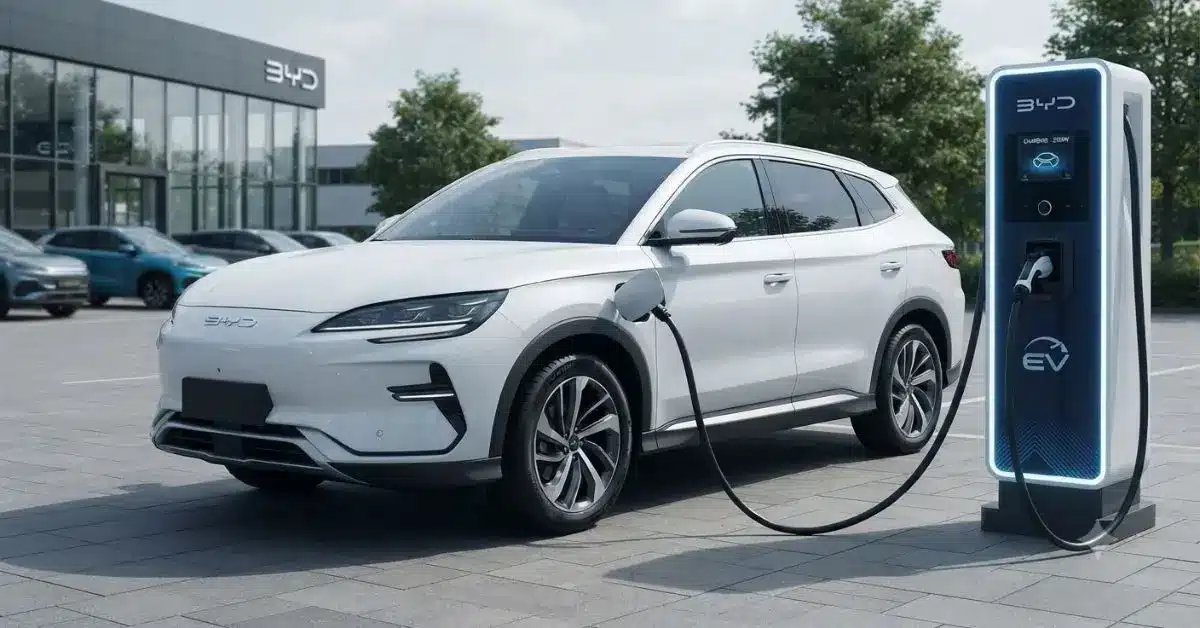
Sources used for the figures on this page: BYD Europe’s launch release and specification table (October 2024), BYD UK and BYD Australia price and warranty statements, EV Database, ADAC and NAF charging tests, and Euro NCAP. Prices are launch prices for the market named and are dated, because BYD adjusts them often.
The BYD Sealion 7 is the Tesla Model Y rival BYD sells in Europe, the UK, Australia and parts of Asia — it is not sold in the United States. In Europe it comes with two batteries: an 82.5 kWh pack in the Comfort and Design AWD, and a 91.3 kWh pack in the Excellence AWD. Both are LFP Blade batteries built into the car’s structure. The stored version of this guide described a European range that does not exist, with a cheaper 71.8 kWh trim and an “Excellence RWD” that BYD has never sold in Europe; that smaller battery is real, but it belongs to Asian-market cars, and it is covered separately below.
Quick answer. The BYD Sealion 7 uses BYD’s LFP Blade Battery in two sizes in Europe: 82.5 kWh (Comfort RWD and Design AWD) and 91.3 kWh (Excellence AWD only). WLTP range runs from 456 to 502 km depending on version. The 82.5 kWh cars charge at up to 150 kW DC; only the 91.3 kWh Excellence reaches 230 kW, and independent tests confirm that figure.
Key figures: 82.5 kWh — 482 km WLTP (Comfort) · 91.3 kWh — 502 km WLTP · DC 150 kW vs 230 kW · battery warranty 8 years / 250,000 km in Europe
BYD Sealion 7 Battery Specs: Two Packs, Three Versions
Europe sells exactly three Sealion 7 versions, and the battery follows the trim, not the drive layout.
Which battery does each version get?
The Comfort and the Design AWD share the 82.5 kWh pack, while the Excellence AWD alone carries the 91.3 kWh pack. That single fact corrects most of what is written about this car elsewhere, because the bigger battery is also the only route to the faster 230 kW charging. A heat pump is standard across the European range, and every version charges on CCS2.
| Version | Battery | Drive | WLTP range | Power | 0–100 km/h | DC peak | 10–80% (BYD claim) |
|---|---|---|---|---|---|---|---|
| Comfort | 82.5 kWh | RWD | 482 km | 230 kW | 6.7 s | 150 kW | 32 min |
| Design AWD | 82.5 kWh | AWD | 456 km | 390 kW | 4.5 s | 150 kW | 32 min |
| Excellence AWD | 91.3 kWh | AWD | 502 km | 390 kW | 4.5 s | 230 kW | 24 min |
Every version uses the same chemistry: lithium iron phosphate (LFP) in BYD’s long Blade cell format, integrated cell-to-body (CTB), so the top of the pack forms part of the cabin floor. If you want the full background on that construction, our guide to what a Blade Battery is covers it.
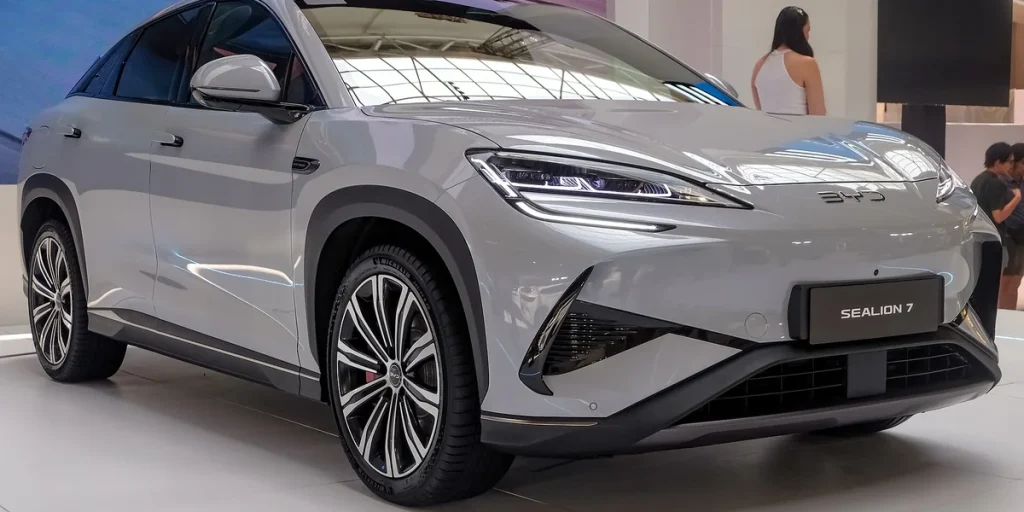
All three versions share a 215 km/h top speed, and the two all-wheel-drive cars produce 690 Nm of torque against the Comfort’s 380 Nm.
Two packs, one dividing line: the 91.3 kWh Excellence is the only Sealion 7 that charges at 230 kW — the AWD badge alone does not get you the fast charging.
What is the gross capacity of each pack?
BYD publishes one capacity figure per pack and no gross-versus-usable split. EV Database treats the quoted 82.5 and 91.3 kWh as the usable capacities and estimates the gross figures at roughly 84 and 93 kWh; those gross numbers are EV Database estimates, not BYD figures.
EV Database also lists the packs at 172 cells with a nominal voltage of around 550 volts for the 82.5 kWh pack and around 540 volts for the 91.3 kWh pack. BYD does not publish a pack weight for this car.
Is the Sealion 7 a 400V or 800V Car?
Neither label is literally true, and the honest dividing line is the battery, not the voltage.
BYD’s European material never calls the Sealion 7 an 800V car, and its launch release describes the whole range as e-Platform 3.0; the “800V platform” language comes from the Chinese original, the Sealion 07 EV, which launched the newer e-Platform 3.0 Evo at home. Measured against real pack voltages, the Sealion 7’s packs sit at roughly 540 to 550 volts nominal — well above a classic 400-volt pack and well below the 700-plus volts of a true 800-volt car, which is why databases file it in the 800V class anyway.
What does a buyer actually feel?
What a buyer actually feels is the charging speed that comes with each pack. The 82.5 kWh cars, rear-drive or all-wheel-drive, peak at 150 kW. The 91.3 kWh Excellence peaks at 230 kW. Any source that tells you “the AWD model” charges at 230 kW is wrong about the Design AWD, which sits on the smaller pack and the slower hardware.
How Far Does the Sealion 7 Really Go?
Expect roughly 400 to 440 km in mixed real-world driving, depending on the version.
EV Database estimates real-world range at around 400 to 420 km for the 82.5 kWh cars and about 440 km for the Excellence, against WLTP figures of 482, 456 and 502 km. ADAC’s test of the Excellence AWD measured consumption of 24.1 kWh per 100 km including charging losses, which works out at roughly 430 km — close to the estimate and a fair planning number for the big-battery car.
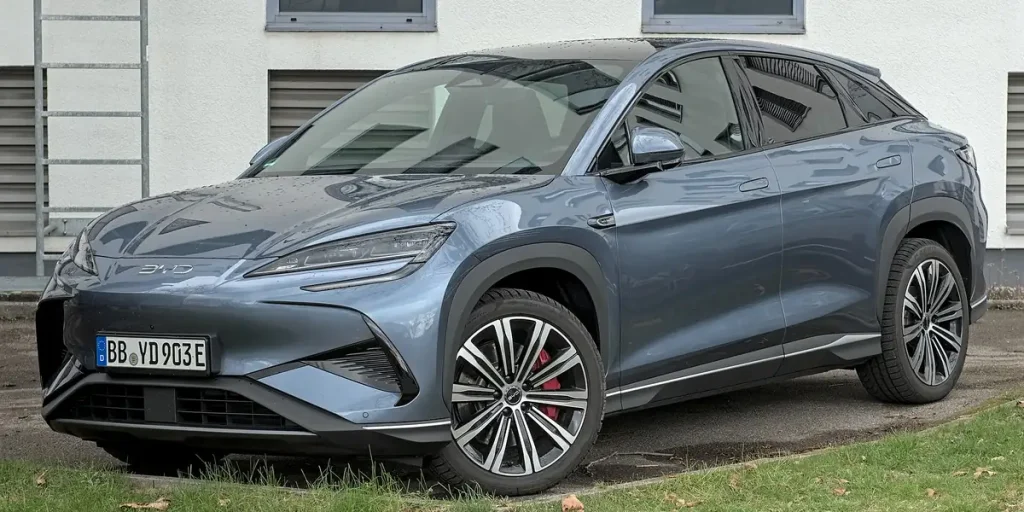
How does cold weather change the range?
Cold weather costs more. EV Database’s cold-weather estimates fall to roughly 345 km for the Design AWD and 375 km for the Excellence, and Carwow’s harder, autobahn-heavy running returned 271 miles (about 436 km) from the big battery with a warning that sustained high-speed work pulls it toward 200 miles. On a low battery, the same estimates mean a 15% charge is worth roughly 60 to 65 km of mixed driving — enough to reach a charger, not enough to skip one.
Sealion 7 Charging: 150 kW vs 230 kW, Claimed and Measured
The Excellence’s 230 kW claim is real — two independent tests have measured it.
ADAC recorded a 226 kW peak and a strong 173 kW average up to 80% on the Excellence AWD, and Norway’s NAF charging test measured 10 to 80% in 24 minutes 33 seconds with a 229 kW peak, matching BYD’s 24-minute claim. The 82.5 kWh cars peak at 150 kW with a claimed 32 minutes for 10 to 80%; EV Database estimates their charging average at about 115 kW.
| Charging | 82.5 kWh (Comfort, Design AWD) | 91.3 kWh (Excellence AWD) |
|---|---|---|
| DC peak | 150 kW | 230 kW |
| DC 10–80% | 32 min (BYD claim) | 24 min (BYD claim; 24 min 33 s measured by NAF) |
| AC | 11 kW three-phase | 11 kW three-phase |
| Home, single-phase ~7 kW | about 12–13 hours full | about 14–15 hours full |
| V2L output | 3.3 kW | 3.3 kW |
What about home charging and cold weather?
Home charging runs through an 11 kW three-phase onboard charger as standard in Europe, and the car can power external equipment at up to 3.3 kW through vehicle-to-load, although the adapter itself is a paid extra in some markets. Two ownership caveats matter more than the headline numbers. The Sealion 7 does not automatically precondition its battery when you navigate to a fast charger, and LFP charging slows noticeably in the cold, so a winter fast-charge can fall well short of the figures above. Because the chemistry is LFP, BYD’s guidance follows the usual LFP pattern: charging to 100% regularly is fine, and periodic full charges keep the charge display calibrated.
BYD Sealion 7 Prices by Market
Launch prices started at €47,990 in Germany and £44,990 in the UK; Australia gets only the 82.5 kWh car.
Germany’s launch prices in late 2024 were €47,990 for the Comfort, €53,990 for the Design AWD and €58,990 for the Excellence AWD. The UK followed in December 2024 at £44,990, £49,290 and £57,290, and UK list prices have since risen to roughly £47,025, £52,025 and £59,025. BYD discounts aggressively and prices move between markets and months, so treat every figure here as a dated launch reference rather than a quote.
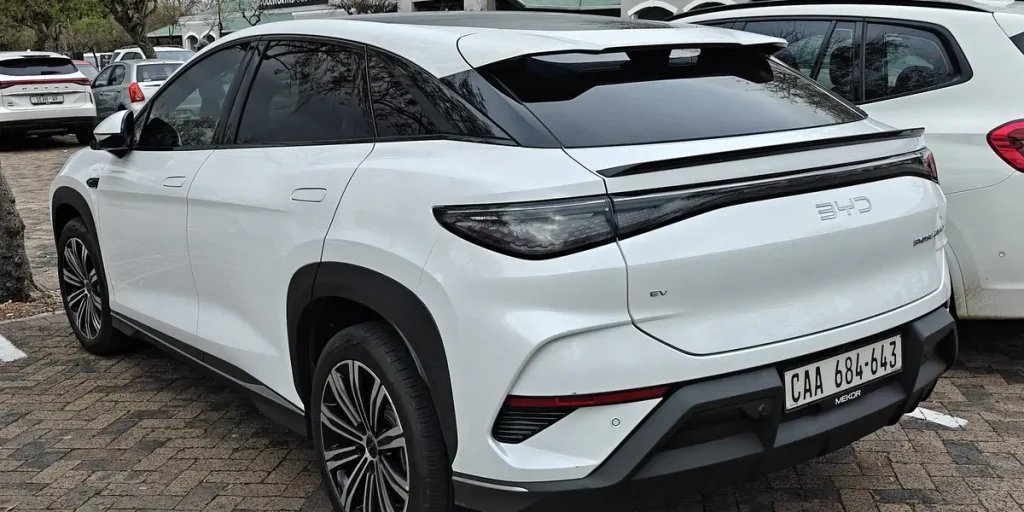
What does Australia get?
Australia launched in February 2025 with two versions, the Premium at A$54,990 and the Performance at A$63,990, both before on-road costs and both on the 82.5 kWh battery, quoted locally as 82.56 kWh. The 91.3 kWh battery is not offered in Australia at all, which is the single most common specification mistake made about this car. In Australia the Sealion 7 has become a genuine volume seller, at one point outselling the Tesla Model Y in a month.
The Other Sealion 7s: Asia’s 71.8 kWh Car and China’s Original
A smaller 71.8 kWh Sealion 7 does exist — just not in Europe.
Thailand, India and Malaysia sell an entry Dynamic version with a 71.8 kWh pack, a 170 kW motor and about 110 kW DC charging, rated at 440 km WLTP in Thai specification. Malaysia’s 2026 update also moved its Premium and Performance up to the 91.3 kWh pack, which is why specification lists from different countries never agree: the line-up genuinely differs by market and by year.
What about the Chinese original?
In China, where the car is named Sealion 07 EV, the range runs from the 71.8 kWh car to an 80.64 kWh all-wheel-drive version, with ranges of 550 to 610 km on China’s CLTC cycle and DC charging up to 240 kW. CLTC figures read far higher than WLTP for the same car, so none of them belong in the European tables above. A plug-in hybrid sibling, the Sealion 07 DM-i, pairs a petrol engine with a 26.6 kWh pack in China; it is a different powertrain and not the car this guide covers.
How Much Does a Sealion 7 Battery Replacement Cost?
No official replacement price exists for this battery in any market.
BYD does not publish a pack price for the Sealion 7, and no dealer catalogue figure could be found for it. The numbers that circulate instead — an Indian aggregator’s unsourced estimate, Malaysian forum guesses spanning a fourfold range — are not prices and are not repeated here as if they were. What is true is that the warranty below makes an out-of-pocket pack purchase unlikely during the car’s first eight years, and that module-level repair is the realistic route if a pack ever does fail outside warranty. Our EV battery replacement cost guide explains what actually drives those bills.
How Long Does the Sealion 7 Battery Last?
No Sealion 7 fleet degradation data exists yet — the car only reached customers in late 2024.
BYD’s framing for the Blade Battery generation in this car is a service life of 3,000 or more charge cycles, which at this car’s range per charge is far beyond the distance most owners will ever drive. You may also see a “5,000 cycles” figure attached to this car: that number belongs to BYD’s current Blade Battery marketing and, in its strongest form, to the newer Blade Battery 2.0 launched in March 2026 — the Sealion 7 predates that battery and does not use it. Any source giving the Sealion 7 a precise percentage of degradation per year is estimating, because no measured fleet data for the model has been published.
What habits protect an LFP pack?
The everyday habits that protect any LFP pack apply here: charge to 100% when you need it without worrying, avoid leaving the car sitting at a full charge in extreme heat for weeks, and let the car complete occasional full charges so its range estimate stays honest. The LFP chemistry is the forgiving part of this car’s ownership story.
Sealion 7 Battery Warranty: Europe vs Australia
Europe covers the battery for 8 years or 250,000 km with a 70% capacity floor; Australia covers it for 8 years or 160,000 km.
The European figure is recent: in January 2026 BYD extended its European battery warranty from 200,000 km to 250,000 km, kept the 70% state-of-health guarantee, and applied the change retroactively to existing owners across Europe and the UK. The vehicle itself is covered for 6 years or 150,000 km, and the drive unit for 8 years or 150,000 km. Australia kept the shorter battery distance at 8 years or 160,000 km with its own 70% capacity guarantee, alongside a 6-year, 150,000 km vehicle warranty.
What about the small low-voltage battery?
Owners also ask about the small battery. Owner reports describe a lithium low-voltage battery mounted under the driver’s seat rather than a conventional lead-acid battery in the nose, and BYD publishes no owner replacement procedure for it — treat it as a workshop item when it eventually ages.
Sealion 7 vs Tesla Model Y
The Sealion 7 is the larger car with the simpler battery story; the Model Y is the established benchmark it was built against.
At 4,830 mm long the Sealion 7 is about 80 mm longer than the Model Y, and it carries a 520-litre boot plus a 58-litre front trunk. Tesla quotes up to 854 litres for the Model Y’s boot, but measures it to the roof, so the two figures are not taken the same way. Every Sealion 7 everywhere uses the same LFP Blade chemistry, while Tesla’s line mixes chemistries by version, and Tesla does not publish its packs’ capacities — one reason this page can give you exact BYD numbers but only descriptions for the Tesla.
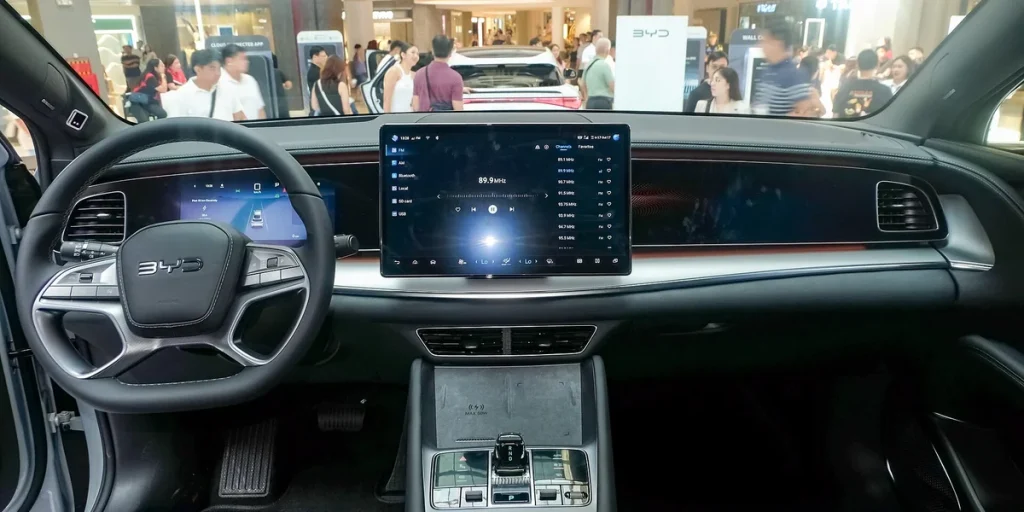
What did Euro NCAP find?
The Sealion 7 earned a five-star Euro NCAP safety rating in 2025. In the showroom its pitch is straightforward: Model Y size and pace, a battery you can charge to 100% every day, and — in Europe — the longest battery mileage warranty BYD offers on any of its cars, at prices that undercut the Tesla at launch in most markets.
Frequently Asked Questions
What battery does the BYD Sealion 7 have?
Two sizes of BYD’s LFP Blade Battery: 82.5 kWh in the Comfort and Design AWD, and 91.3 kWh in the Excellence AWD. Both are lithium iron phosphate, built into the car’s structure cell-to-body. Australia sells only the 82.5 kWh version, and Asian markets add a smaller 71.8 kWh entry car.
Is the Sealion 7 battery LFP or NMC?
LFP, in every version and every market. There is no NMC Sealion 7 anywhere; the long Blade cells are lithium iron phosphate, which is why daily charging to 100% is acceptable in this car.
Does the Sealion 7 use Blade Battery 2.0?
No. The Sealion 7 launched in 2024 with the original Blade Battery. Blade Battery 2.0, with its Flash Charging system, arrived in March 2026 on newer BYD group cars, and no Sealion 7 version with that battery has been announced.
Is the Sealion 7 400V or 800V?
Neither, literally. Its packs run at roughly 540 to 550 volts nominal — above classic 400-volt cars, below true 800-volt cars — which is why databases file it as 800V-class. What matters in practice is charging speed: 150 kW for the 82.5 kWh cars, 230 kW for the 91.3 kWh Excellence.
How far can a Sealion 7 go on a full charge?
WLTP figures are 482 km (Comfort), 456 km (Design AWD) and 502 km (Excellence AWD). Real-world estimates land around 400 to 420 km for the 82.5 kWh cars and about 440 km for the Excellence, with cold weather pulling those down by roughly 15 to 20%.
Which Sealion 7 charges fastest, and how long does it take?
The Excellence AWD, at up to 230 kW: BYD claims 10 to 80% in 24 minutes, and Norway’s NAF test measured 24 minutes 33 seconds. The 82.5 kWh Comfort and Design AWD peak at 150 kW with a claimed 32 minutes for the same charge.
Can you charge a Sealion 7 to 100% every day?
Yes. Its LFP battery tolerates routine full charges, and BYD’s guidance for LFP cars is to charge to 100% regularly, which also keeps the displayed range calibrated. It is one of the main ownership advantages of this car over NMC rivals.
Is the 91.3 kWh Sealion 7 sold in Australia?
No. Australia sells the Premium and Performance, both with the 82.5 kWh battery (quoted locally as 82.56 kWh). The 91.3 kWh pack is a European and selected-market option; Malaysia added it for 2026, Australia has not.
What does a Sealion 7 battery replacement cost?
There is no published price. BYD does not release pack prices for this car, and the figures circulating on aggregators and forums are unsourced guesses. The 8-year battery warranty — 250,000 km in Europe, 160,000 km in Australia, with a 70% capacity floor — covers the realistic risk period.
Is the BYD Sealion 7 sold in the United States?
No. BYD sells no passenger cars in the US, and the Sealion 7 is offered in Europe, the UK, Australia and parts of Asia only.
Conclusion
The Sealion 7’s battery story is simple once the markets are kept apart.
In Europe you choose between the 82.5 kWh pack in the Comfort and Design AWD and the 91.3 kWh pack in the Excellence AWD — and that choice, not the driven wheels, decides whether you charge at 150 or 230 kW. It sits above the smaller BYD Atto 2 in BYD’s line-up, uses LFP Blade cells you can charge to 100% daily, and carries Europe’s 8-year, 250,000 km battery warranty. If you need seven seats instead of a coupé roofline, the BYD Tang is the larger stablemate to look at, and the BYD Seal is the saloon that shares this car’s 82.5 kWh pack.
