What Is DC Fast Charging (DCFC)? Complete Guide

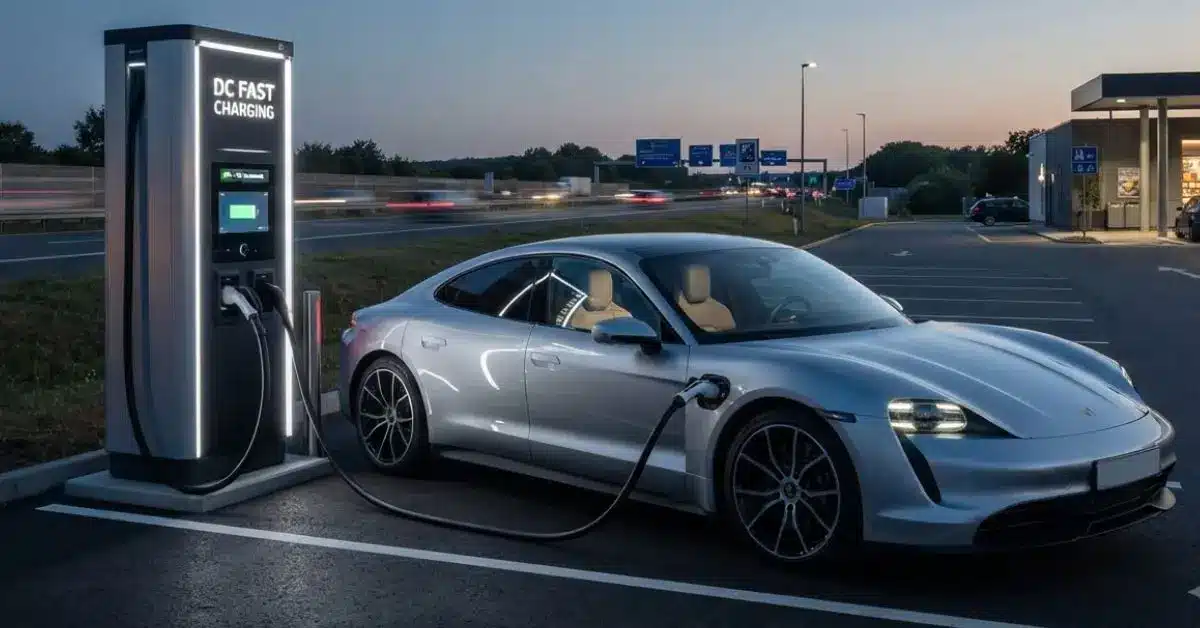
DC fast charging can add hundreds of miles of driving range during a short stop. Understanding how it works helps you charge faster, save time, and protect your battery.
DC fast charging (DCFC) rapidly charges an electric car. It adds 100 to 300 miles of range in just 20 to 45 minutes. Unlike other chargers, this system does not use the car’s onboard charger to change power types.
Instead, these stations change AC power to DC power outside of the car. They send this power directly into the battery at very high levels. This guide explains how DC fast charging works, how much it costs, and how to use it effectively.
How DC Fast Charging Works
EV batteries store energy as Direct Current (DC). When you use a Level 1 or Level 2 charger, the car’s onboard charger converts the outlet’s Alternating Current (AC) into DC for the battery. This internal converter limits how fast the car can charge. DC fast chargers skip this step by converting power inside the station. They send DC power directly to the battery at very high speeds.
A 150 kW DC fast charger delivers about 14 times as much power per hour as an 11 kW Level 2 charger. Most EVs charge from 10% to 80% in 20 to 45 minutes using these fast chargers. The car’s Battery Management System (BMS) controls the flow of power. It manages the DC current to keep the battery safe from heat and damage.
DC Fast Charging Speed by Station Power
| Station Power | 10–80% Time (75 kWh EV) | Miles Added in 20 Minutes | Example Network |
|---|---|---|---|
| 50 kW | ~65 minutes | ~50 miles | Older Electrify America, Blink |
| 100 kW | ~38 minutes | ~100 miles | ChargePoint Express Plus (older) |
| 150 kW | ~28 minutes | ~130 miles | IONNA, Electrify America standard |
| 250 kW | ~18 minutes | ~190 miles | Tesla Supercharger V3/V4 |
| 350 kW | ~13 minutes* | ~250 miles* | Electrify America HPC, IONNA |
*350 kW is achieved only with EVs that accept the full 350 kW — currently Hyundai Ioniq 5/6, Kia EV6/EV9, and a handful of other 800V vehicles.
DC Fast Charging: Key Facts
| Specification | Detail |
|---|---|
| Current type | Direct Current (DC) |
| Voltage | 200–920V DC (varies by system) |
| Power output | 50 kW – 473 kW (typical stations: 50–350 kW) |
| Charging speed | 10–80% in 15–45 minutes (varies by EV and station) |
| Miles added in 15 minutes | 80–200+ miles (EV-dependent) |
| Connectors (US) | NACS (most 2024+ EVs), CCS1, CHAdeMO (rare) |
| Cost per session | $10–$45 (10–80% charge on typical EV) |
| Where found | Highways, commercial sites, and some urban locations |
| Frequency recommended | 1–2 times/week (battery health) |
DC Fast Charging Connectors in the U.S.
NACS (North American Charging Standard)
Now standard on virtually all new EVs sold in the U.S. from 2024–2025 onward. It works at Tesla Superchargers and across other charging networks with compatible adapters. It uses the same physical connector as Tesla vehicles.
CCS1 (Combined Charging System, Type 1)
The previous U.S. DC fast-charging standard. Most EVs built between 2021 and 2023 use CCS1. A CCS-to-NACS adapter is available for about $50 from Tesla and many automakers.
CHAdeMO
An older Japanese charging standard used by older Nissan Leaf models. CHAdeMO stations are becoming increasingly rare as most U.S. charging networks have transitioned to CCS1 and NACS.
How to Use a DC Fast Charger
- Step 1: Route to the charging station in your car’s built-in navigation — this triggers automatic battery preconditioning (warming or cooling the battery to optimal charging temperature)
- Step 2: Pull into a charging stall, open your charging port cover, and plug in the DC connector — the stall activates automatically on most modern networks (Plug & Charge or tap to pay)
- Step 3: Monitor charging progress on the station screen or your car’s display — charge to 80% and stop (charging above 80% is significantly slower)
- Step 4: Unplug when finished — press the release button on the connector, then hang the cable back on the station
DC Fast Charging Costs and Membership Savings
DC fast charging usually costs $0.35–$0.60 per kWh. This price is about 2–3 times higher than home electricity rates. A 10–80% charge for a 75 kWh EV uses about 52 kWh of energy. This session costs between $18 and $31.
Many networks offer membership plans to lower these costs. Electrify America Pass+ costs $4 per month and gives a 25% discount. EVgo Plus costs $7.99 per month and offers cheaper rates. Tesla Supercharger users pay an average of $0.32–$0.50 per kWh.
Is DC Fast Charging Bad for Your Battery?
Occasional DC fast charging does not significantly harm modern EV batteries. However, high-power DC charging creates more heat than Level 2 charging. Heat is the main cause of long-term battery wear. Most companies recommend using DC fast charging only once or twice a week to keep your battery healthy.
Modern EVs use active liquid cooling systems to manage heat while you charge. These systems reduce heat stress, though they cannot eliminate it completely, as older cars without cooling systems did.
Conclusion
DC fast charging makes long-distance travel possible by adding 100 to 300 miles of range in just 20 to 45 minutes. To use it well, know your car’s maximum DC acceptance rate. You should also use battery preconditioning, which warms your battery through the navigation system before you arrive at a station.
Stop charging at 80% State of Charge (SoC) to travel more efficiently. Also, limit these fast sessions to one or two times per week to protect your battery’s health. Level 2 home charging remains the best choice for daily use, but DC fast charging is essential for road trips and emergencies.
FAQs
Can every electric vehicle use DC fast charging?
No. Most modern EVs support DC fast charging, but the maximum charging speed depends on the vehicle’s battery, charging system, and connector type.
Why should I stop charging at 80%?
Charging slows down significantly after 80% to protect the battery from excess heat and stress. Stopping at 80% also reduces your charging time during long trips.
