
What Is the Maximum Charging Speed of My EV?

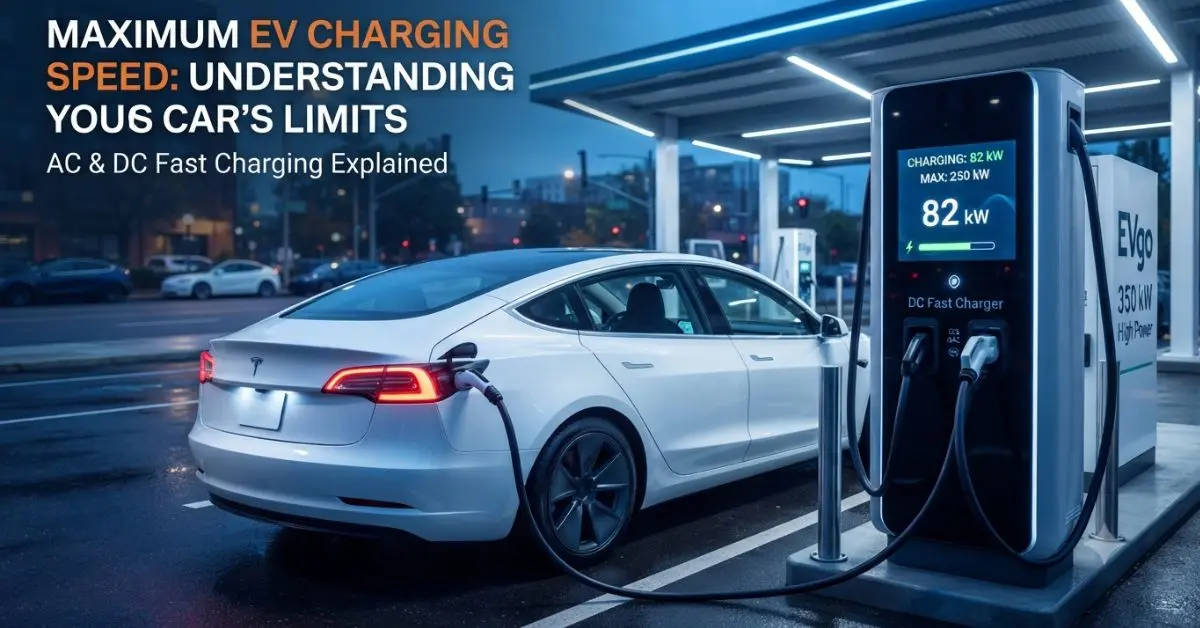
Your EV’s maximum charging speed is determined by two separate specifications — the maximum AC charging rate (for Level 1 and Level 2) and the maximum DC fast-charging rate. Both are listed in your car’s specifications sheet and owner’s manual. The actual charging speed you experience at any charger is always limited to whichever is lower: the charger’s output or your car’s acceptance rate. Here is how to find your EV’s maximum charging speed and what to realistically expect at different charger types.
Want to know what the fastest stations can actually deliver? See our guide on what ultra-fast 350 kW EV charging is.
Maximum Charging Speeds: Popular EVs in 2026
| EV Model | Max AC Rate (Level 2) | Max DC Rate (Fast Charging) | Architecture | 10–80% DC Time |
|---|---|---|---|---|
| Tesla Model 3 Long Range | 11.5 kW | 250 kW | 400V | ~25 min |
| Tesla Model Y Long Range | 11.5 kW | 250 kW | 400V | ~27 min |
| Hyundai Ioniq 5 LR AWD | 11 kW | 350 kW | 800V | ~18 min |
| Hyundai Ioniq 6 LR RWD | 11 kW | 233 kW | 800V | ~18 min |
| Kia EV6 GT | 11 kW | 350 kW | 800V | ~18 min |
| BMW i4 M50 | 11 kW | 210 kW | 400V | ~31 min |
| Ford F-150 Lightning LR | 19.2 kW | 150 kW | 400V | ~41 min |
| Chevy Equinox EV LR | 11.5 kW | 150 kW | 400V | ~25 min |
| VW ID.4 Pro | 11 kW | 135 kW | 400V | ~29 min |
| Porsche Taycan 4S | 11 kW | 270 kW | 800V | ~22 min |
Why the Charger’s Output Doesn’t Equal Your Charging Speed
Plugging a 350 kW charger into a car that accepts only 150 kW DC does not make that car charge at 350 kW — the car’s acceptance rate caps the speed. Similarly, plugging an 11 kW wallbox into a car with a 7.2 kW onboard charger charges the car at 7.2 kW — not 11 kW. The actual charging speed is always the lower of the charger’s output and the car’s maximum acceptance rate. This is why knowing your specific EV’s maximum rates matters more than knowing the charger’s rated power.
How to Find Your EV’s Maximum Charging Speed
Check the Owner’s Manual
The owner’s manual is the most reliable source. Look for the Charging Specifications or Charging Rates section in the index. It lists both the AC charging rate and the DC fast charging rate in kilowatts (kW).
Visit the Manufacturer’s Website
Every EV manufacturer provides a specifications page that includes the onboard AC charger capacity and the maximum DC fast charging rate.
Use EV Charging Apps
Apps such as ABRP (A Better Routeplanner) include databases of EV charging performance. They show not only the peak charging rate but also the charging curve and how charging speed decreases after 80% state of charge.
Check Your Vehicle’s Display
Most modern EVs display the real-time charging power in kilowatts during a charging session. Watching the charging screen during your first DC fast charge can help you see your vehicle’s actual peak charging speed.
Why Real World Charging Speeds Are Often Lower
Even if your EV is rated for 250 kW DC charging and you connect it to a 350 kW charger, you may still see lower charging speeds.
Cold Battery Temperature
Cold batteries are one of the biggest reasons for slower charging. A battery below 59°F (15°C) may charge at only 50 to 100 kW until it warms up, regardless of the vehicle’s maximum charging capability or the charger’s output.
Battery preconditioning through the vehicle’s navigation system helps solve this problem by warming the battery before you arrive at a DC fast charger.
Battery State of Charge
Charging is usually fastest between 10% and 80% battery level. Once the battery passes 80%, charging speed gradually decreases to protect battery health and reduce heat buildup.
Curious how close EVs are getting to gas-station speeds? See our guide on whether EVs will ever charge as fast as filling up with gas.
Conclusion
Your electric vehicle charging speed depends on two fixed values in your car specs. These values are the maximum AC rate for Level 2 and the maximum DC rate for fast charging. Always check your car specs instead of the charger power to plan your charging.
Battery temperature, state of charge, and charger compatibility change your real-world charging speeds. Use your car navigation system to start preconditioning before you use a DC fast charger. This simple habit brings your charging speed closest to the maximum limit every time.
Curious how semi-trucks charge at even higher power levels? See our guide on what megawatt charging is for electric semi trucks.
FAQs
How do I know the maximum charging speed of my EV?
You can find your EV’s maximum AC and DC charging rates in the owner’s manual, the manufacturer’s specifications page, or on your vehicle’s charging screen during a charging session.
Can I damage my EV by using a higher power charger?
No. Your EV automatically limits the charging speed to its maximum supported rate, so using a higher-rated charger will not harm the battery.
Why does my EV charge slowly even at a 350 kW charger?
The most common reasons are a cold battery, a high battery state of charge, charger limitations, or your EV’s own maximum DC charging limit.
