
What Is Dynamic Load Management in EV Charging?

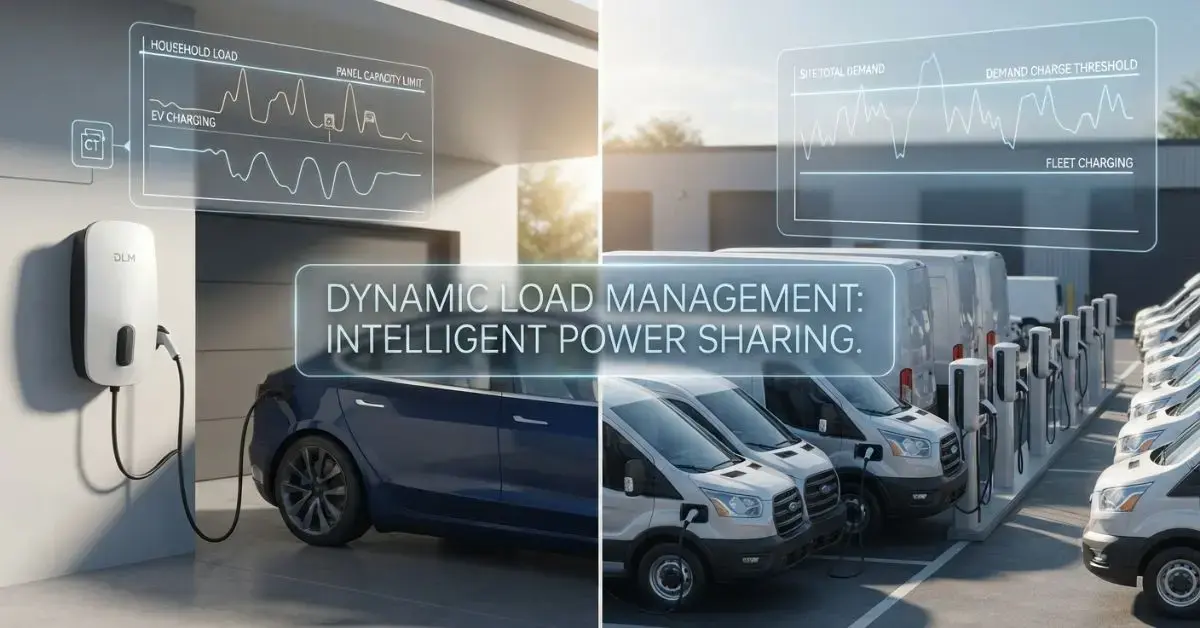
Your electrical panel has limits, but your EV charging need not stop. Dynamic load management lets you charge safely, avoid overloads, and get the most from your existing electrical system.
Dynamic load management (DLM) automatically adjusts charging power in real time. It uses your home’s available electrical capacity to prevent circuit overloads. This technology stops you from needing expensive panel upgrades.
DLM monitors total electricity demand. It continuously changes the charger output to stay within safe limits. When you run high-power appliances, the system lowers the EV charging speed. When those appliances stop, the speed increases again.
This technology allows multiple electric vehicles to charge simultaneously. It works even when you have limited electrical infrastructure.
See how this fits into the broader picture in our guide on what load balancing is for home EV charging.
How Dynamic Load Management Works
A DLM system uses current transformer (CT) sensors on your main electrical panel to measure your home’s real-time power usage. This data goes to the EV charger’s management software. The software then calculates how much power you can safely use to charge your vehicle.
If your home appliances and the EV charger require more power than your panel can safely handle, the DLM system automatically reduces the charging rate. When your other appliances stop using power, the charger returns to full speed. This process works smoothly without any input from the owner.
DLM Applications: Home to Fleet
| Application | Key Benefit | Cost |
|---|---|---|
| Single EV home (100–150A panel) | Prevents overloads; avoids $1,500–$3,000 panel upgrade | $200–$500 |
| Multi-EV home | Both EVs charge simultaneously without overloading | $400–$1,200 |
| Workplace (10–50 EVs) | Manages demand charges; optimises all vehicles | $5,000–$50,000 |
| Fleet depot (50+ EVs) | Prevents transformer overloads; enables V2G | $50,000–$500,000+ |
Dynamic Load Management for Home EV Charging
For homeowners with a 100A panel who want a 48A Level 2 charger, DLM is often cheaper than upgrading the panel. A CT sensor costs between $150 and $300. This device, combined with a DLM-capable charger like the Emporia Pro or ChargePoint Home Flex, prevents overloads. It stops your power from cutting out when you use your dryer, oven, or AC at the same time.
This $200–$500 solution replaces a $1,500–$3,000 panel upgrade. It offers great value for your overnight home EV charging needs.
Dynamic Load Management for Commercial EV Charging
Commercial electricity bills include demand charges. These fees are based on your highest 15-minute power usage during a billing period. If a fleet of 20 EVs charges simultaneously, it creates large power spikes. These spikes add hundreds or thousands of dollars to your monthly costs.
Dynamic Load Management (DLM) helps solve this. DLM spreads charging over different time slots. This keeps your peak power use below the limit that triggers extra fees. For a fleet of 20 vehicles, using proper DLM can save you $500–$3,000 every month in demand charges.
Installing this as a renter? See our guide on whether a landlord can deny EV charging installation.
Conclusion
Dynamic load management makes charging electric vehicles safe and affordable by using your current electrical setup. This technology saves homeowners from paying for expensive panel upgrades. For businesses, it reduces high energy costs and lets them add more chargers to a single power line.
Top smart home chargers, such as the Emporia Pro and ChargePoint with a CT sensor, include this feature. It is also a key part of every commercial fleet charging platform.
This kind of upgrade may also qualify for savings — see our guide on the federal tax credit for EV home charger installation.
FAQs
What is dynamic load management in EV charging?
Dynamic load management automatically adjusts EV charging power based on available electrical capacity to prevent overloads and improve energy use.
Do I need dynamic load management for home EV charging?
If your home has limited electrical capacity or you plan to install a high-power Level 2 charger, DLM can help you avoid an expensive electrical panel upgrade.
Can dynamic load management charge multiple EVs at the same time?
Yes. DLM intelligently shares available power between multiple EV chargers, allowing several vehicles to charge safely without exceeding the electrical system’s limits.
