
What Does a BMS Warning Light Mean in an EV?

Researched from the manufacturers’ own owner’s manuals and support pages (Tesla, Kia, GM Canada, Nissan, Volkswagen, Ford, Renault), NHTSA recall records, and Pico Technology’s published diagnostic case study. Prices are labelled with their source and market.
If a battery warning has just appeared on your dashboard, the first thing worth knowing is that the name you searched for does not quite exist. No mainstream EV has a dashboard lamp labelled “BMS warning light” — the battery management system reports problems through whatever warning your brand happens to use. This guide translates those warnings: what each one means, whether you can keep driving, and what to do next.
No mainstream EV has a dedicated BMS light. The BMS flags faults through your brand’s own battery or electric-system warning plus a written message — Tesla shows coded alerts such as BMS_a074, Hyundai and Kia show “Check electric vehicle system”, and a Nissan Leaf lights its amber EV system warning light. Judge yours by colour and wording:
• Red, or any message saying stop or that the car won’t restart → stop safely and arrange a flatbed tow
• Amber or yellow, car driving normally → drive gently and book a diagnosis within days
• A warning that returns after a restart or a charge → a real fault until proven otherwise
One of the most common — and cheapest — causes is a failing 12-volt battery, not the main high-voltage pack.
Is there really a “BMS light”? What you actually see
No mainstream EV has a lamp with that name — the BMS is the messenger, not the light, and the exact wording on your screen matters more than the symbol.
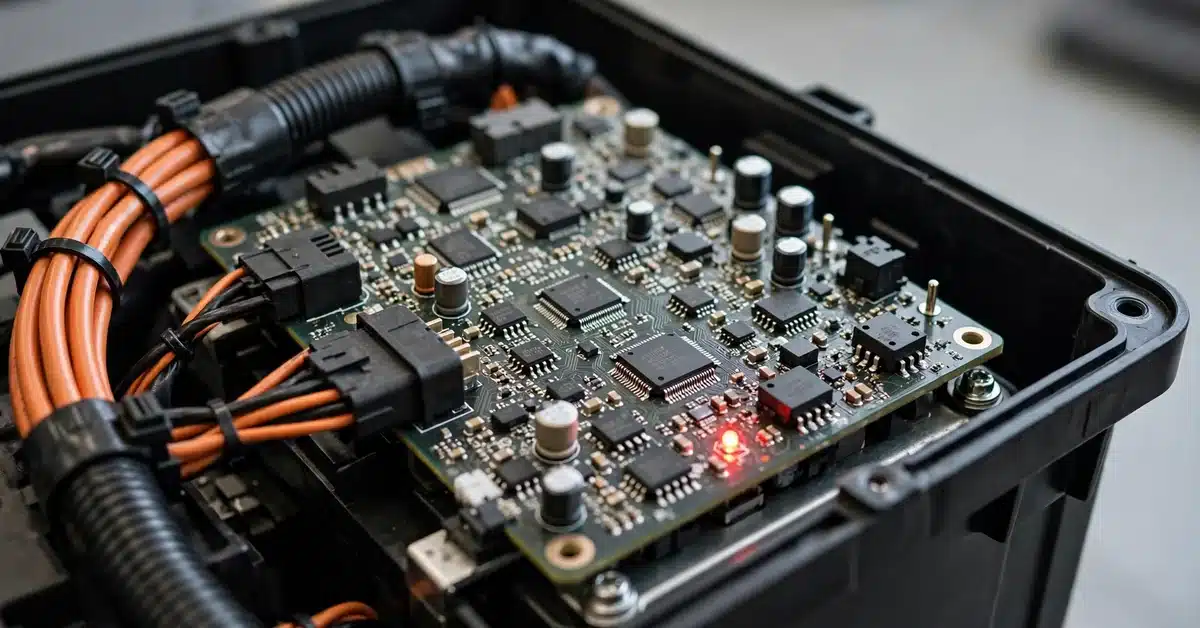
The BMS watches the pack continuously; when a value crosses a safety line it stores a fault code and asks the car to warn you. Each manufacturer chooses how that warning looks, so the same problem produces very different dashboards.
Tesla: text alerts and BMS codes, not a lamp
Tesla shows no battery icon at all — you get a written alert with a code, and the code is the diagnosis. The alert most owners meet is BMS_a074: “Maximum battery charge level reduced — OK to drive — Schedule service” — a condition inside the pack limiting performance, with service needed to restore full charge and range. BMS_a079 follows when the pack’s maximum level has already been lowered below 50%, so it cannot charge.
Behind both sits an imbalance chain: BMS_a066 (Service Mode only) → BMS_a064 caps charge at 50% → the driver-visible alerts. Owners can read their codes in Service Mode (Controls → Software, hold the model name, enter “service”) — look, but change nothing. Older Model S and X cars show the same story as BMS_u029.
Hyundai and Kia: “Check electric vehicle system”
On a Hyundai or Kia the message is “Check electric vehicle system” — and the owner’s manual is blunt: do not drive the car. Kia’s manual tells you to park safely and have the car towed to an authorised dealer. More specific messages separate out the cause: “EV Battery Overheated! Stop vehicle” for a hot pack; “Stop vehicle and check power supply” for a 12-volt supply failure. On the E-GMP cars (Ioniq 5, EV6, GV60), one named pattern sits behind many of these warnings: failure of the ICCU, the unit that also charges the 12-volt battery — the subject of NHTSA recalls 24V-204 and 24V-868 (Hyundai) and the matching Kia campaigns.
Volkswagen ID: yellow vs red high-voltage warnings
Volkswagen formalises the colour logic — Priority 2 yellow means get it checked soon; Priority 1 red, shown with the STOP lamp, means do not drive. The symbol is a car with an exclamation mark. In yellow it reports a fault in the electric drive system: still driveable, but the manual warns that driving on unchecked can end in a breakdown. In red it means the high-voltage battery cannot be charged — stop when safe, park in the open air, switch the drive system off.
Nissan Leaf: EV system warning light and the turtle
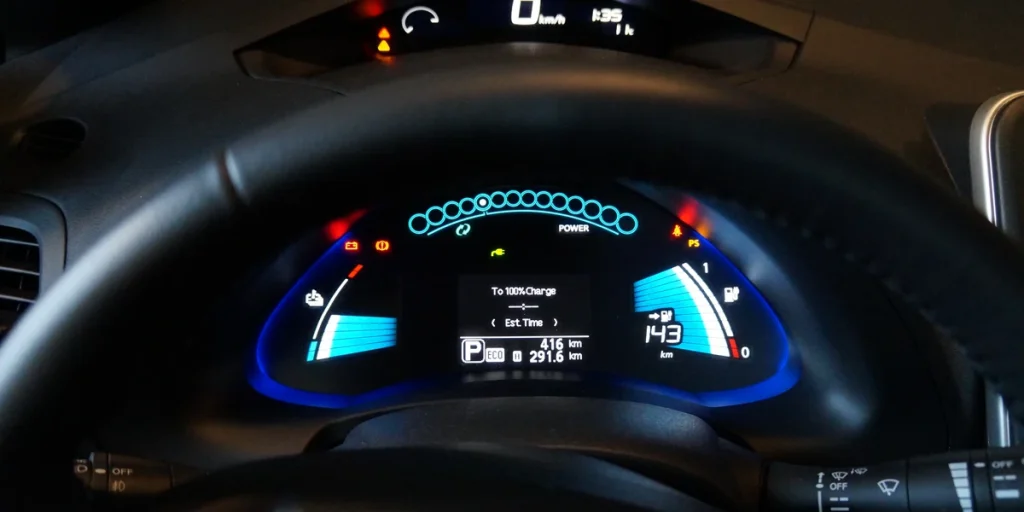
The Leaf comes closest to a named lamp: an amber “EV system warning light”, a car-with-exclamation symbol. Per Nissan’s manual it covers a malfunction in the traction motor or inverter, the charge port or onboard charger, the battery, the cooling system, the shift control, or an active emergency shut-off. The red master warning with a “Service EV System” message is the stop-and-check state; the separate turtle light means motor output has been cut — which also happens for innocent reasons, covered next.
GM and Ford: “Service Vehicle Soon” and message pairs
GM and Ford pair a telltale lamp with plain-English messages — and GM’s red messages are the most explicit in the industry. GM EVs light a “Service Vehicle Soon” telltale and put the detail in the driver display — “Service Battery Fault Vehicle Won’t Restart”, “Reduced Acceleration Drive With Care”, “Charge Vehicle Soon” — with power reduced to protect the battery; Bolt drivers know the family as “PROPULSION POWER IS REDUCED”. On Ultium models the pack’s modules report to the BMS wirelessly, which changes how faults are isolated — we explain how GM’s Ultium BMS manages the battery separately.
Ford’s Mach-E uses a wrench lamp (“Powertrain Malfunction / Reduced Power”), escalating from “High-Voltage Battery Warning” and “Service Vehicle Soon” to “Stop Safely Now” — the signature, on 2021–2022 cars, of the junction-box fault in TSB 25-2247.
Renault: “Check ELECTRIC system” vs “STOP: Electric failure DANGER”
Renault runs two tiers: an amber “Check ELECTRIC system” message for faults to book in, and a red STOP warning that means stop immediately. The Zoe’s electrotechnical warning light covers a traction battery too hot or too cold, or a fault in the small 12-volt battery. Hold on to that second possibility: the scariest Renault message of all, “STOP: Electric failure DANGER”, has been traced in a fully documented case to a failed 12-volt battery — as the causes section shows.
The warnings that are NOT faults (low charge and temperature)
A plain low-charge lamp and cold-weather power limits are the car protecting itself, not reporting a fault — separate them from real warnings before you panic.
Low charge: the EV’s fuel light
The plain battery-charge lamp works like a fuel light: the BMS lights it when charge falls below a set percentage, typically around 5–15% depending on the model. Kia’s manuals give concrete anchors on some models — “Low battery” at roughly 8% or less, “Charge immediately. Power limited” at roughly 3% — but thresholds vary by model. Below the threshold the car progressively trims power and cabin heating before limiting you to a crawl, all intended behaviour.
A cold or heat-soaked pack: temporary power limits
A very cold battery cannot deliver full power, so cars limit output until it warms: Kia shows “Power limited due to low EV battery temperature”, and the Leaf’s turtle is a documented cold-battery response. Owners report turtle mode on deep-cold mornings even with a healthy charge showing. These limits clear as the pack warms — a warning that behaves this way is protection, not a fault.
What colour and symbol mean: amber vs red
Amber means “book it in”; red means “stop” — and because EVs usually spell the warning out in words as well, reading the full message is always step one.
Amber or yellow: attention within days
An amber or yellow warning means a system has reported a malfunction. The car is usually still driveable, but the fault will not clear itself — treat it as a booking to make within days, not weeks, because ignoring one can end in a breakdown.
Red: stop when safe
A red electrical warning — typically a car-with-exclamation or battery symbol — means stop when safe, switch off, and call assistance. The same applies to any message containing “STOP”, “Stop Safely Now”, or wording that the car won’t restart. Red is the one colour you never drive through to see if it goes away.
The turtle, and the 12-volt lamp that confuses everyone
The tortoise symbol means reduced-power mode: output is limited because the battery is very low, very cold, too hot, or faulty. Separately, the 12-volt battery has its own warning, routinely mistaken for a main-battery fault — yet if it goes flat, the car may not switch on at all, even with a fully charged traction battery, because it powers the locks, screens and wake-up systems.
What the BMS is watching when it sets a warning
A warning means one of the values the BMS watches — a cell voltage, a temperature, the insulation between the high-voltage system and the body — has crossed a safety line.
The BMS is the pack’s control and protection layer, continuously monitoring:
- Every cell group’s voltage, plus pack current, temperature, state of charge and state of health
- The insulation resistance between the high-voltage system and the chassis
- Whether the main contactors — the pack’s heavy-duty switches — open and close as commanded
- Cell balancing, charge estimation, thermal control and fault diagnosis
When a reading leaves its safe range, the BMS limits charging or power, stores a code, and requests the warning you see. That does not automatically mean a dead pack: the trigger can be a value the BMS cannot trust — a sensor or communication fault — rather than a failed cell.
Common causes behind a BMS warning
Most warnings trace back to a short list of causes — and the cheapest one, a dying 12-volt battery, deserves suspicion before the main pack does.
A weak or failing 12-volt battery
One of the most common — and cheapest — causes of a terrifying battery warning is the small 12-volt battery. The best-documented case comes from Pico Technology’s diagnostic series: a Renault Zoe showing “STOP: Electric failure DANGER” intermittently, and “Check ELECTRIC system” at unlock, was root-caused to a failed 12-volt battery — Renault’s codes 0510 and 0512 point at the 12-volt battery and its charge control — and ran five months symptom-free after it was replaced. The pattern repeats: Ford’s code U3003 on the Mach-E almost always means a weak 12-volt battery, and a weak low-voltage battery on a Tesla can brown out several modules at once, producing a scatter of unrelated warnings, screen reboots and slow waking in the same week.
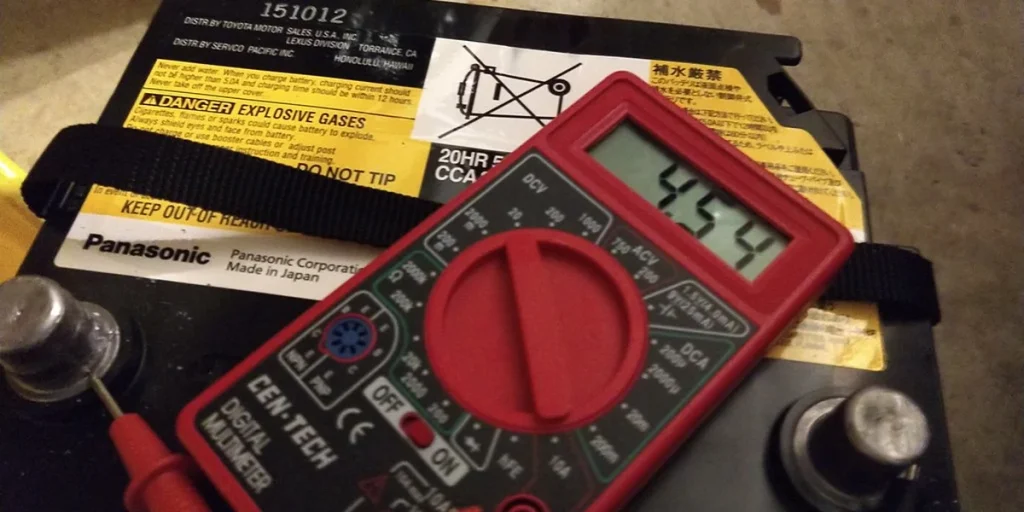
The exception that proves the rule: if a Hyundai or Kia keeps killing 12-volt batteries, the battery is the victim, not the culprit — the ICCU fault described earlier stops it being charged, and swapping batteries without fixing the ICCU just repeats the failure.
Cell imbalance or a failing cell group
A pack is only as strong as its weakest cell group, and the BMS stops charging the moment the fullest group reaches its ceiling — so one weak group shrinks the whole pack. Balancing bleeds a little charge from the fullest groups while the car sits at a high state of charge, and it is slow work measured in hours, which is why imbalance surfaces at the end of a high charge, when the BMS measures cell spread most closely: Tesla’s chain runs from the Service-Mode-only BMS_a066, through a 50% charge cap, to the driver-visible BMS_a074 and BMS_a079.
Leaf owners can watch it directly — LeafSpy displays all 96 cell-pair voltages, and our guide to what BMS the Nissan Leaf uses explains the hardware behind those readings.
Isolation fault: high voltage leaking where it should not
An isolation fault (code P0AA6) means the insulation between the high-voltage system and the car’s body has fallen below a safe level — serious, but not automatically a dead battery. The BMS monitors that insulation resistance continuously, and when it drops, safety protocols start. The causes are often physical rather than chemical: Hyundai’s own service bulletin for P0AA6 traced it to an internal coolant leak inside the traction motor, and the documented list runs from damaged high-voltage cables and water ingress to insulation failures inside the motor, inverter or high-voltage air-conditioning compressor. As one UK EV specialist puts it, an isolation fault does not automatically mean the battery is defective — diagnosis isolates which component is leaking.
Temperature and thermal-system faults
Lithium packs work best roughly between 15 and 45 °C; coolant loops, pumps, valves and heat pumps hold them there, and repeated back-to-back DC fast charging is one of the most intense thermal stressors the system faces. When a pump fails, coolant runs low, or a sensor misreads, the symptoms are temperature warnings, slower charging and reduced power. The driver-facing forms are Kia’s “EV Battery Overheated! Stop vehicle”, the Leaf’s overheating turtle, and GM’s “Propulsion Power Reduced Due to Temperature” — which GM classifies as protection behaviour that sets no fault codes at all.
Contactor and interlock faults
The contactors are the pack’s main switches, and a contactor that welds itself shut is a named, coded failure — not a mystery. GM’s service campaign for the 2019 Volt describes contactors welded closed, setting codes P0AA1 and P0AA4 and sometimes leaving the car unable to start; the fix there was a control-module reprogram. The Mach-E’s junction box is the modern version: its contactors overheat under repeated fast charging and hard acceleration, the car shows “Service Vehicle Soon” then “Stop Safely Now”, and the remedy under TSB 25-2247 is a replacement junction box plus a software update.
The high-voltage interlock loop completes the picture — it drops the contactors the moment an HV connector or cover is opened, so interlock faults also default to reduced power.
Sensor or communication glitches
Sometimes the warning is about the data, not the battery: a sensor or communication error can make a healthy pack look faulty. A failed temperature sensor, a coolant-pump feedback fault or a contactor-monitoring error can all trigger warnings and reduced power as a safe default. GM states this openly: its red battery messages can also appear when the car’s battery systems have errors communicating with each other. The extreme version is in a Stellantis service bulletin — communication lost between the vehicle controller and the battery pack control module prevented the contactors closing at all, leaving the car unable to start; the fix was a software flash.
Genuine degradation or pack failure
Real pack failures do sit behind some of these warnings — the generic codes P0A7F (battery pack deterioration) and P0A80 (replace battery pack) exist for exactly that. Owner reports for persistent Tesla BMS_a074/BMS_a079 alerts show the full spread of outcomes, from the alert clearing after a software update to Tesla replacing the pack under warranty. The Bolt’s recall-era failure pattern presented the same way: “Propulsion Power is Reduced” and “Service Vehicle Soon” messages, charge limits, and in some cases a car that would not move. Pack failure is a diagnosis of exclusion — what remains after the codes, the 12-volt battery and the live cell data have been checked.
Can you still drive? The triage table
Judge by colour, wording and how the car behaves — not by the mere fact that a warning exists.
One pattern outranks every other clue: a warning that returns after a restart or after a charge. Specialist repairers stress that BMS faults are rarely confirmed by a simple reset, and a warning that keeps coming back is the never-ignore signal. Everything else sorts like this:
| Situation | What to do |
|---|---|
| Red warning, “STOP” / “Stop Safely Now” / “Vehicle Won’t Restart” wording, smoke or burning smell, or sudden power loss | Stop when safe, switch off, do not keep restarting it — arrange recovery |
| “Check electric vehicle system” on a Hyundai or Kia | The manual says do not drive — park safely and have it towed to a dealer |
| Amber or yellow warning, car driving normally | Drive gently and book a diagnosis within days; it will not clear itself |
| Turtle / reduced power with plenty of charge and a normal temperature | Treat as a fault until proven otherwise and get the codes read |
| Turtle / reduced power with very low charge, or a very cold or heat-soaked pack | Charge, or let the pack reach a normal temperature, first — usually protection, not a fault |
| Low-charge battery lamp only | Not a fault — charge soon, and expect progressive power cuts below the threshold |
| Warning appeared straight after a charging session, car otherwise normal | Try your brand’s documented reset once (next section); if it returns, it is a fault, not a glitch |
Safe checks you can do yourself
Read the message, try one documented restart where your brand offers one, and gather clues — do not start unplugging things.
Start with the message itself
Read the full text on the screen rather than guessing from the symbol, and note the colour and exact wording — a photograph on your phone is genuinely useful to a workshop. Check the manufacturer’s app too: brand apps surface charging status and stored alerts the dashboard may not show again once you switch off. And note what changed just before the warning — a charging session, a cold night, a software update — because that timing is diagnostic evidence.
The one restart worth trying
For its EVs, GM publishes an official reset for communication-type errors: unplug if you are charging, then with the car in Park switch it on for 10 seconds, off for 10 seconds, and on again, up to three cycles. If the warning persists, GM’s deeper sleep reset is to switch off, lock the car, and leave the key fob at least 15 feet away for 30 minutes before trying again. GM attaches a warning that must travel with this advice: depending on the error, the car may not restart after you switch it off — so do any restart somewhere safe and accessible, never mid-journey at the roadside.
Clues worth handing to the workshop
Tesla owners can read the exact alert code in Service Mode and quote it when booking — codes name faults precisely, which saves paid diagnostic time. Leaf owners get real data from LeafSpy, and the Car Scanner app with the right profile shows battery data a generic reader cannot. Finally, report any 12-volt symptoms alongside the warning — slow waking, screen reboots, several unrelated warnings in one week, sluggish door handles — as they point a good workshop at the cheap battery first.
What NOT to do when the warning appears
The dangerous mistakes are opening things, erasing things, and driving through a red warning.
- Never open the battery pack or touch orange cabling. High-voltage wiring is orange and labelled for a reason; Kia’s manual warns that touching orange or high-voltage-labelled components can cause severe injury or death. There are no user-serviceable parts inside the high-voltage system.
- Do not clear the fault codes before they are recorded. Clearing wipes the freeze-frame data — the snapshot of conditions when the fault set — which is often the technician’s most useful clue.
- Do not keep driving on a red warning, and do not charge a car with a suspected isolation fault until it has been assessed.
- Do not repeatedly restart a car that says it will not restart — each attempt risks stranding it somewhere worse, and GM’s own guidance warns a restart may not happen at all.
- Do not let it be towed on its driven wheels. An EV must travel on a flatbed, all four wheels off the ground; towing with driven wheels down spins the motor and generates uncontrolled current that can damage the motor controller and BMS.
- Do not disconnect the 12-volt battery as a “reset” — a later section explains why it cannot clear a high-voltage fault, and it destroys evidence in the attempt.
How a workshop diagnoses it (and what diagnosis costs)
Proper diagnosis is a full-system scan plus live battery data — a BMS warning is rarely confirmed by a simple reset.

A competent workshop starts with the stored fault codes, then works through live data, module communication checks, charge and load testing, and a cell-imbalance check. The dealer tools are brand systems: Hyundai and Kia’s GDS (its isolation-breakdown test is documented in Hyundai’s own bulletin), Nissan’s CONSULT for the Leaf battery health report, Ford’s FDRS — which can even read Mach-E codes remotely — and Tesla’s Toolbox and Service Mode. The codes they may quote back include P0AA6 (isolation), P0AA1/P0AA4 (contactor stuck closed), P0A7F/P0A80 (deterioration / replace pack), the E-GMP isolation family P1AA700/P0AA700, and Tesla’s BMS_a066/a064/a074/a079 chain.
Why a pocket OBD reader won’t read it
A generic OBD2 reader on an EV typically returns few or no useful codes, because the standard was built for petrol and diesel emissions systems. The data that decides a battery warning — individual cell voltages, state of health, insulation resistance, BMS fault codes — sits behind manufacturer-specific protocols. The owner apps that do read real battery data are the exceptions: LeafSpy, Car Scanner with the correct profile, and Scan My Tesla. Beyond those, diagnosis needs professional EV equipment.
What diagnosis costs
No manufacturer publishes a standard diagnostic fee, so treat every figure as what it is: a third-party price list or owner reporting. One published anchor: UK independent Bartlett Auto lists an EV vehicle diagnostic at £192 including VAT on its July 2025 price list. US dealer diagnosis is typically reported at $100–$300, and the fee may be charged even when the repair itself is covered. Owner reports consistently say the fee is not charged in the end when the fault is covered under warranty — worth confirming when you book.
What the fix usually is — and what it costs
Outcomes run from a 12-volt battery to, rarely, a whole pack — and most cars still under warranty never see the big numbers.
The cheap outcome: the 12-volt battery
If the culprit is the 12-volt battery, the bill is ordinary-car money. Tesla owners report a mobile-service replacement at roughly $120–$160 all-in, and owner-reported 12-volt replacements across brands mostly land between $100 and $300. On a Zoe-class car it is simply a standard 12-volt battery — the Pico case above was fixed with a 40 Ah unit.
The middle outcome: a module, a junction box, or software
Where the maker authorises module-level repair, one module from the parts catalogue lists at a fraction of a pack: $1,404.76 for a Hyundai Ioniq 5 module and $1,885 for a Kia EV6 module in October 2026 catalogue pricing — parts only, labour on top. Ford, Hyundai, Kia and BMW all authorise module-level work. Tesla’s imbalance repairs sit in the same band: one independent European Tesla specialist publishes $1,500–$7,000 for module and pack work. And some fixes are software alone — GM’s welded-contactor campaign was a reprogram, and the E-GMP ICCU fault is a recall repair.
The rare outcome: a full pack
A complete new pack is the worst case and the least common. Catalogue list prices put a new Chevrolet Bolt pack at $16,250 and a new 62 kWh Nissan Leaf pack at $16,564.71. The same Leaf pack, remanufactured, lists at $2,352.94 plus a $2,500 core deposit — a gap that explains why the remanufactured market matters for out-of-warranty cars. Before any of these numbers become your problem, read the warranty section below.
Reset myths: disconnecting the 12-volt, clearing codes, software updates
Clearing a code erases the record, not the fault — and some codes cannot be erased at all until the car passes its own re-test.
Myth: clearing the code fixes it
Clearing wipes the stored and pending codes, the freeze-frame snapshot and the readiness monitors in one move. If the condition is still there, the car’s monitors run again and the light returns — a returning light is the system confirming the fault is still active. Some codes cannot be erased by any scanner or battery disconnect: “permanent” fault codes on US cars from 2010 onward clear only when the car’s own self-test passes after a repair. Honda’s documentation for the welded-contactor code P0AA1 makes the safety case plainly — do not clear the code before diagnosis is complete, because clearing and switching on can mask a welded contactor.
Myth: disconnecting the 12-volt resets the BMS
It does not. High-voltage fault codes live in the battery and powertrain modules, not in the 12-volt system, and permanent codes survive a disconnect anyway. What a disconnect does achieve is destroying the freeze-frame evidence the workshop needed. The 12-volt battery earns its place in this story as a cause of warnings, not as a cure for them.
What a restart can honestly clear
Two fault types do legitimately clear with a proper power-down. Communication errors between the battery systems are the first — exactly the class GM’s official reset procedure in the Safe checks section is written for. Charger-handshake faults are the second: Mach-E owners document the full warning set appearing after a faulty charger or an interrupted charge, and the pinned owner procedure is to unplug and power the car fully down for around 15 minutes.
Software updates cut both ways
Software genuinely matters here, because the BMS’s limits and calibration live in code that updates over the air — our guide to what BMS firmware is and why your EV needs it explains how those updates reach the car. Tesla owners report imbalance-type alerts appearing straight after a charge to 90% or more — a calibration moment, when the BMS measures cell spread — and in some cases disappearing after a later update. Read that honestly in both directions: an update can retire a marginal alert, but in the same owner threads, other cars showing the same alert needed replacement packs.
When warnings appear: after charging, on cold mornings, after fast charging
Timing is a clue: a warning that follows a charge, a cold night or a fast-charging session is pointing in three different directions.
Right after charging
Two stories hide here. The benign one is the charger handshake: an interrupted session or a misbehaving charger can throw the whole warning set on a Mach-E, and GM’s reset procedure tellingly starts with “if you were charging, unplug”. The more serious one is calibration: Tesla’s imbalance alerts characteristically surface the morning after a charge to 90–96%, because that is when the BMS measures and balances the cells. A post-charge warning that survives one proper reset belongs in the second story until a workshop proves otherwise.
On cold mornings
A marginal 12-volt battery fails first in the cold — Tesla 12-volt failures cluster in winter, and a battery that coped in mild weather can give up on the first properly cold morning, taking the dashboard’s sanity with it. Alongside that, expect the protection messages: Kia’s “Power limited due to low EV battery temperature” and cold-triggered turtle modes are the car working as designed. If a warning clears as the car warms and stays away in mild weather, suspect temperature and the 12-volt battery before the pack.
After fast charging, or hard driving in heat
A heat-soaked pack derates: reduced power and slower charging until temperatures recover. GM documents its “Propulsion Power Reduced Due to Temperature” message appearing at any state of charge immediately after a fast charge in extreme heat, and classifies it as setting no fault codes at all — protection, recorded as nothing. Repeated back-to-back fast charging is the classic trigger. A warning in this pattern that fades with cooling is the thermal system doing its job; one that stays is not.
Check the battery warranty before you pay for anything
Before paying for any battery diagnosis or repair, check the battery warranty — it is longer and stronger than most owners realise, and a driver with a three-year-old car can end up paying for a covered pack.
- The US floor: every EV battery sold in the US carries at least an 8-year/100,000-mile warranty against defects and excessive degradation, under a federal requirement.
- The capacity trigger: most brands guarantee roughly 70% capacity retention inside the term. Below the threshold is a claim; a battery at 71–79% is explicitly “normal degradation” and not claimable.
- California and CARB states: qualifying vehicles carry a 10-year/150,000-mile battery warranty under California’s emissions rules.
- Above the floor: Hyundai and Kia’s factory battery cover runs 10 years/100,000 miles with a 70% guarantee.
- Claims need evidence: a warranty claim requires authorised diagnostics — a state-of-health measurement and BMS logs — one more reason never to clear codes before they are read.
- The exception: the 12-volt battery is not on the battery warranty. On a Tesla, for example, it sits under the basic vehicle warranty of 4 years/50,000 miles.
FAQs
Short answers, with the warning still on your dash — the full detail sits in the sections above.
Is there really a “BMS warning light” on my dashboard?
No. No mainstream EV has a dashboard lamp with that name — the BMS reports faults through your brand’s own electric-system warning and a written message. Tesla shows coded text alerts, Hyundai and Kia show “Check electric vehicle system”, and the Leaf has its amber EV system warning light. The message and its colour, not the phrase “BMS light”, are what you act on.
Can I drive with the battery warning light on?
It depends on colour and wording. Amber or yellow, car driving normally: drive gently and book a diagnosis within days. Red, any “STOP” or “won’t restart” wording, or sudden power loss: stop safely and arrange a flatbed. Hyundai and Kia’s manual goes further for “Check electric vehicle system” — do not drive; have the car towed.
My warning appeared right after charging — is it serious?
Not always. An interrupted session or a misbehaving charger can throw a full set of warnings that one proper power-down clears, and Tesla’s imbalance alerts also surface after a high charge because that is when the BMS measures the cells. Try your brand’s documented reset once, somewhere safe. If the warning returns, treat it as a genuine fault and get the codes read.
Will disconnecting the 12-volt battery reset the warning?
No — not for a high-voltage fault. Battery fault codes live in the battery and powertrain modules, permanent codes survive a disconnect, and you erase the freeze-frame data the workshop needs. Ironically, the 12-volt battery itself is one of the most common causes of these warnings; replacing a failing one is a fix, disconnecting a healthy one is not a reset.
How much does diagnosis cost?
There is no standard fee — no manufacturer publishes one. A published UK anchor is £192 including VAT for an EV diagnostic at an independent specialist, and US dealer diagnosis is typically reported at $100–$300. Owner reports consistently say the fee is waived when the fault turns out to be covered under warranty, so ask before you book.
Is a battery warning covered under warranty?
Often, yes. Every US EV battery carries at least an 8-year/100,000-mile warranty against defects and excessive degradation, most brands guarantee around 70% capacity inside the term, and California-rule cars get 10 years/150,000 miles. A genuine pack, module or contactor fault inside those limits is the manufacturer’s bill — but the 12-volt battery is not covered by the battery warranty.
Conclusion
A BMS warning is the start of a diagnosis, not a verdict on your battery.
Read the full message before you react to the symbol. Judge it by colour, wording and how the car drives, and use the triage table to decide between driving gently to a booking and stopping for a flatbed. Try one documented reset only when the pattern fits — a warning straight after charging, on a car that otherwise behaves — and never clear codes or disconnect batteries in a way that destroys the evidence. Suspect the 12-volt battery and read the codes before accepting any conclusion about the pack itself. And before money changes hands, check the warranty: on a car inside its battery cover, the scariest warning on the dashboard is very often somebody else’s bill.
