
What Is a BMS Microcontroller Unit (MCU)?

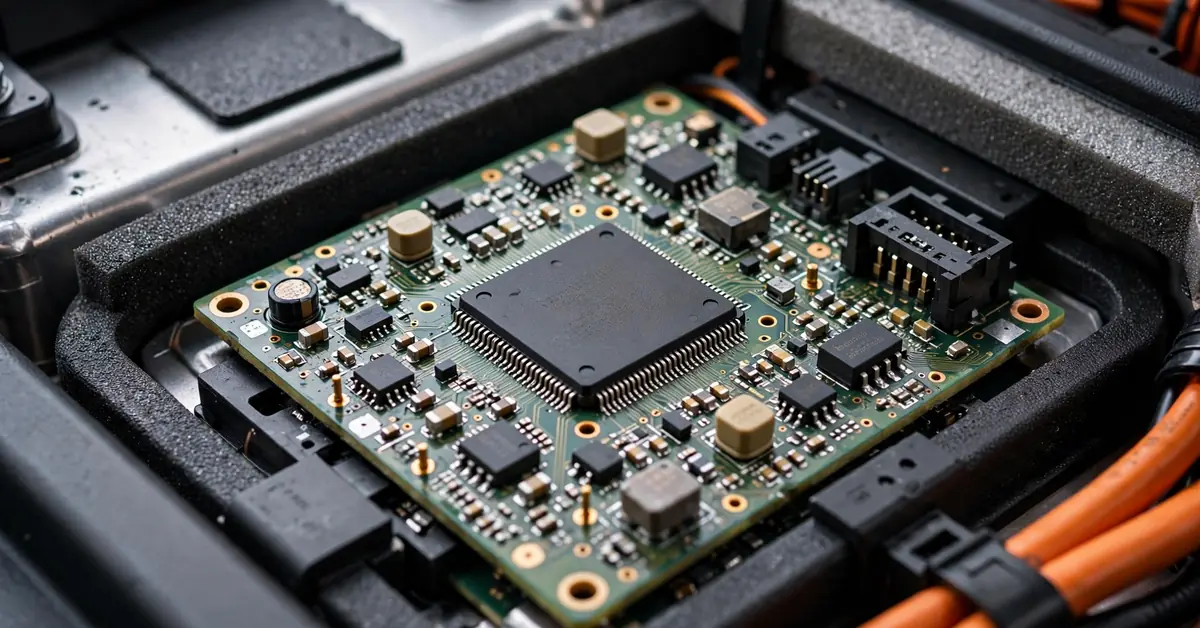
A BMS microcontroller unit (MCU) is the central processor that runs the battery management system’s core software, taking sensor data from the analog front-end and fuel gauge, then executing the algorithms that make protection, balancing, and state-estimation decisions. It’s the decision-making brain sitting at the heart of the whole system.
Why the MCU Is Considered the Core of the BMS
While the analog front-end handles raw sensing and power electronics handle physical switching, neither makes complex decisions on its own. The MCU is what interprets that data through algorithms, state-of-charge and state-of-health estimation, cell balancing logic, fault detection, and thermal management decisions, then commands the rest of the system accordingly.
What Determines Which MCU a BMS Design Uses
Processing Power
More sophisticated analysis, like real-time impedance tracking or Kalman filter-based SOC estimation, demands more computational headroom than simpler coulomb-counting-only designs. Higher cell counts and more complex algorithms both push toward more powerful MCU selection.
Peripheral Support
MCUs used in BMS applications typically need a wide range of built-in peripherals: SPI, I2C, and CAN interfaces for communication, precision ADCs for any locally handled sensing, PWM engines for controlling switching components, and often a real-time clock for timestamping data.
Power Management Features
Since some BMS functions need to remain active even when a vehicle is parked, monitoring for faults or managing low-power standby states, MCUs with efficient low-power modes and minimal standby current draw are highly valued in automotive BMS design.
Safety and Security Features
Given the safety-critical nature of battery management, automotive-grade MCUs often include hardware security features like trust protection units, alongside compliance with functional safety standards relevant to automotive electronics.
What Software Actually Runs on the MCU
Many modern BMS platforms run real-time operating systems, such as AUTOSAR or FreeRTOS, specifically chosen to manage the complex, time-sensitive coordination required across monitoring, protection, balancing, and communication tasks running simultaneously.
How the MCU Fits Into the Broader BMS Structure
In a typical design, the MCU works alongside an analog front-end (which handles direct sensing and sometimes fast local protection) and a fuel gauge IC (which may handle specialized SOC/SOH calculations). The MCU ties these pieces together, making higher-level decisions and handling communication with the rest of the vehicle.
The MCU as a Secondary Protection Layer
In some designs, the AFE can handle the fastest, most time-critical protection responses directly, while the MCU serves as a secondary, more sophisticated protection mechanism, applying more complex logic and configurable thresholds that would be harder to implement purely in the AFE’s simpler hardware logic.
| MCU Requirement | Why It Matters |
|---|---|
| Processing power | Supports complex algorithms like Kalman filtering |
| Communication peripherals (CAN, SPI, I2C) | Enables data exchange with sensors and vehicle systems |
| Low-power modes | Supports monitoring during parked/standby states |
| Safety/security features | Meets automotive functional safety requirements |
Conclusion
A BMS microcontroller unit is the central processor that transforms raw sensor data into the protection, balancing, and state-estimation decisions the whole battery system depends on. Its processing power, peripheral support, power efficiency, and safety features all directly shape how sophisticated and reliable the overall BMS can be.
FAQs
Does a more powerful MCU always mean a better BMS?
Not necessarily on its own — algorithm quality, sensor accuracy, and overall system design matter just as much as raw processing power.
Why does the MCU need to run even when the car is parked?
To continue monitoring for faults and manage low-power standby functions, though it operates in a reduced-power mode to conserve energy.
What operating systems do BMS MCUs typically run?
Many use real-time operating systems like AUTOSAR or FreeRTOS, chosen for their ability to manage time-sensitive, simultaneous tasks reliably.
