
What Sensors Does a BMS Use?

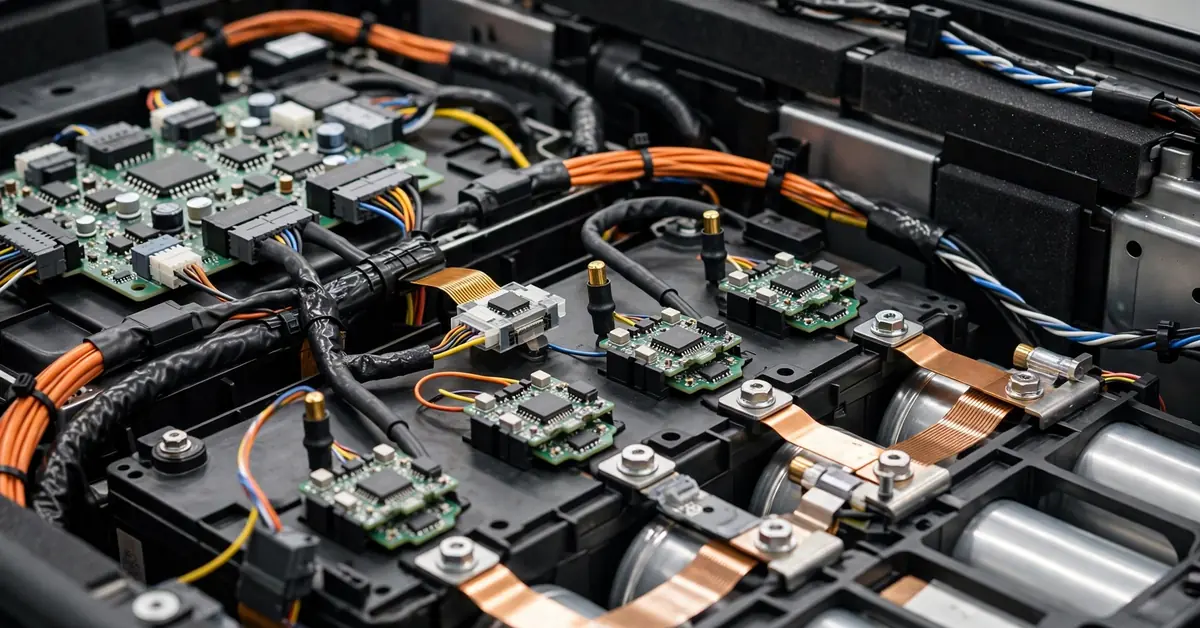
A BMS uses voltage sensors, current sensors (shunt resistors or Hall-effect devices), and NTC temperature sensors as its three core measurement types, with some advanced designs adding pressure, gas, and insulation-resistance sensors for enhanced safety. Every other BMS function ultimately depends on the quality and placement of these sensors.
Voltage Sensors: Reading Every Individual Cell
Rather than a simple voltmeter, BMS voltage sensing uses specialized analog front-end chips paired with high-resolution ADCs, capable of isolating and measuring one specific cell’s voltage even within a series stack reaching hundreds of volts. Sigma-delta ADCs are commonly used specifically because they handle the high common-mode voltages present across a long cell chain while still resolving small millivolt-level differences between cells.
Current Sensors: Tracking Energy Flow
Shunt Resistors
A precision, low-resistance shunt placed directly in the current path creates a small voltage drop proportional to current. This remains the dominant approach in automotive BMS design due to its accuracy, linearity, and fast response time.
Hall-Effect Sensors
These measure the magnetic field generated by current flow without direct electrical contact, offering built-in isolation. Many designs use Hall sensors as a redundant secondary measurement alongside a primary shunt, specifically to satisfy automotive safety redundancy requirements.
Temperature Sensors: NTC Thermistors
NTC (negative temperature coefficient) thermistors dominate BMS temperature sensing because they’re inexpensive, respond quickly, and remain accurate across the range of temperatures EVs actually experience. They’re distributed across multiple points in the pack, not just centrally, since heat isn’t uniform across a large battery.
Beyond the Core Three: Advanced Sensing Technologies
Pressure and Gas Sensors
Increasingly common in newer designs, these sensors detect early physical signs of internal cell breakdown, sometimes before any significant temperature change is measurable, providing an earlier warning layer for thermal runaway precursors.
Insulation Resistance Monitoring
This detects ground faults, a serious electrical safety issue where high-voltage current could inadvertently reach the vehicle chassis, by continuously checking the resistance between the high-voltage system and the vehicle’s ground.
Infrared and Distributed Temperature Sensing
Some emerging designs use infrared sensor arrays routed through the pack to detect sudden localized temperature spikes in individual cells without requiring a physically wired sensor at every single cell location.
Why Sensor Redundancy and Placement Matter So Much
A single point of sensor failure could leave the BMS operating on false information, exactly the scenario the whole system exists to prevent. This is why automotive-grade BMS designs emphasize redundant sensing paths, cross-checking between different sensor types, and careful physical placement to catch localized issues an averaged reading would miss entirely.
| Sensor Type | What It Measures | Why It Matters |
|---|---|---|
| Voltage sensor (AFE + ADC) | Individual cell voltage | Core input for protection and SOC/SOH |
| Shunt resistor | Current via voltage drop | Fast, accurate, industry standard |
| Hall-effect sensor | Current via magnetic field | Isolated, often used redundantly |
| NTC thermistor | Temperature at multiple points | Drives thermal management decisions |
| Pressure/gas sensor | Early internal fault signals | Earliest possible thermal runaway warning |
Conclusion
A BMS relies on voltage, current, and temperature sensors as its foundational measurement layer, with pressure, gas, and insulation-resistance sensing increasingly added for earlier and more comprehensive safety coverage. Since every protective decision the BMS makes traces back to these sensor readings, their accuracy, redundancy, and placement are just as important as the algorithms that process their data.
FAQs
Why does a BMS need more than one type of current sensor?
Redundancy helps meet automotive safety standards and lets the system cross-check readings to catch a faulty sensor.
Are gas sensors common in EV battery packs today?
They’re increasingly adopted in newer designs specifically for earlier thermal runaway warning, though not yet universal across all EVs.
Can a single faulty sensor compromise the whole BMS?
Well-designed systems use cross-checking between multiple sensors specifically to catch and isolate this kind of individual sensor failure.
