
What Is AI-Powered Battery Management in EVs?

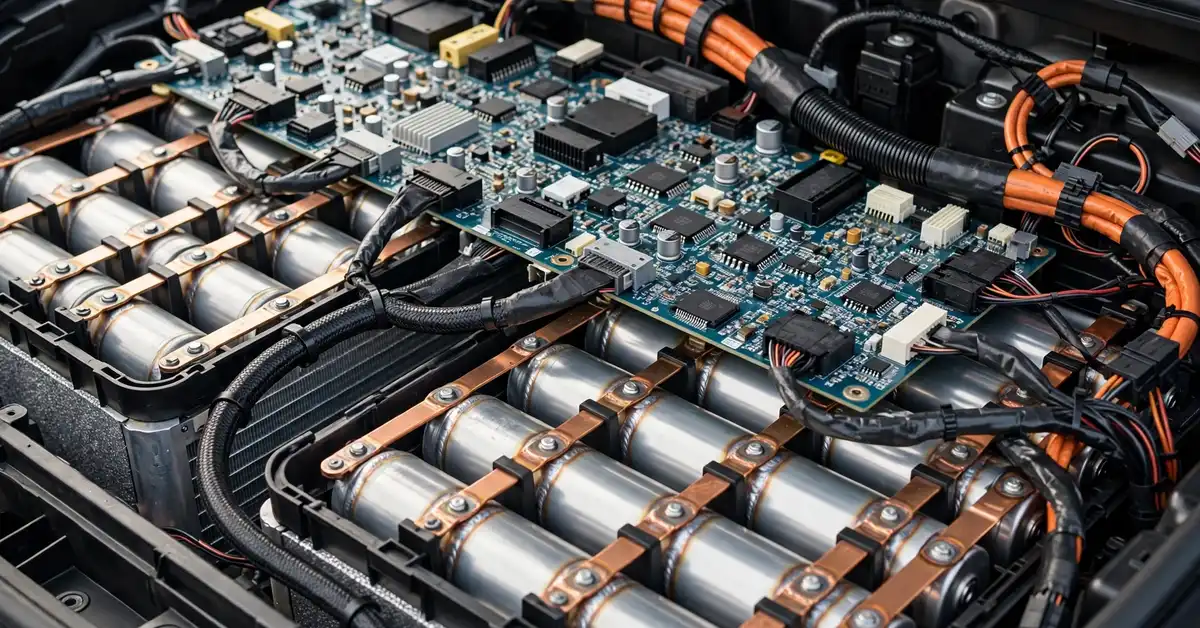
AI-powered battery management in EVs uses machine learning models, like neural networks and gradient boosting, to predict SOC, SOH, and potential faults more accurately than traditional physics-based formulas, especially under the complex, nonlinear conditions real-world driving creates. It’s a shift from fixed mathematical models to systems that improve as they learn from actual battery behavior.
Why Traditional Methods Struggle With Battery Complexity
Battery behavior depends on a tangle of interacting factors, temperature, state of charge, load dynamics, and aging effects, all influencing each other in nonlinear ways. Traditional mathematical models frequently struggle to fully capture these complex relationships, which is exactly the gap AI and machine learning approaches are designed to close.
How AI Improves Core BMS Functions
More Accurate SOC Prediction
Machine learning models like Random Forest Regression and ensemble methods combining multiple algorithms have demonstrated accuracy that surpasses traditional coulomb-counting or simple voltage-based methods, particularly at tracking the nonlinear voltage curves real cells actually produce under changing load.
Better SOH and Remaining Useful Life Estimation
Deep learning approaches, including LSTM (Long Short-Term Memory) networks, are well suited to SOH prediction because they can integrate a broad range of system features and historical patterns into a single estimate, something considerably harder for fixed formula-based models to do well.
Predictive Fault Detection
By recognizing patterns across large volumes of data, AI models can identify problems like early degradation or developing faults before they become significant, supporting genuinely predictive rather than purely reactive maintenance.
Types of AI Techniques Used in Modern BMS Design
Neural Networks (including LSTM/CNN)
These excel at real-time data processing and pattern recognition, particularly useful for predicting battery behavior and detecting degradation trends from sequences of historical data.
Supervised and Reinforcement Learning
Supervised learning is commonly used for predictive tasks, like SOH prediction, trained on historical labeled data. Reinforcement learning is applied to optimization tasks, like refining charging and discharging strategy based on outcomes over time.
Fuzzy Logic
Fuzzy logic handles the inherent uncertainty in sensor data and constantly changing external conditions, allowing the system to make charge, discharge, and temperature-regulation decisions with a flexibility closer to human judgment than rigid rule-based logic.
Self-Learning BMS: Getting Smarter Over Time
A self-learning BMS continuously refines its own predictive accuracy as more real-world operating data accumulates, dynamically fine-tuning its SOC or SOH estimation algorithms rather than remaining static from the day it was deployed.
Practical Limitations Worth Knowing
Sophisticated machine learning models often require significant data and computing power that a vehicle’s onboard controller can’t always provide directly. This is one reason many AI-enhanced BMS designs offload the heaviest computation to cloud infrastructure, syncing results back to the vehicle rather than running everything locally in real time.
| AI Technique | Primary Use in BMS |
|---|---|
| Neural networks (LSTM/CNN) | SOC/SOH prediction, fault pattern recognition |
| Ensemble methods (Random Forest, XGBoost) | Improved SOC/SOH accuracy over traditional formulas |
| Reinforcement learning | Optimizing charge/discharge strategy over time |
| Fuzzy logic | Handling sensor uncertainty and variable conditions |
Conclusion
AI-powered battery management uses machine learning models to predict SOC, SOH, and developing faults with greater accuracy than traditional physics-based formulas, particularly under the complex, real-world conditions where fixed models struggle most. As computing power and cloud connectivity continue expanding what’s practical to run, this data-driven approach is becoming an increasingly central part of how modern EV battery systems are designed.
FAQs
Does AI-powered BMS run entirely inside the vehicle?
Not always — the most computationally demanding models often run partly in the cloud, with results synced back to the vehicle.
Can AI-based SOH prediction replace traditional physics-based models entirely?
Not necessarily; many systems combine both approaches, using AI to enhance accuracy rather than fully replace established physics-based methods.
Does a self-learning BMS improve after I buy the car?
Yes, in vehicles that support it, the system can refine its predictions over time as it accumulates more real-world driving and charging data.
