
Why Does NMC 811 Have More Range Than Older NMC?

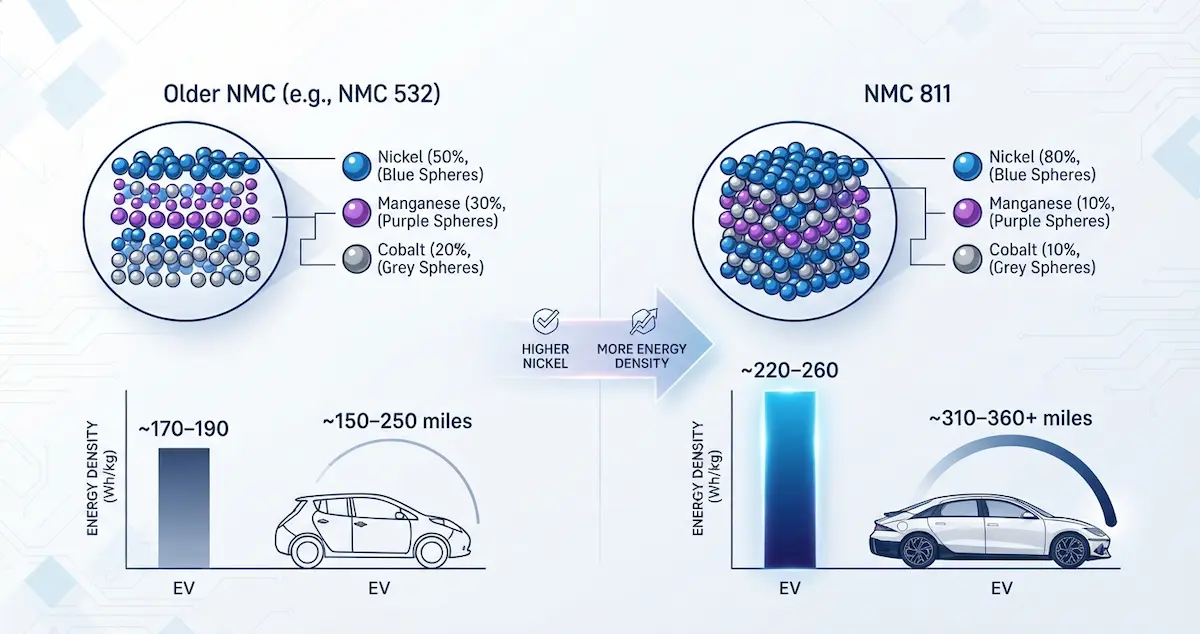
NMC 811 has more range than older NMC variants because of one simple principle: more nickel = more lithium stored per gram = more energy per kilogram. NMC 811’s cathode is 80% nickel vs 50% in NMC 532. That higher nickel content raises the cell’s energy density from ~170–190 Wh/kg (NMC 532) to ~220–260 Wh/kg (NMC 811) — a 30–40% improvement that translates directly into more miles per charge for the same battery weight.
New to NMC chemistry itself? Start with our full explainer on what NMC battery chemistry is.
The Nickel-Energy Density Relationship
In NMC chemistry, nickel is the primary contributor to energy capacity. Nickel can reversibly accommodate more lithium ions per unit weight than manganese or cobalt. As nickel content increases from 50% (NMC 532) to 80% (NMC 811), the cathode can store and release more lithium per charge cycle — directly increasing the cell’s gravimetric capacity (measured in mAh/g). Higher capacity × cell voltage (~3.7V) = higher energy density (Wh/kg).
| NMC Variant | Nickel Content | Approx. Capacity (mAh/g) | Energy Density | Range Impact (75 kWh pack) |
|---|---|---|---|---|
| NMC 532 | 50% | ~155–165 mAh/g | ~170–190 Wh/kg | ~250–280 miles |
| NMC 622 | 60% | ~170–180 mAh/g | ~190–220 Wh/kg | ~280–310 miles |
| NMC 811 | 80% | ~190–200 mAh/g | ~220–260 Wh/kg | ~310–360+ miles |
What Manganese and Cobalt Do (Why Not Just Use More Nickel?)
If nickel provides more energy, why not use 100% nickel? Because manganese and cobalt serve essential structural roles:
- Manganese: Stabilizes the layered oxide crystal structure, reducing cation mixing (Ni²⁺ migrating to Li⁺ sites) and improving thermal stability. Without manganese, the cathode structure degrades faster.
- Cobalt: Maintains the ordered layered structure, improves electronic conductivity, and enables the high-rate capability needed for fast charging. Without cobalt, the cathode becomes harder to process and more prone to structural disorder.
At 80% nickel (NMC 811), the remaining 10% manganese and 10% cobalt are the minimum needed to maintain structural integrity. Attempts to push to 90%+ nickel (ultra-high nickel NMC) face serious challenges with particle cracking, surface instability, and rapid degradation — requiring advanced surface coatings and doping strategies.
Real-World Range: NMC 811 vs Older NMC
The Hyundai Ioniq 6 Long Range uses NMC 811 in a 77.4 kWh pack to achieve 361 miles EPA range. An equivalent vehicle using NMC 532 with the same 77.4 kWh pack would need to be significantly heavier to carry equivalent range — because NMC 532 stores ~30% less energy per kilogram of cathode material. The shift from NMC 622 to NMC 811 in premium EVs from 2020 onward added approximately 50–80 miles of range to comparable vehicles without increasing pack size.
Want the complete side-by-side numbers for all three ratios? See our comparison of NMC 532 vs NMC 622 vs NMC 811.
The Trade-off: Stability and Thermal Risk
NMC 811’s higher nickel content makes the cathode more reactive:
- Thermal runaway onset: ~200–210°C (slightly lower than NMC 622’s ~215–220°C)
- Higher sensitivity to overcharging
- More prone to cation mixing degradation over many cycles
- Requires more aggressive active cooling systems
This is why 800V NMC 811 EVs like the Hyundai Ioniq 6 and Porsche Taycan invest heavily in sophisticated thermal management — liquid cooling systems with precise cell-level temperature control that maintains the pack within 20–35°C during fast charging to protect the high-nickel cathode.
See our full explainer on why NMC battery needs active cooling for how these systems work.
Frequently Asked Questions
Why does NMC 811 have more range than older NMC?
NMC 811’s 80% nickel content allows it to store significantly more lithium ions per gram than older NMC 532 (50% Ni) or NMC 622 (60% Ni). More lithium stored = more energy released per charge = more range per kilogram of battery. NMC 811 delivers ~220–260 Wh/kg vs NMC 532’s ~170–190 Wh/kg — a 30–40% energy density improvement.
Is NMC 811 better than NMC 622?
NMC 811 is better for energy density and range — it stores 15–30% more energy per kilogram. NMC 622 is better for thermal stability and cycle life due to its higher manganese content. For premium long-range EVs with advanced cooling systems, NMC 811 is the superior choice. For applications where safety margin and cycle life are more important than maximum range, NMC 622 remains relevant.
What comes after NMC 811?
NCMA (Nickel Cobalt Manganese Aluminum) adds aluminum to NMC 811 to improve structural stability at even higher nickel content. GM’s Ultium battery uses NCMA from LG Energy Solution. Ultra-high nickel NMC (90%+ Ni) is in development at CATL, Samsung SDI, and Panasonic. Each generation pushes energy density higher while requiring more advanced manufacturing and thermal management to maintain safety and durability.
Conclusion
NMC 811 has more range than older NMC variants because higher nickel content directly increases the cathode’s lithium storage capacity — delivering 30–40% more energy per kilogram vs NMC 532. The 80/10/10 ratio represents the current commercial sweet spot: maximum energy density with just enough manganese and cobalt to maintain structural integrity. Beyond NMC 811, NCMA and ultra-high nickel chemistries are pushing the boundary further — but each step up requires increasingly sophisticated engineering to manage the tradeoffs between energy density, thermal safety, and long-term cycle durability.
