
How Does Cloud-Connected BMS Work in Modern EVs?

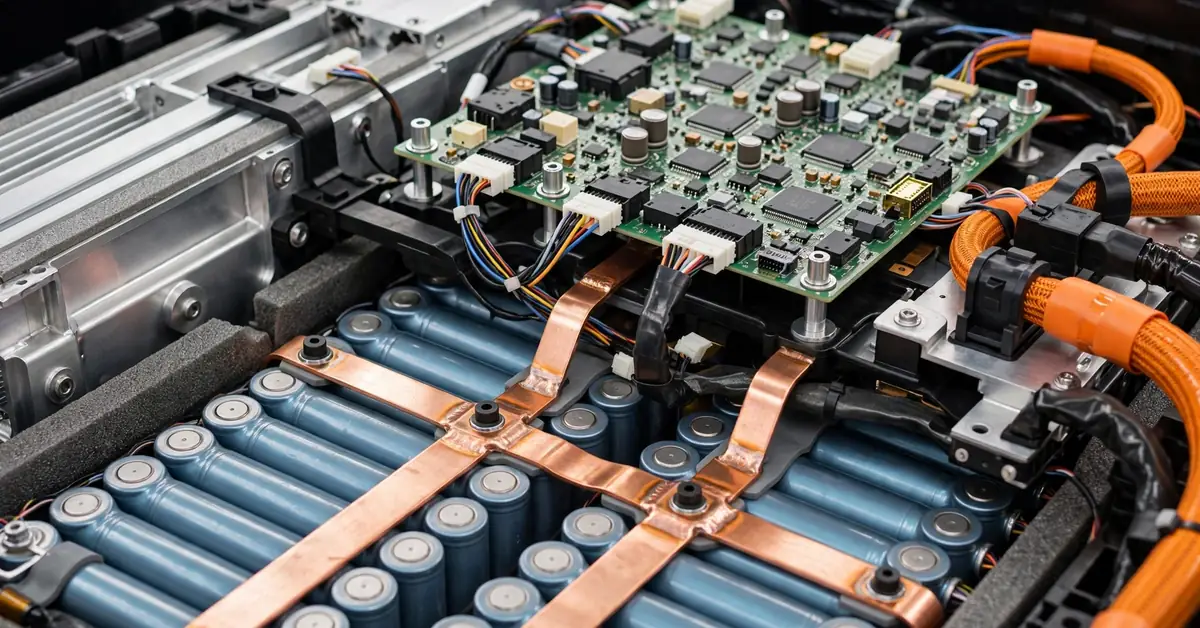
A cloud-connected BMS works by streaming battery telemetry, voltage, current, temperature, SOC, and SOH data, from the vehicle to remote servers over cellular or WiFi connectivity, where more powerful computing resources analyze it for insights the onboard controller couldn’t generate alone. The vehicle still handles its own real-time safety protection locally; the cloud adds a deeper, longer-term analytical layer on top.
Why Move Any BMS Function to the Cloud at All
A vehicle’s onboard BMS controller has real, practical processing and memory limits, and it has to prioritize immediate, split-second safety decisions above all else. Certain valuable analyses, like fleet-wide pattern recognition or resource-intensive machine learning models, need computing power and data volume that simply isn’t practical to run locally, which is exactly the gap cloud connectivity fills.
How Data Actually Flows From Vehicle to Cloud
The onboard BMS continues its core local functions uninterrupted, monitoring, protection, and control all happen in real time on the vehicle itself. Separately, telemetry data streams out over the vehicle’s cellular or WiFi connection to manufacturer servers, typically at intervals rather than a continuous raw feed, balancing data usefulness against bandwidth and power constraints.
What the Cloud Side Actually Does With That Data
Fleet-Wide Pattern Analysis
By aggregating data across many vehicles rather than just one, cloud systems can identify patterns, like a specific fault signature or degradation trend, appearing across a model line that would be invisible when looking at any single vehicle in isolation.
Advanced Machine Learning Model Execution
Computationally heavy models, larger neural networks or ensemble methods requiring more processing power than an onboard controller can spare, run in the cloud, then feed refined predictions or parameter updates back to the vehicle.
Remote Diagnostics and Predictive Maintenance
Manufacturers and fleet operators can monitor battery health trends remotely, flagging vehicles showing early signs of a developing issue before the owner even notices a symptom, supporting proactive rather than purely reactive service scheduling.
Supporting Over-the-Air Improvements
Insights generated in the cloud can inform firmware updates pushed back to vehicles, refining SOC/SOH algorithms or other BMS behavior based on real-world fleet data rather than only pre-launch testing.
Why the Vehicle Still Needs Full Local Protection Regardless
Cloud connectivity can be interrupted, delayed, or simply unavailable in areas with poor signal. Because of this, safety-critical protection functions, overvoltage cutoffs, thermal fault response, short-circuit protection, always remain fully capable of operating locally on the vehicle, with the cloud serving as an enhancement layer rather than a dependency for basic safety.
Privacy and Data Considerations
Streaming detailed vehicle telemetry to manufacturer servers raises reasonable questions about what data is collected and how it’s used. Manufacturers vary in their transparency and data practices around this, which is worth understanding for owners who want clarity on what their vehicle actually reports.
| Function | Handled Locally or in Cloud |
|---|---|
| Real-time safety protection | Locally, always available regardless of connectivity |
| Fleet-wide pattern analysis | Cloud |
| Heavy machine learning models | Cloud, results synced back to vehicle |
| Predictive maintenance flagging | Cloud |
Conclusion
A cloud-connected BMS streams battery telemetry to remote servers for deeper analysis, fleet-wide pattern recognition, advanced machine learning, and predictive maintenance, while the vehicle’s onboard BMS continues handling all real-time safety-critical protection locally, independent of connectivity. This split lets modern EVs benefit from cloud-scale computing power without ever making basic battery safety dependent on a network connection.
FAQs
Does my EV’s safety protection stop working if it loses cellular connection?
No, core safety functions run locally on the vehicle and don’t depend on cloud connectivity.
What kind of data does a cloud-connected BMS typically send?
Usually telemetry like voltage, current, temperature, and calculated SOC/SOH values, though exact data collected varies by manufacturer.
Can cloud-connected BMS data improve my specific vehicle over time?
Yes, insights from fleet-wide data can inform firmware updates that refine algorithms affecting your vehicle’s future behavior.
