
How Does Tesla’s BMS Work?

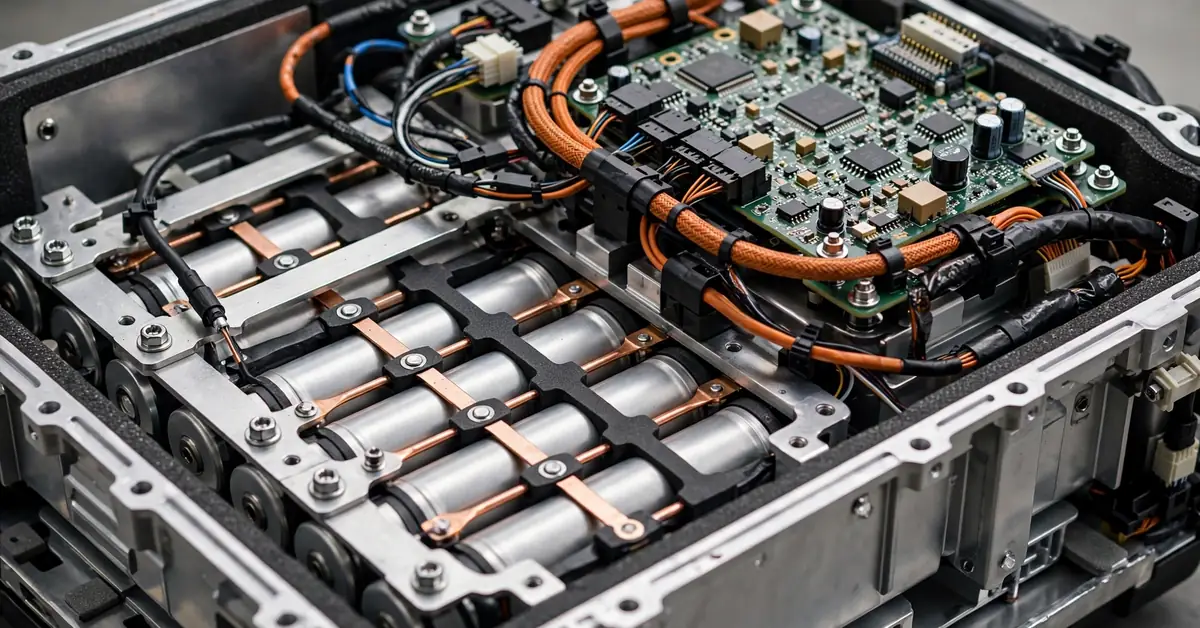
Tesla’s BMS uses a master-slave architecture, with a central Battery Management Unit (BMU) handling high-voltage functions, insulation detection, and external communication, while distributed Battery Management Boards (BMB) monitor cell voltage and temperature locally and report back to the master. This layered design is what allows Tesla to manage thousands of individual cells per pack while keeping voltage differences within just 10mV of each other.
The Master-Slave Structure in Practice
Tesla’s BMU, positioned centrally within the pack, handles the system’s highest-level responsibilities: high-voltage management, insulation detection, high voltage interlock monitoring, contactor control, and communication with the rest of the vehicle. The distributed BMBs handle the more granular work, reading cell voltage and temperature locally and reporting that data back up to the BMU, sometimes described as a “one master, four slaves” layout in Tesla’s design.
Dual-MCU Redundancy in the Master Controller
Tesla’s BMU uses a dual-microcontroller design, with a primary and secondary MCU. The secondary MCU continuously monitors the primary’s status and can take over control authority if it detects the primary has become unresponsive or invalid, a meaningful redundancy layer protecting against a single point of control failure.
Why Bidirectional Communication Matters
Commands and responses in Tesla’s system travel in both clockwise and counterclockwise directions around the distributed network, a deliberate design choice that improves fault tolerance, if communication is disrupted in one direction, data can still potentially reach its destination via the alternate path.
Managing Extreme Cell Counts With Tight Tolerances
Tesla’s packs, built from thousands of individual cells depending on the model, require voltage differences between cells to stay within roughly 10mV, while thermal control aims to keep temperature variation across the pack within about 3°C. Achieving this level of consistency across such a large cell count is a genuinely demanding engineering target that shapes much of the system’s design.
Module-Level Fault Isolation
Because Tesla’s architecture separates module-level monitoring from pack-level control, faults can frequently be isolated to a specific module rather than requiring a full pack or BMS replacement. This matters practically for repair scenarios, since technicians can sometimes address a problem at the module level rather than defaulting to more expensive whole-system intervention.
Startup Diagnostics
At vehicle startup, Tesla’s BMS performs a rapid diagnostic sweep across every cell group, reading voltage and temperature data and flagging any anomaly, a weak cell or a temperature outlier, before the pack is allowed to deliver power to the vehicle.
Data Analytics for Health Estimation
Beyond the onboard architecture, Tesla has developed systems that analyze historical BMS data to provide more accurate state-of-health characterization and range estimation than relying purely on real-time operating parameters alone, feeding into the broader connected, data-driven approach increasingly common across the industry.
| Component | Role |
|---|---|
| BMU (master) | High-voltage management, insulation detection, external communication |
| BMB (slaves) | Cell-level voltage/temperature monitoring, reports to BMU |
| Dual-MCU design | Redundant control authority if primary MCU fails |
Conclusion
Tesla’s BMS uses a master-slave architecture with a centralized BMU handling high-voltage and safety functions while distributed BMBs manage cell-level monitoring, combined with dual-MCU redundancy and bidirectional communication for fault tolerance. This layered design is what allows Tesla to maintain remarkably tight voltage and temperature consistency across packs containing thousands of individual cells.
FAQs
Does Tesla’s BMS architecture make repairs easier than other EVs?
The module-level fault isolation can allow targeted repairs at the module level in some cases, rather than always requiring full BMS or pack replacement.
How many cells does Tesla’s BMS typically manage per pack?
It varies by model and pack configuration, but Tesla packs have historically used thousands of small cylindrical cells, requiring the BMS to manage consistency across a very large cell count.
What happens if Tesla’s primary BMU controller fails?
The dual-MCU design allows a secondary controller to detect the failure and take over control authority.
