
How Does BMS Communicate With EVSE During Charging?

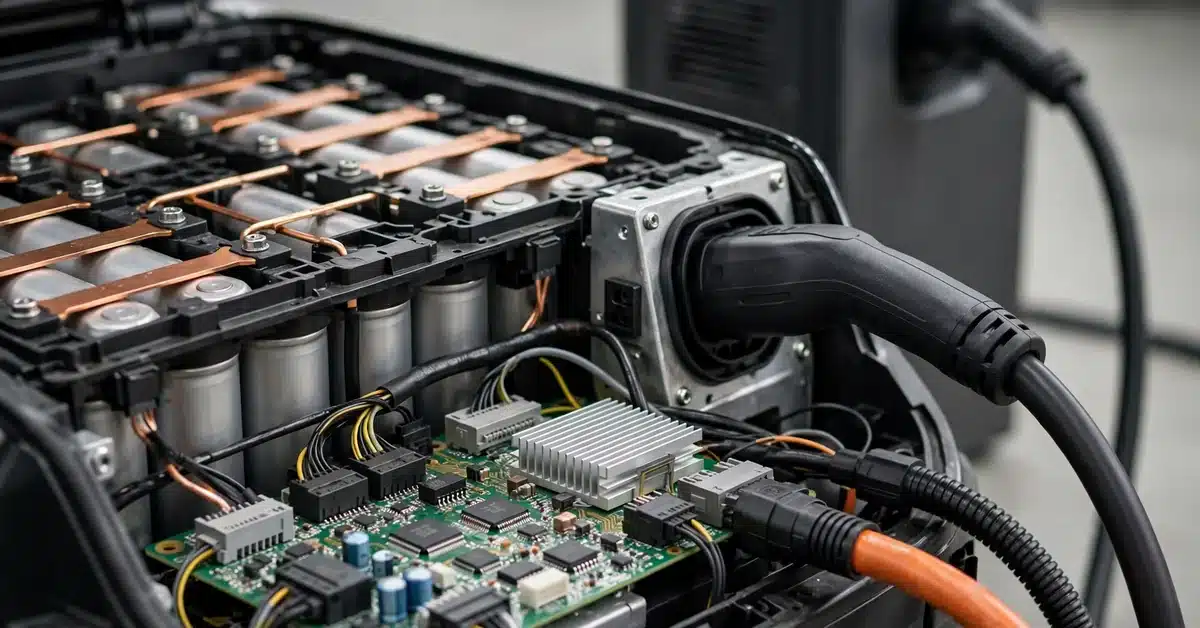
A BMS communicates with the EVSE during charging through a handshake process, either a simple analog Control Pilot signal for AC charging or a more advanced digital communication link for DC fast charging, exchanging information about maximum current, voltage limits, and safety status throughout the session. This exchange happens before, and continuously during, every charging session.
Why This Communication Exists at All
Before any real power flows, the vehicle and charger need to agree on how much current can safely pass between them, confirm the connection is secure, and continuously coordinate as conditions change throughout the session. Without this communication, charging would be an unsafe guessing game rather than a controlled, negotiated process.
How AC Charging Communication Works (Level 1/2)
The Control Pilot (CP) Signal
Defined by SAE J1772 and IEC 61851 standards, the Control Pilot uses a 1 kHz, ±12V pulse-width modulated analog signal. The charger communicates its maximum available current through the signal’s duty cycle, and the vehicle’s BMS then decides how much of that offered current to actually draw, which may be less than the maximum if the battery’s own limits call for it.
Why This Simple Approach Still Works So Well
The CP/PP signaling approach achieves robust, safe coordination using minimal digital complexity, essentially an analog waveform and a few resistors and voltage thresholds. It’s immune to network outages and degrades safely, if the pilot line is severed, the charger simply sees no valid signal and keeps its contactor open.
How DC Fast Charging Communication Works
DC fast charging (CCS/CHAdeMO) requires considerably more sophisticated coordination than a simple analog signal can provide, since the charger itself supplies DC power directly to the battery, bypassing the vehicle’s onboard AC-to-DC converter entirely. A digital communication link is established between vehicle and charger, over which the BMS communicates specific battery limits and requests: maximum current, maximum voltage, and target power. The charger confirms what it can deliver and sets its output accordingly.
Continuous Updates Throughout the Session
This isn’t a one-time exchange. As the battery warms, as state of charge rises, or as any other condition changes, the BMS continues sending updated limits throughout the charging session, and the charger adjusts its output in response, which is exactly why fast-charging curves taper rather than staying constant.
The Role of ISO 15118 in Modern DC Charging
Newer CCS systems increasingly use ISO 15118, a higher-level protocol layered on top of the basic digital communication link, enabling features like Plug & Charge (automatic authentication without a separate app or card) and more advanced energy services beyond basic power delivery negotiation.
How the Session Ends
Charging doesn’t simply cut off abruptly under normal conditions. The BMS and charger coordinate an orderly ramp-down of current before the connection is safely terminated, avoiding the electrical stress a sudden cutoff could otherwise cause.
| Charging Type | Communication Method |
|---|---|
| AC (Level 1/2) | Analog Control Pilot (PWM) signal per J1772/IEC 61851 |
| DC fast charging | Digital communication link, often with ISO 15118 for advanced features |
Conclusion
A BMS communicates with the EVSE through a handshake tailored to the charging type: a simple, robust analog Control Pilot signal for AC charging, and a more sophisticated digital communication link for DC fast charging, where the BMS actively requests specific current and voltage limits throughout the session. This continuous back-and-forth is what keeps every charging session both safe and appropriately matched to the battery’s real-time condition.
FAQs
Can a charger force more current into my EV than the BMS wants?
No, the BMS communicates its own limits, and the vehicle only draws up to what it determines is safe, even if the charger could technically supply more.
What happens if the communication link fails during DC fast charging?
The charging session typically halts safely, since the charger needs continuous valid communication with the BMS to keep delivering power.
Is ISO 15118 required for DC fast charging?
No, basic DC fast charging communication works without it, but ISO 15118 enables additional features like Plug & Charge authentication.
