
How Long Do EV Batteries Last?


One of the biggest questions for anyone thinking about buying an electric vehicle (EV) is: How long do EV batteries last?
The quick answer: most EV batteries last 12 to 15 years, or between 100,000 and 200,000 miles. That’s competitive with a standard gas-powered car.
How Long Do EV Batteries Actually Last?
EV batteries typically last 12 to 15 years, although several factors can affect their lifespan. It depends on driving habits and the atmosphere. Battery maintenance is important.
Warranty terms give us the clearest industry benchmark for EV battery longevity:
Manufacturer / Model | Warranty Period | Minimum Capacity Guarantee |
|---|---|---|
Tesla (Model 3 / Y Long Range) | 8 years / 120,000 miles | 70% |
Tesla (Model S / X) | 8 years / 150,000 miles | 70% |
Hyundai / Kia | 10 years / 100,000 miles | 70% |
Chevrolet (Bolt) | 8 years / 100,000 miles | 60% |
Ford (Mustang Mach-E) | 8 years / 100,000 miles | 70% |
The U.S. federal minimum for EV battery warranties is 8 years or 100,000 miles. This is a legal floor — many manufacturers go further.
What Factors Affect EV Battery Life?
1. Charging Habits
How you charge your EV has a real impact on long-term battery health.
- Charging to 100% every day stresses the cells
- Draining to 0% regularly does the same
- DC fast charging (Level 3) generates more heat than Level 2 home charging. See our full guide on how to charge an electric car to understand which method is best for daily use.
2. Temperature and Climate
EV batteries perform best between 50°F and 86°F (10°C–30°C).
- Cold weather temporarily reduces range and forces the battery to work harder.
- Extreme heat is the bigger long-term threat — it speeds up chemical aging inside the cells
3. Battery Management Software (BMS)
Every EV has a Battery Management System — a smart onboard computer that monitors and protects the battery. The BMS prevents true 0% and 100% charges with a software buffer, balances cells within the pack, and adjusts charge rates based on temperature.
4. Physical Damage Risks
EV batteries sit under the floor of the car, which protects them from most road hazards — but not all. Road debris at high speed can cause punctures. Off-road driving in any EV increases this risk.
It also helps to understand what an EV battery actually is compared to other systems in the car. It’s worth knowing the difference between BEV, PHEV, and HEV batteries if you’re cross-shopping electrified vehicle types, and how the traction battery compares to a traditional fuel tank in terms of energy stored — see EV battery vs gas tank: what’s the difference. And if your 12V system ever leaves you stranded rather than the main pack, can an EV jump-start another car covers how that separate battery works.
EV Battery Degradation — What the Numbers Say
What Is Battery Degradation?
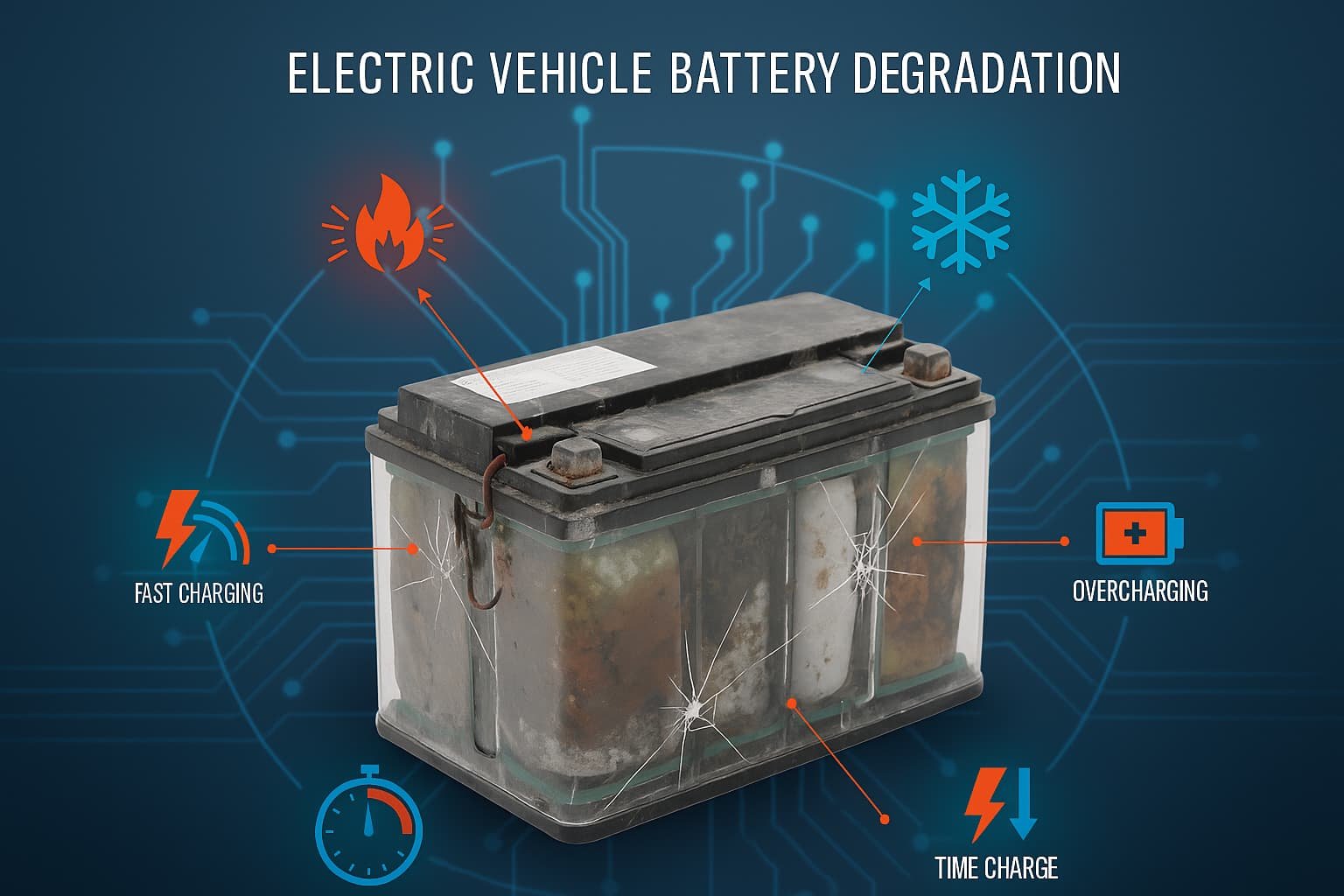
Every time you charge and discharge an EV battery, it loses a tiny bit of capacity. This is called degradation. Most manufacturers consider 70–80% of original capacity as the end-of-life threshold — meaning the battery still works, it just holds less charge. The rate of degradation also varies depending on battery chemistry — read our comparison of LFP vs NMC batteries to see how each chemistry holds up over time.
EV Battery Degradation Chart
Years | Mileage (km) | Charge Cycles | Capacity Retention (%) | Health Status |
|---|---|---|---|---|
0–2 Years | 0–40,000 | 0–300 | 95–100% | Excellent |
3–5 Years | 40,001–100,000 | 301–800 | 85–94% | Good |
6–8 Years | 100,001–160,000 | 801–1300 | 75–84% | Fair |
8+ Years | 160,000+ | 1300+ | 65–74% | Degraded |
How to Make Your EV Battery Last Longer
1. Optimal Charging Practices
You can significantly extend how long your EV battery lasts by adjusting how you charge it:
- Keep your daily charge between 20% and 80%
- Reserve full 100% charges for long road trips only
- Use DC fast chargers sparingly — rely on Level 2 home charging for daily use
- Charge overnight when temperatures are cooler
2. Temperature Management Tips
- Pre-condition your battery before driving in cold weather — let the car warm up while still plugged in
- Park in a garage or shaded area in hot climates when possible
- Let the car manage its own thermal preparation before connecting to a fast charger
3. Driving Habits That Help
- Use smooth, gradual acceleration instead of hard launches
- Rely on regenerative braking to recapture energy and reduce brake wear
- Avoid regularly running the battery below 10%
EV Battery Safety — Should You Worry?
Fire Risk vs. ICE Vehicles
EV battery fires get a lot of media attention — but the data tells a different story.
A combined analysis drawing on Swedish and U.S. data found approximately 25 EV fires per 100,000 vehicles compared to roughly 1,530 fires per 100,000 ICE vehicles. EVs are statistically far less likely to catch fire than gas-powered cars.
EV fires do burn hotter and are harder to extinguish — which is why they make headlines. But they are rarer.
Safety Standards for EV Batteries in the U.S.
The Department of Energy requires all EV batteries to pass rigorous testing before hitting the road, including overcharge and over-discharge testing, crash and crush simulations, water immersion, and extreme temperature exposure. Built-in protections include insulated high-voltage lines and automatic shutoff systems that cut power in an accident.
EV Battery Maintenance Checklist
You don’t need to service an EV battery the way you service an engine — but these steps keep the whole car healthy:
- Check tire wear regularly — EVs are heavier than comparable gas cars and wear tires faster
- Inspect brake pads and rotors — regenerative braking reduces wear, but check annually
- Install software updates — manufacturers frequently push updates that improve battery management
- Request an annual battery health check from your dealership or a certified EV technician
Conclusion
So how long do EV batteries last? For most drivers in moderate U.S. climates, 12 to 15 years is a realistic expectation — right in line with the lifespan of an average gas-powered vehicle. Federal law requires an 8-year warranty, real-world studies show gradual and flattening degradation, and the DOE estimates a solid lifespan under normal conditions. By charging smart, managing temperature, and using software updates, you can push that lifespan even further.
If you want to understand how energy density affects how far your EV can go on a single charge, that context helps too. You may also want to check what your EV battery warranty covers and the cost of replacing an EV battery if it ever needs replacing.
